
DLD05A3 2D TOF Obstacle-avoidance LiDAR (5 m)
2D TOF LiDAR with NPN/PNP switching outputs that wires like a photoelectric sensor — no protocol stack, no SDK.
 🔍 Click to enlarge · 1/16
Technical Specifications
| Model | DLD05A3-3N / DLD05A3-3P |
|---|---|
| Output Type | DLD05A3-3N: NPN switching output ×3 + device status indicator ×1; DLD05A3-3P: PNP switching output ×3 + status ×1 |
| Switching Output Capacity | DC30V 50mA MAX |
| Detection Range | 0.05-5m |
| Scanning Angle | 270° |
| Scan Frequency | 15/30Hz |
| Angular Resolution | 0.1° / 0.3° |
| Detection Accuracy | ±30mm |
| Laser | 905nm, Class I |
| Operating Voltage | DC9-28V |
| Debug Interface | Micro-USB |
| Output Interface | DB15 MALE / flying leads |
| Ingress Protection | IP65 |
| Zone Sets | 16 zone sets (3 zones per set) |
| Dimensions | 50×50×76mm |
| Weight | 150g |
Overview
The DLD05A3 is a compact 2D Time-of-Flight laser scanner that measures distance across a 270° field and converts the result into discrete switching outputs instead of raw point-cloud data over a fieldbus. It is built for machine and vehicle builders who need wide-angle obstacle detection but do not have a software team to parse LiDAR data streams.
Available as DLD05A3-3N (NPN sinking) or DLD05A3-3P (PNP sourcing), the sensor outputs 3 discrete switching signals plus 1 status signal, driven up to DC30V/50mA. Detection range is 0.05–5 m across the 270° field with ±30 mm accuracy, and 16 storable zone sets (3 detection zones each) let the 3 outputs implement a warning/slow-down/stop sequence that can be switched on the fly.
Features & Benefits
Wires like a photoelectric sensor
Outputs are 3 discrete switching signals (NPN or PNP) plus 1 status signal, driven up to DC30V/50mA. There is no point-cloud parsing, no protocol stack, and no SDK — the detection result goes straight into a PLC input.
NPN and PNP versions for both control architectures
DLD05A3-3N (NPN sinking) suits Japanese-style PLC conventions, while DLD05A3-3P (PNP sourcing) suits European-style conventions. One product family covers both electrical architectures.
3 outputs, 3 nested zones, 16 storable zone sets
Each of the 16 zone sets defines 3 detection zones, letting the 3 discrete outputs implement a hard-wired warning / slow-down / stop sequence. Zone sets can be switched as vehicle conditions change, such as straight travel versus turning.
0.05 m minimum detection range
Detection starts from just 0.05 m, minimizing the near-field blind zone left by many scanners close to the housing — useful for docking or narrow-aisle situations where obstacles can be very close to the sensor.
0.1°/0.3° angular resolution at 15/30 Hz
At 0.1° resolution, the angular point spacing at 5 m is under 9 mm, and the 15/30 Hz scan-frequency options let integrators trade responsiveness against resolution.
USB configuration, standalone operation
The 16 zone sets are configured once over Micro-USB; the sensor then runs fully standalone in the field and does not occupy any of the host machine's communication resources during operation. The output/power interface is available as a DB15 male connector or flying leads.
Compact and IP65-rated for mobile platforms
At 50×50×76 mm and 150 g, with a 9–28 V DC wide input range and IP65 ingress protection, the DLD05A3 fits into small battery-powered AGV/AMR chassis. The laser is a 905 nm Class I (eye-safe) source.
Applications
Models & Ordering Information
DLD05A3 Series
PDF & 3D CAD Downloads
Browse all downloadsDLD05 / DLD20 5 m / 20 m TOF LiDAR User Manual
DLD05 / DLD20 TOF LiDAR NPN and PNP Quick Wiring Guide
DLD05 / DLD20 TOF LiDAR Quick User Manual
Two-page quick reference. Original fold-out page layout retained; zoom in to read wiring details.
Confirm the document and CAD file match the exact ordered version before installation or mechanical design. Contact us if your model is not listed.
How to Select
- Detection range for the DLD05A3 series is fixed at 0.05–5 m with a 270° scanning angle; for higher vehicle speeds or a larger detection radius, consider the same-platform DLD20A5 (0.05–20 m) — the DLD05A3 targets low-speed vehicles and close-range protection.
- Choose DLD05A3-3N (NPN sinking) for PLC input cards following Japanese-style electrical conventions, and DLD05A3-3P (PNP sourcing) for European-style conventions; match the sensor's output type to your PLC input card's electrical type.
- Both models store 16 zone sets, each with 3 detection zones mapped to the 3 switching outputs — pre-configure multiple sets for typical vehicle states (straight travel, turning, docking) and switch between them at runtime without rewiring or reprogramming.
- The output/power interface is available as a DB15 male connector or flying leads; choose based on your existing wiring harness or connector standard. Configuration is always done via Micro-USB.
- Operating voltage is DC9–28V, a wide input range compatible with common 12V/24V vehicle or industrial power supplies; IP65 ingress protection suits environments with dust or light moisture.
- Select 0.1° angular resolution for finer scanning of small obstacles or dense zone boundaries, or 0.3° where response speed matters more than resolution; choose 15 Hz or 30 Hz scan frequency to match your system's response-time requirements.
📘 Need the full method? How to Choose a 2D LiDAR Scanner
When NOT to specify the DLD05A3 — and what to use instead
Using the DLD05A3 as the protective device in a machine-safety stop function
Why not: The DLD05A3 has no Type (IEC 61496), SIL (IEC 61508) or Category/PL (ISO 13849) rating, and its outputs are 3 plain NPN/PNP switching signals (DC 30 V, 50 mA max) plus 1 status signal — not OSSDs. It is an obstacle-avoidance sensor and cannot serve as a safety component.
Use instead: The DAIDISIKE ST27 Series Safety Laser Scanner — Type 3 / SIL 2 / Cat. 3 PL d, true OSSD outputs, 3 m or 5 m protective field at 1.8% remission.
A vehicle needs obstacle anticipation beyond 5 m — a faster AGV needing longer look-ahead
Why not: Detection range is 0.05-5 m across the 270 degree field. Nothing beyond 5 m is evaluated at all.
Use instead: DLD20A5-5N / DLD20A5-5P (0.05-20 m), which shares the same 50 x 50 x 76 mm housing and discrete-output wiring style.
The integrator wants raw ranging data, a point cloud, or a fieldbus feed for mapping, SLAM or PLC logging
Why not: The DLD05A3 has no Ethernet, RS485 or Modbus interface. Its only outputs are 3 discrete switching signals plus 1 status signal, and its Micro-USB port exists purely to load the 16 zone sets — not to stream runtime data.
Use instead: DLD30T-5N or the DLD50T8 series, which provide Ethernet-based ranging output.
Wiring into a PLC input card without checking whether that card is sinking or sourcing
Why not: DLD05A3-3N is NPN (sinking) only and DLD05A3-3P is PNP (sourcing) only. There is no dual-mode or field-selectable output.
Use instead: Confirm the PLC card's input type first, then order the matching -3N or -3P variant. They are not interchangeable.
Detecting a slim object — a thin cable, chair leg or rack upright — near the 5 m limit in the coarser 0.3 degree mode
Why not: Sub-9 mm scan-point spacing at 5 m applies only at the 0.1 degree setting. The 0.3 degree option leaves wider gaps between points at the same range, so a slim object can fall between them.
Use instead: Select the 0.1 degree setting and accept its scan-frequency trade-off, or add a dedicated close-range photoelectric sensor at that specific point.
Installing outdoors or in an unconditioned space with wide temperature swings
Why not: We do not publish an operating temperature range for the DLD05A3 because the factory has not confirmed one. Only the IP65 ingress rating is documented, and an IP rating says nothing about temperature tolerance.
Use instead: Ask us for the confirmed operating temperature range before specifying an outdoor or extreme-temperature installation.
Specifications we do not publish yet
We only publish a figure once we are confident it is true. The items below are still being validated through further testing and real-world customer feedback, so for now we would rather leave them open than guess. If one of them matters to your design, ask us for the latest validated status.
- Operating temperature range.
- Housing and lens material.
- Power consumption and current draw across the DC 9-28 V input range — only the voltage range is documented.
- End-to-end response time from obstacle entry to output change — figures you may find elsewhere (134 ms @15 Hz / 66 ms @30 Hz) are not validated by us, so we do not publish them yet
- Exact DB15 connector pin assignment and flying-lead cable length.
- Tolerance to ambient sunlight and optical interference.
- MTBF or rated service life.
- Certification documentation. Certification documents are available on request.
Frequently Asked Questions
Does the DLD05A3 output raw point-cloud data over a fieldbus like Modbus or Ethernet?
What is the difference between DLD05A3-3N and DLD05A3-3P?
What is the detection range and scanning angle of the DLD05A3?
How is the sensor configured — is there a display or buttons on the unit?
How many protection zones can be stored, and how are the 3 outputs used?
What is the laser class and is it eye-safe for indoor use around people?
What is the ingress protection rating and power supply requirement?
What physical size and weight should I plan for when integrating into a mobile robot chassis?
Is this sensor certified as a safety-rated device (e.g., for personnel safety per IEC 61496)?
What output connector options are available for wiring into my machine?
Related Categories and Example Products
Explore other functions that may be needed in a machine or line. The products below are category examples, not pre-validated electrical or safety combinations. Confirm each interface and application separately: Relay & Timer Modules · Safety Light Curtains · Proximity Sensors
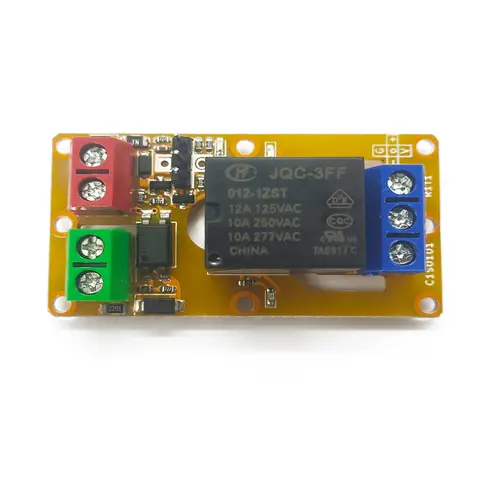
A1J0101 Economical Input Amplifier Module
Optocoupler-isolated input amplifier that turns a low-voltage signal into a 250V AC / 10A relay output.
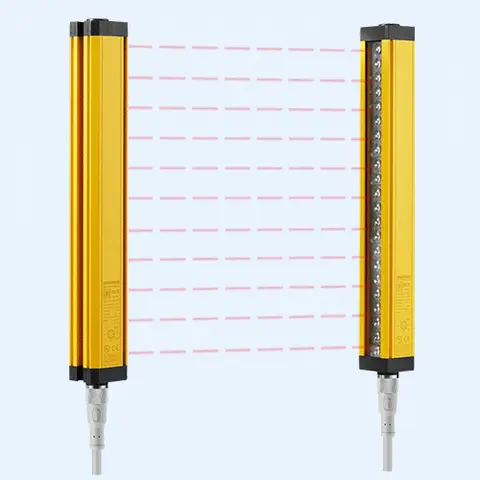
DCE Automation Safety Light Curtain
Compact through-beam safety light curtain in a 30 x 30 mm housing: 10/20/30/40 mm beam pitch, up to 72 beams, 0.3-3 m or 0.3-6 m sensing distance, NPN/PNP output. Catalogue-stated Type 4 design basis; confirm exact safety-document scope.
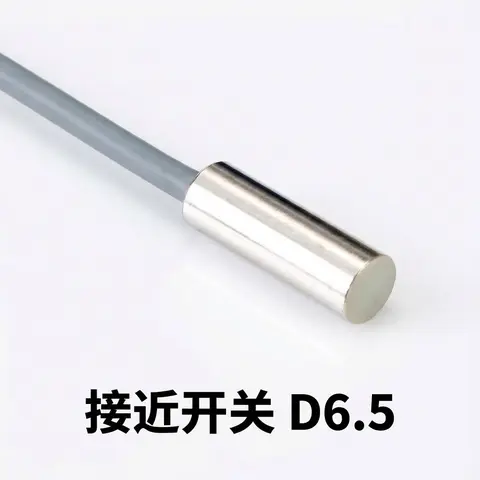
D6.5 Series Inductive Proximity Sensors (Ultra-Short 18mm / Y-Type / 35mm / 45mm)
6.5mm-diameter inductive proximity sensors for tight-clearance mounting where M8 sensors won't fit.
Related Products in LiDAR Scanners
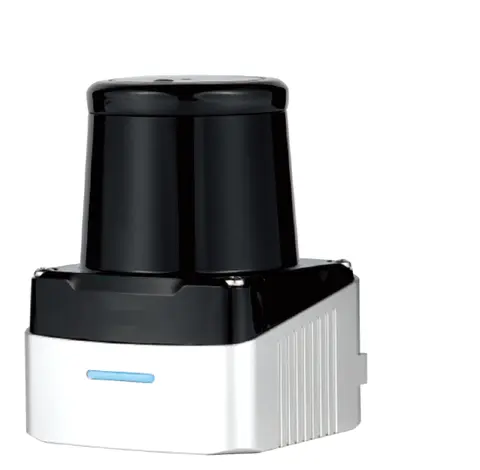
DLD-100D Single-Line TOF Scanning LiDAR
Single-line TOF scanning LiDAR with up to 100 m range, model-dependent 280°/360° coverage, and a 100 Hz / 0.32° DLD-100DP option.
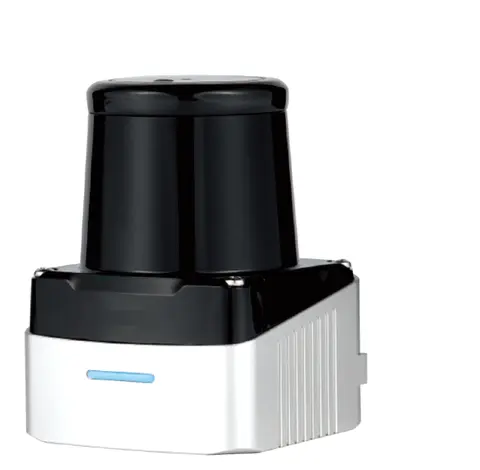
DLD-50D 2D TOF LiDAR for Navigation & Mapping (50 m)
50 m-range 2D TOF LiDAR for mobile robot navigation and mapping — ±20 mm repeatability, 280° FoV, Ethernet output.
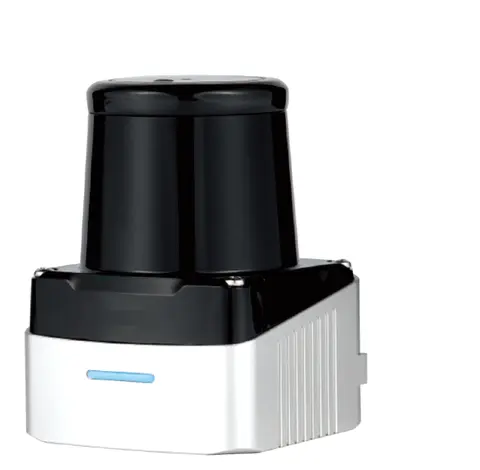
DLD-50G 2D Single-line LiDAR (Diffuse-remission Measuring Type)
2D single-line laser scanner measuring diffuse-remission distance off natural surfaces, no reflector needed.
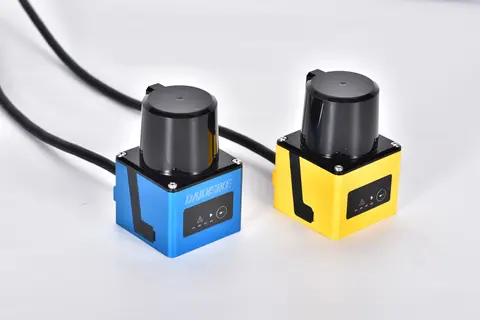
DLD20A5-5N / DLD20A5-5P 2D TOF Obstacle-avoidance LiDAR (20 m)
20 m 2D TOF LiDAR with pure NPN/PNP discrete outputs — wires straight into a PLC, no protocol, no SDK.