
Safety Door Locks & Switches
Guard locking interlocks, RFID and magnetic coded safety switches for machine doors and fences.
Choose a Safety Interlock Switch by Guard Function
A safety interlock switch either monitors whether a machine guard is closed, or monitors and physically locks it. Monitoring without locking requires the hazard to stop before a person can reach it, as verified by the machine risk assessment. Use guard locking when the assessment requires the door to remain closed until a persistent hazard has ended and release is permitted.
This category includes mechanical tongue switches, magnetic coded and RFID non-contact switches, solenoid guard locks, actuator keys and a mechanical safety-door bolt. The first decision is monitoring versus locking; the second is contact, magnetic or RFID actuation.
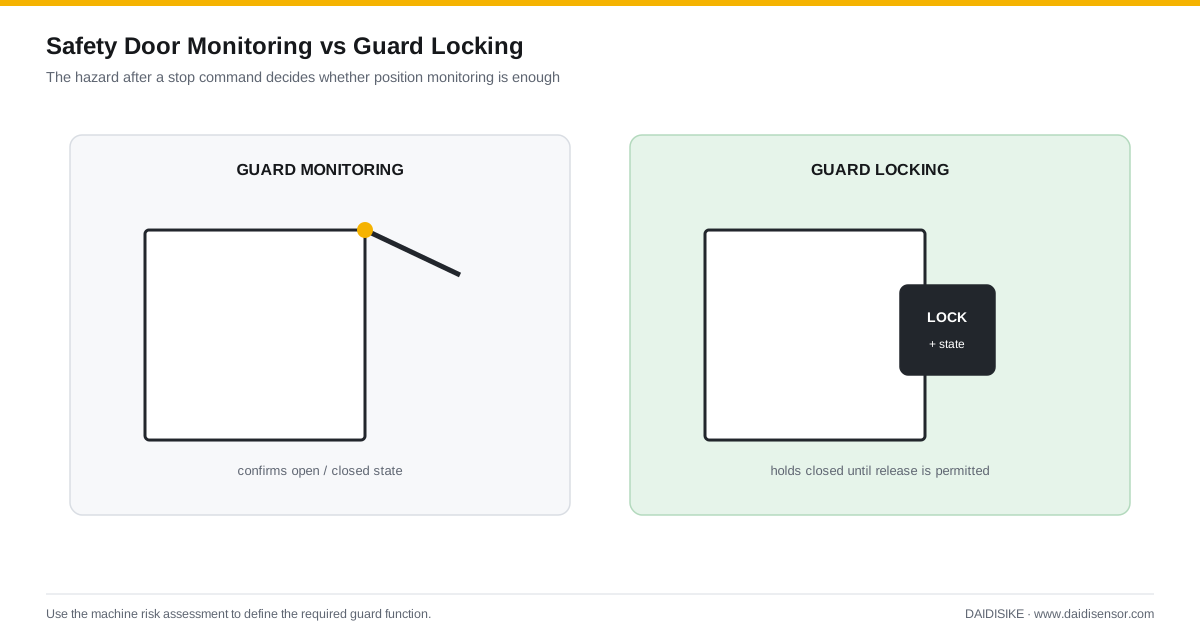
Safety Door Switch and Guard Locking Range
Use the table to shortlist a family before comparing its full model list below. Monitoring-only switches and guard locking switches perform different jobs; a shared housing or matching connector does not make them interchangeable.
For compact RFID-actuated guard locking, DX-D6 provides C/D lock behaviours and model-specific dual NPN or PNP outputs in a 30 × 30 mm housing. Match the exact output, R/H function version, actuator and cable on the quotation. If the required function is unclear, follow the safety-door selection guide before ordering.
| Need | Starting family | Published distinction |
|---|---|---|
| mechanical door-position monitoring | DX-D2 / DX-D3 | NC/NO contacts, no locking function |
| magnetic non-contact monitoring | DX-C1 | coded magnet, up to 17 mm published sensing distance |
| RFID non-contact monitoring | DX-R1 | universal or uniquely coded, dual NPN/PNP output |
| mechanical-contact guard locking | DX-W2 / DX-W3 / DX-W5 | solenoid lock options and 1300 N published holding force |
| compact electronic guard locking | DX-D6 | RFID actuator, 2000 N, 30 × 30 mm body |
The family comparison is a starting point, not confirmation of a safety circuit. Use each product's specifications and applicable documentation for contact arrangement, coding, holding force and release options. Request the certificate and instruction version for the exact order when needed.
Compare 9 Safety Door Locks & Switches Series
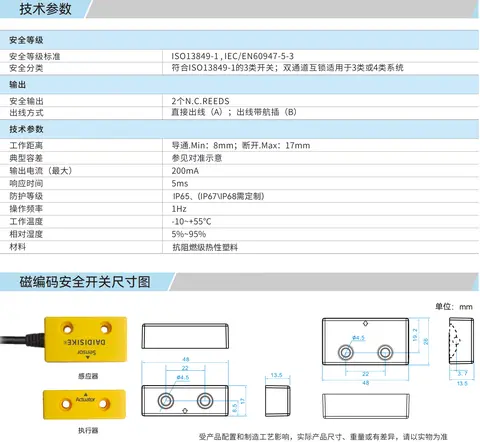
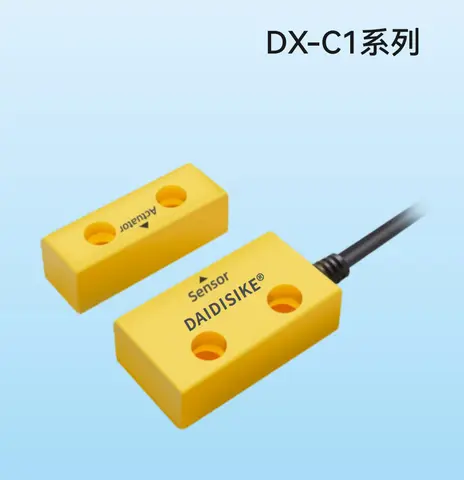
DX-C1 Magnetic Coded Safety Switch
Non-contact coded-magnet safety switch with 17 mm sensing range and high misalignment tolerance for guard doors.
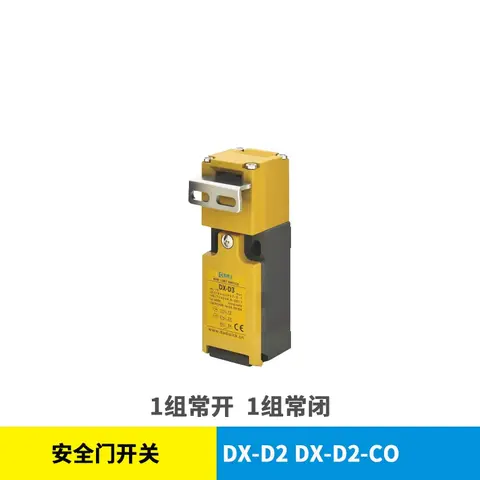
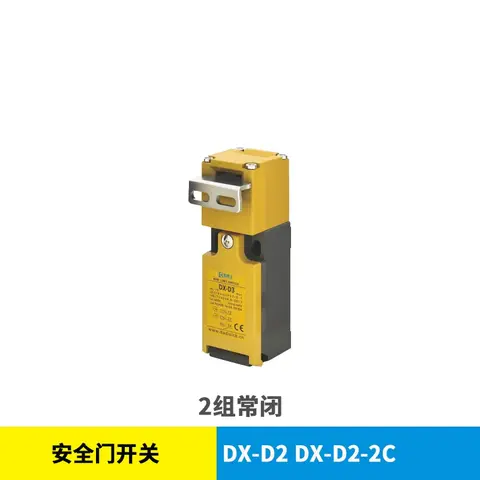
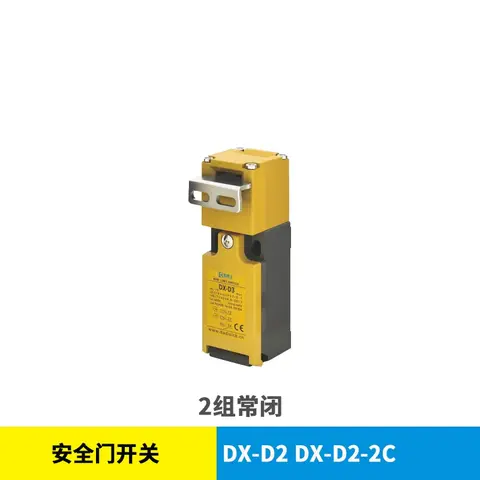
DX-D2 & DX-D3 Safety Door Switch
Mechanical NC/NO safety interlock switch, IP67, 1,000,000-cycle mechanical life, no locking function.
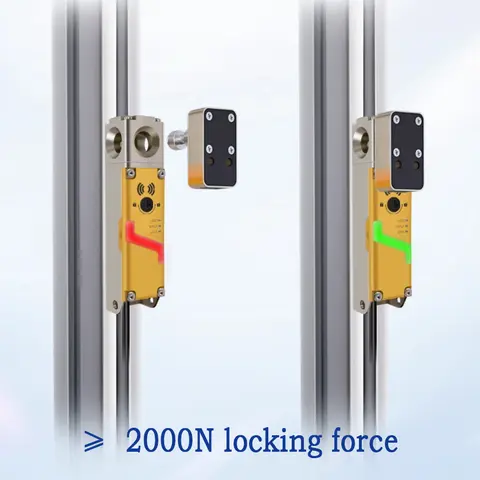
DX-D6 Guard Locking Safety-Door Switch
Guard locking safety-door switch: 2000 N holding force, redundant dual outputs, RFID-coded actuators.
DX-K Series Safety Door Lock Operation Keys
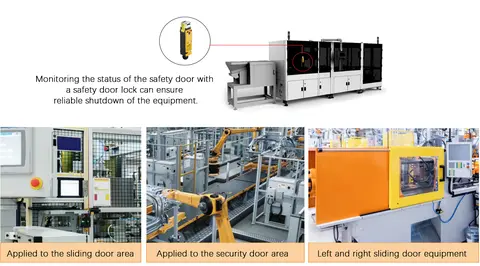
11-model range of fixed and adjustable operation keys for DX-W2/W3/W5 and DX-D2/D3 safety door interlock switches.
DX-R1 Non-contact Safety Switch (RFID Coded)
Non-contact RFID-coded safety switch, dual-channel PLe/Type 4 output, 0-10mm switch-on, cascadable, 8 NPN/PNP models.
DX-W2 Safety Door Lock (Solenoid Guard Locking Interlock Switch)
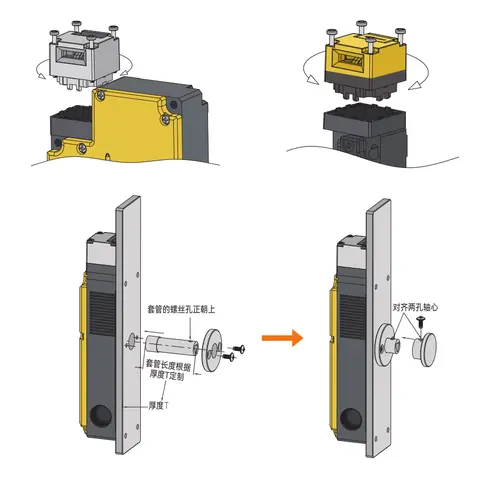
Contact-type guard locking switch with 4 contact blocks in 14 NC/NO configurations and 1300 N holding force.
DX-W3 Safety Door Lock
Compact mechanical-contact safety door lock: 1300 N holding force, 2 contact blocks, 6 NC/NO configurations, IP67.
DX-W5 Safety Door Lock (Guard Locking Interlock Switch)
Solenoid safety door lock with 6 gold-plated contacts, 4 configurations, 1300 N holding force and IP67 protection.
DXL Safety Door Bolt (DXL-A / DXL-B)
Purely mechanical safety door bolt pre-drilled to mount DX-W2/W3/D2/D3 interlock switches directly.
How the DX-D6 Guard Locking Sequence Works
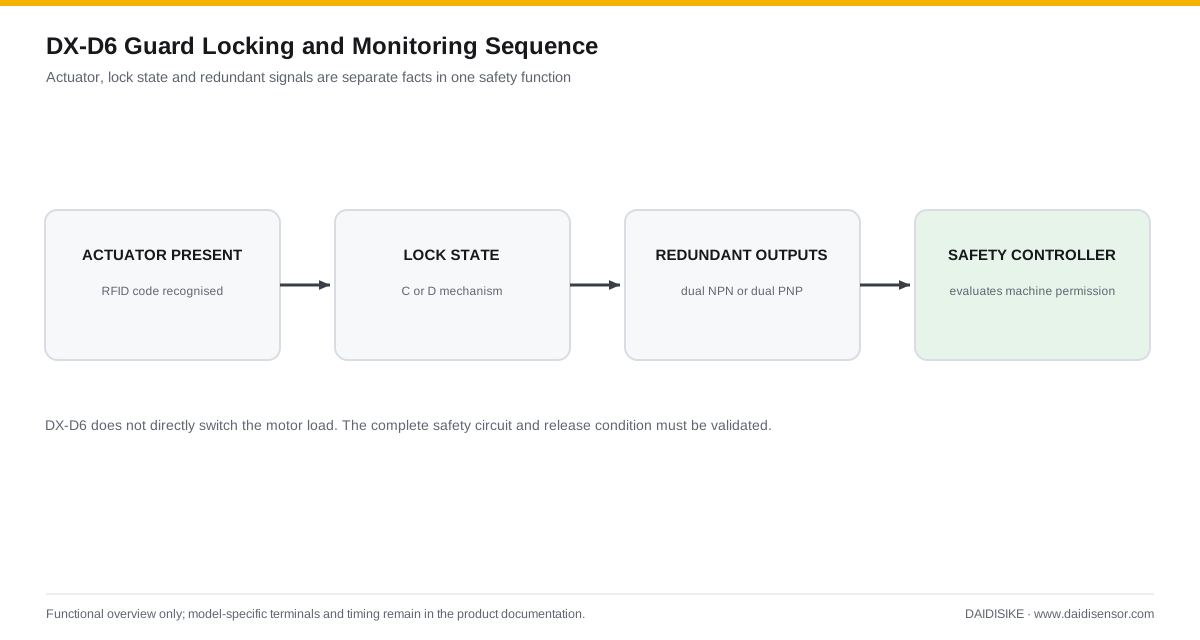
DX-D6 separates three facts that are often confused: the actuator is present at the switch, the locking mechanism is engaged, and the redundant output signals are available to the safety controller. The controller evaluates those signals; the switch does not directly remove power from the machine load.
C-type is mechanical lock with solenoid release (power-to-release). D-type is solenoid lock with mechanical release (power-to-lock). The correct loss-of-power behaviour depends on whether the machine retains a hazard after power is removed, so that choice belongs to the risk assessment rather than a generic preference.
Magnetic, RFID or Mechanical Safety Switch?
Magnetic coded switches have no tongue entering a head; their permitted sensing distance and alignment tolerance are model-specific. RFID-coded switches add universal- or uniquely-coded actuator choices where documented. Resistance to defeat also depends on coding level, installation and access to substitute actuators, not RFID alone. Mechanical tongue switches remain practical where conventional contacts and positive mechanical actuation are required and documented.
No technology is automatically correct for every door. Record door type, alignment movement, need for locking, desired coding, output style, ingress requirement and the safety function's required performance before selecting a model.
From Door Switch to Safety Relay
A door switch supplies the guard state; a safety relay or safety controller evaluates the safety channels and controls downstream contactors. The DA31 safety relay module includes a selectable safety-door input mode and accepts dual-channel PNP or NPN signals. The safety relay category compares DA31 with DQSRN.
For exact terminal wiring, validate the switch variant, relay input mode and complete machine safety circuit together. Category text is not a substitute for the model wiring document or the machine risk assessment.
Send the door type, whether the hazard coasts after stop, required holding force, coding preference and controller input type through the inquiry form.
Order the Switch, Actuator and Release Arrangement Together
Record the door swing or slide direction, mounting faces, actuator travel and required behaviour after loss of power. Separate position monitoring from actual guard locking: an actuator key or a door bolt alone is not an electronic safety switch.
| Item to agree on the quotation | Reference |
|---|---|
| Electronic lock and matching coded actuator | DX-D6 model and options |
| DX-D6 matching actuator, bracket and cable | Confirm DX-K9 and the door-direction mounting option in the DX-D6 order-kit checklist |
| Other DX-family mechanical actuator compatibility | DX-K1–K8 operation keys — match the listed switch family; not a DX-D6/DX-K9 substitute |
| Door bolt and mounting arrangement | DXL mechanical bolt |
| Monitoring versus locking decision | Safety-door selection guide |
Ask the quotation to identify the switch and actuator codes, swing or slide direction, cable or connector, required release arrangement and any items supplied separately. Request the exact certificate scope and circuit documents before safety validation; documents can be supplied directly when needed. Do not transfer one DX family's contacts, coding, force or release options to another. For robot cells, use the sensor-role procurement checklist to separate door access control from process measurement.
Frequently Asked Questions
What is the difference between a safety interlock switch and a guard locking switch?
An interlock switch monitors whether the guard is closed. A guard locking switch also holds the door shut until release is permitted.
When does a machine safety door need guard locking?
Use guard locking when a hazardous condition can remain after the stop command, such as coast-down, stored pressure, heat or residual motion, and the risk assessment requires access to be delayed.
What is a magnetic safety switch used for?
A magnetic coded safety switch monitors a movable guard without a tongue entering a mechanical head. Verify the permitted sensing distance, approach direction and alignment tolerance for the exact switch and matching actuator; non-contact construction does not guarantee a larger usable tolerance in every installation.
What is the difference between universal and uniquely coded RFID actuators?
A universal-coded switch accepts the matching actuator type; a uniquely coded version recognises its paired actuator, increasing resistance to simple substitution.
Does DX-D6 directly switch the machine motor?
No. Its redundant transistor outputs are evaluated by a safety controller or safety relay; downstream safety contacts or contactors remove power from hazardous functions.
How do I choose power-to-release or power-to-lock?
Choose from the risk assessment and the safe state on loss of power. Consider whether a hazard remains after power-off and whether emergency escape or process protection must be maintained.
Safety Door Locks & Switches in Action — 1 Demonstration Videos
Wiring, setup and live operation filmed on the actual modules. Each clip links back to the series it demonstrates, so you can go straight from footage to specification.
Safety Light Curtain + Guard-Locking Door Switch Interlock — Wiring Demo
Light curtain and safety door lock wired through one safety relay: the door stays locked while the hazard runs, and breaking the curtain drops the same safety circuit. Shows the interlock logic most inspectors ask to see documented.
Related: DA31 emergency-stop safety relay module · Safety door locks & switches
Selection Help & Related
📘 Not sure which series? How to Choose a Safety Door Switch / Interlock
Get a Quote
Ask about Safety Door Locks & Switches — we reply within 24 hours.
💬 WhatsApp: +86 152 1890 9599