
Industry News & Insights
Practical, standards-based insight on machine safety and industrial sensing from DAIDISIKE engineers — the background behind specifying the right product with confidence.
Application Insights & Buying Notes
Quick Answers
What "Type 4" Means on a Safety Light Curtain
Type describes requirements for the protective device; it is not a simple high-risk or low-risk label for the whole machine. Start with the machine risk assessment and applicable machine requirements, then verify the declared Type and safety evidence for the exact ordered model and output version. A device rating alone does not validate the complete safety function.
Compare safety light curtains →Safety Laser Scanner vs Safety Light Curtain — When to Use Each
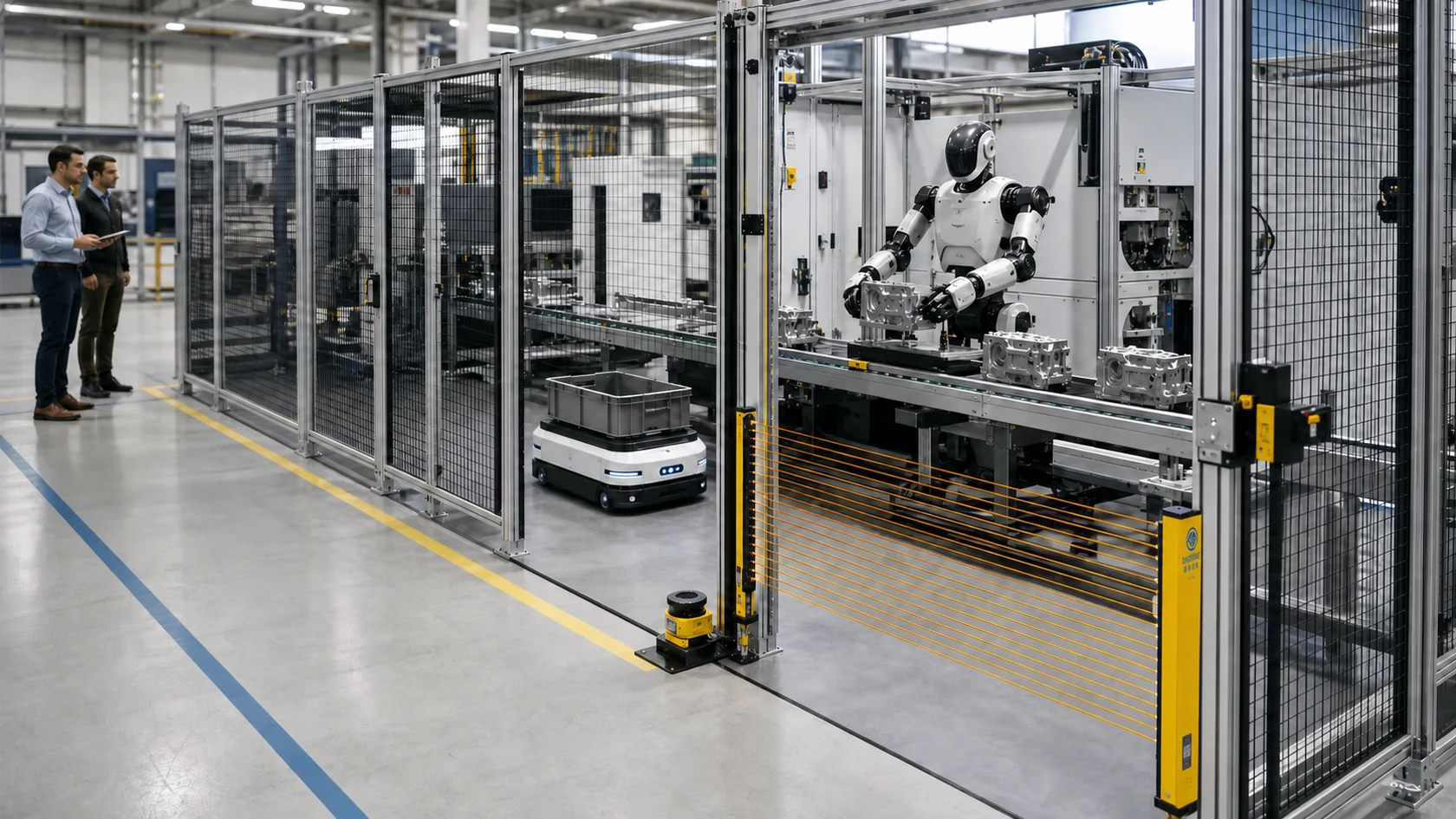
A light curtain monitors a fixed plane of beams across an opening. A safety laser scanner monitors a configured two-dimensional scan plane, subject to range, occlusion and access geometry; warning and protective fields have different roles. Some curtains provide finger/hand detection, while suitable safety scanners address area guarding and mobile applications. Check the exact model's detection capability, protective range, response time and applicable safety evidence. The complete safeguarding function still needs application-specific design and validation.
Explore the ST27 safety scanner →Reading a Safety Scanner's Protective-Range Conditions
ST27 protective-range figures are stated under specified target conditions, including 1.8% remission in the published data. Keep protective, warning and measuring ranges separate, and verify the exact configuration and application conditions. A through-beam light curtain uses a different detection principle: do not transfer the scanner's remission condition to it or treat remission as a universal separation-distance calculation input.
How protective range works →Measuring LiDAR vs Safety LiDAR — Not Interchangeable
The navigation and measuring LiDAR products in this range supply process or perception data; they are not offered as certified personnel-protection devices. Do not substitute a mapping, warning or measuring range for a validated protective field. Personnel safeguarding requires the exact safety-rated device, interfaces and complete safety function to be selected and verified for the application.
Compare our LiDAR range →Guard Locking vs Simple Interlock on Machine Doors
Guard interlocking monitors access; guard locking also holds the physical guard closed. Whether locking is needed, and when release is permitted, depends on the machine hazards and stopping behaviour. For defeat resistance, verify the exact device's declared coding level, actuator pairing or replacement rules, and installation measures rather than judging by RFID, magnetic or mechanical technology alone.
See safety door switches →NPN vs PNP: Matching a Sensor Output to Your PLC
An NPN (sinking) output switches the signal line toward 0 V; a PNP (sourcing) output switches it toward the positive supply. Confirm compatibility using the exact PLC input-module datasheet, common-terminal arrangement, supply and wiring diagram. Do not choose polarity from the customer's country or the controller brand alone; confirm the sensor output version in the quotation.
Read the full explainer →