
Slot Sensors
U-shaped slot photoelectric sensors for edge, mark and small-part detection.
Choose the Slot Opening and Mounting Before Output Logic
A slot sensor contains opposing optical elements in one body. Compare slot width, slot depth, target path, bracket access and connector orientation before choosing output logic. The nominal slot size is not a guarantee that every small or transparent target can be detected.
Compare 5 Slot Sensors Series
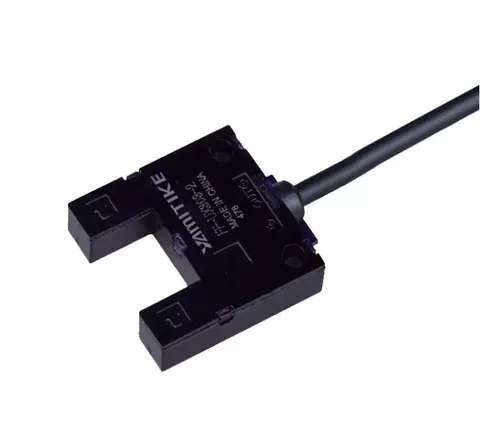
DD-303N / DD-403N Wide-slot Photoelectric Sensor
13 mm through-beam slot sensor giving real tolerance for thick or fluttering parts, still detecting down to 2.2×0.5 mm.
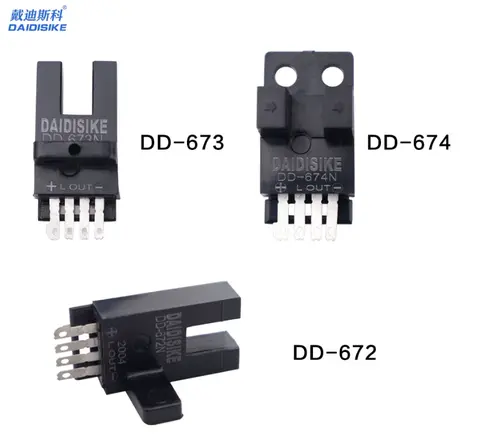
DD-670 Series Slot Photoelectric Sensor (Pin/Plug-in Connector Type)
Plug-in connector slot photoelectric sensor, 5 mm slot, 20 models across 5 housing styles, 4 NPN/PNP output versions.
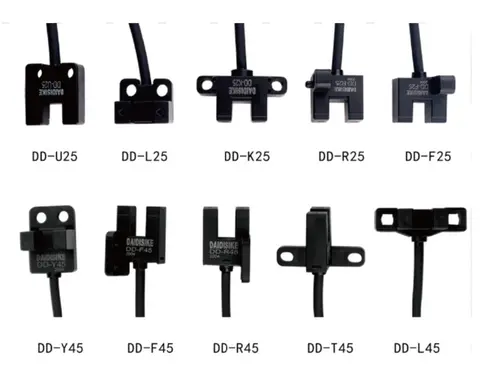
DD-L25/45 Series Micro-slot (Micro U-shaped) Photoelectric Sensor
Micro U-shaped photoelectric sensor with 0.01 mm repeatability and 0.025 mm hysteresis, in 10 compact mounting shapes.
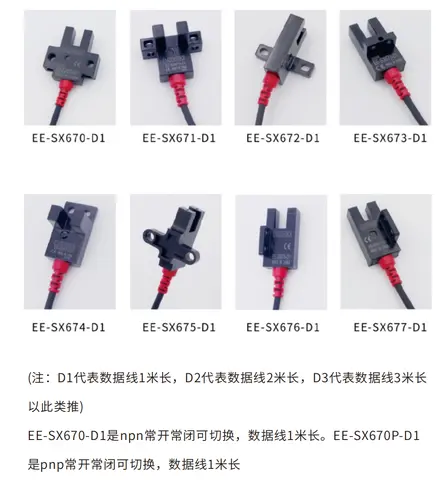
EE-SX67 Series Slot-type Photoelectric Sensor (Photomicrosensor)
Pre-aligned U-shaped photoelectric sensor in 8 shapes with full NPN/PNP output and wiring-selectable NO/NC logic.
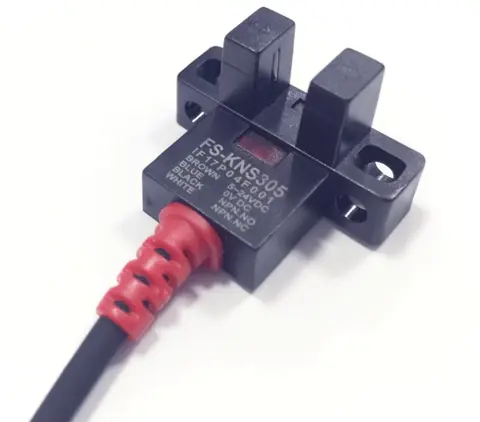
FS-KNS Slot Photoelectric Sensor (Plug-in Type)
5 mm-slot sensor with simultaneous NO+NC outputs, 0.3 ms response, and 1 mm minimum detectable object.
Compare the Configuration Paths
| Required task | Existing product page | What to confirm |
|---|---|---|
| Wide opening for a passing target | DD-303N / DD-403N wide-slot options | Check the actual target clearance and sensing position. |
| Compact slot installation | DD-L25/45 micro-slot family | Compare mounting hole position, opening and cable exit. |
| Connector-based installation | DD-670 pin/plug-in options | Order the correct mating connection and electrical version. |
A Slot-Sensor Sample Request
| Purchase input | Information to provide |
|---|---|
| Target and path | Send thickness, opacity, smallest gap, motion direction and speed. |
| Mechanical envelope | Record opening, insertion depth and free space around the body and connector. |
| Control signal | Confirm supply, output type, light-on/dark-on behaviour and receiving input. |
Use the NPN/PNP guide for current-path selection. For printed registration rather than beam interruption, compare colour-mark sensors.
Send the application details and required configuration through the inquiry form so that the quotation identifies the selected equipment and options.
Selection Help & Related
📘 Not sure which series? NPN vs PNP Sensor Outputs Explained