
Press & Press Brake Protection
Photoelectric guards and laser protection systems for power presses and press brakes.
Press Brake vs Punch Press: Two Different Guarding Problems
Presses and press brakes need a safeguarding solution matched to the machine and the operator task. A fixed field across an access opening and a ram-mounted laser system monitor different geometries; neither is automatically suitable for every machine of that name.
A press-brake risk assessment must account for sheet handling, tooling, side and rear access, stopping performance, operating modes and the applicable machine standard. A fixed light curtain is not universally prohibited, and a ram-tracking device is not a complete safeguarding solution by itself.
Compare the DKE-L3 ram-mounted laser configuration, DQS controller-based photoelectric guard and DQV double-sided system. Request the complete equipment configuration and evidence for the intended machine.
Compare 3 Press & Press Brake Protection Series
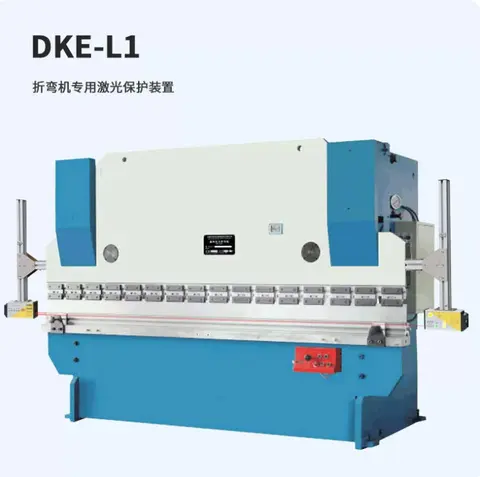
DKE-L3 Press Brake Laser Protection
Ram-mounted laser guarding that tracks the punch tip on press brakes and shears without blocking hand-fed work.
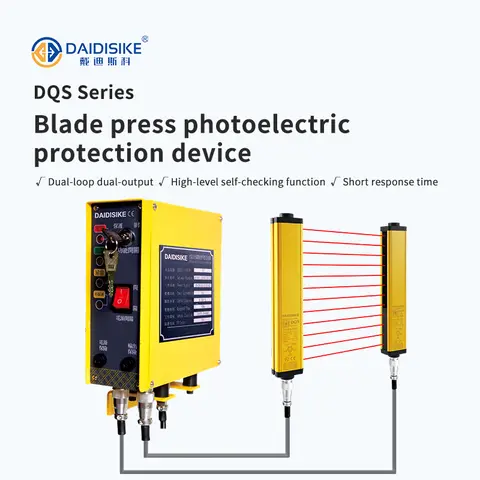
DQS Press Photoelectric Safety Guard
Type 4 press light curtain plus dedicated controller: dual relay outputs wire straight into your press circuit.
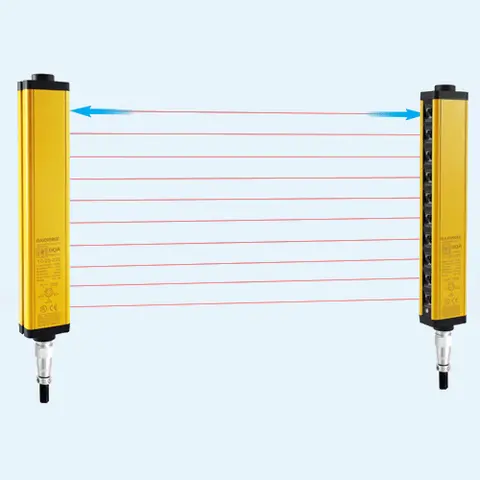
DQV Double-sided Photoelectric Safety Protection Device
Guards two hazardous machine sides at once with independent light-curtain sets and dual output channels.
Which of the Three Systems Fits Your Machine?
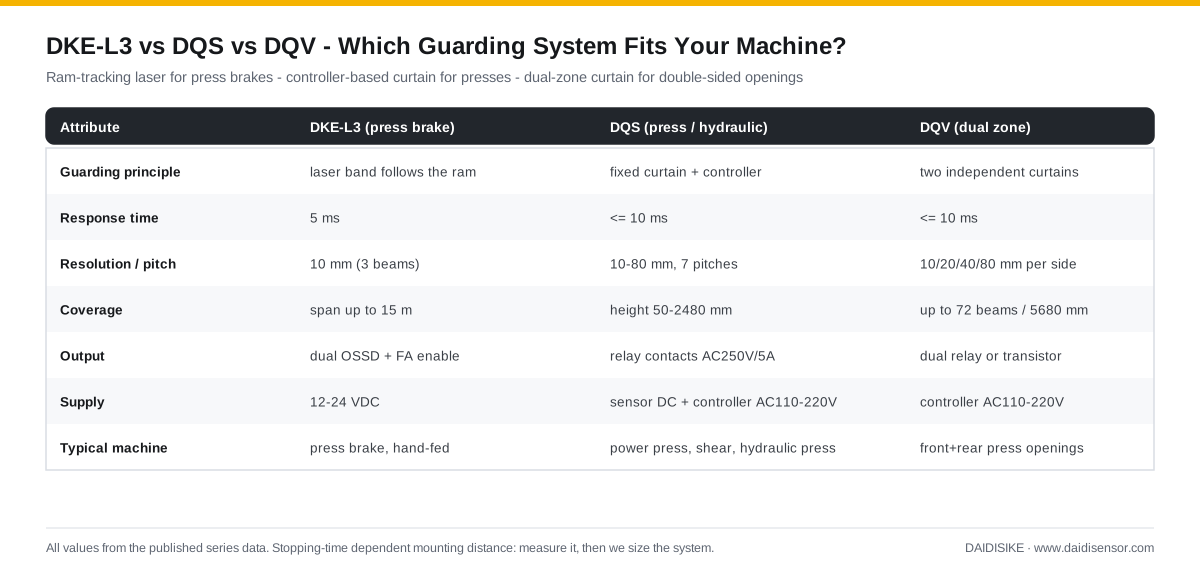
Compare the published configurations below as procurement starting points. Sensor response, optical spacing, output arrangement and machine-level stopping time are separate quantities; a table does not establish a certified combination.
| Attribute | DKE-L3 (press brake) | DQS (press / hydraulic) | DQV (dual zone) |
|---|---|---|---|
| Guarding principle | DKE-L3: 3-beam laser band that travels with the ram | DQS: fixed curtain + dedicated controller | DQV: two independent curtains, one controller |
| Response time | 5 ms | ≤ 10 ms | ≤ 10 ms |
| Published detection capability | 10 mm published detection capability; verify exact document | Request the minimum detectable object for the exact configuration; do not infer it from pitch | Request the minimum detectable object for the exact configuration; do not infer it from pitch |
| Optical pitch / arrangement | 3-beam laser arrangement; use the setup instructions, not a curtain-pitch conversion | 7 pitches: 10 / 14 / 20 / 25 / 30 / 40 / 80 mm | 10 / 20 / 40 / 80 mm per side |
| Coverage | spans up to 15 m between brackets | protective height 50–2480 mm (4–32 beams) | up to 72 beams / 5680 mm combined |
| Published output (verify selected version) | dual OSSD + FA fast-approach enable | relay contacts AC250V / 5A from the controller | dual relay or dual transistor |
| Supply | 12–24 VDC | sensors DC 12/24 V; controller AC 110–220 V | controller AC 110–220 V |
| Ingress protection | IP65 | IP65 | IP65 |
For a preliminary comparison, send the machine task, tooling and opening layout, controller/interface details and preferred configuration via the inquiry form. We can propose a model and quotation scope while listing information still needed; this is not final safeguard positioning or safety validation.
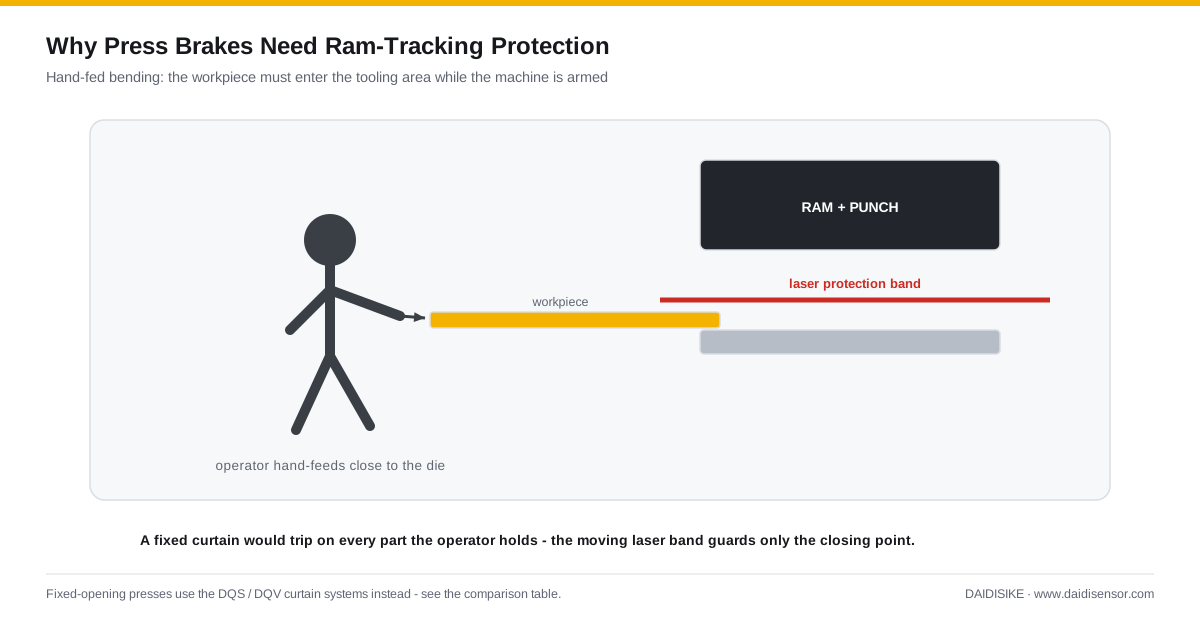
Press Brake Laser Protection: How Ram-Tracking Guarding Works
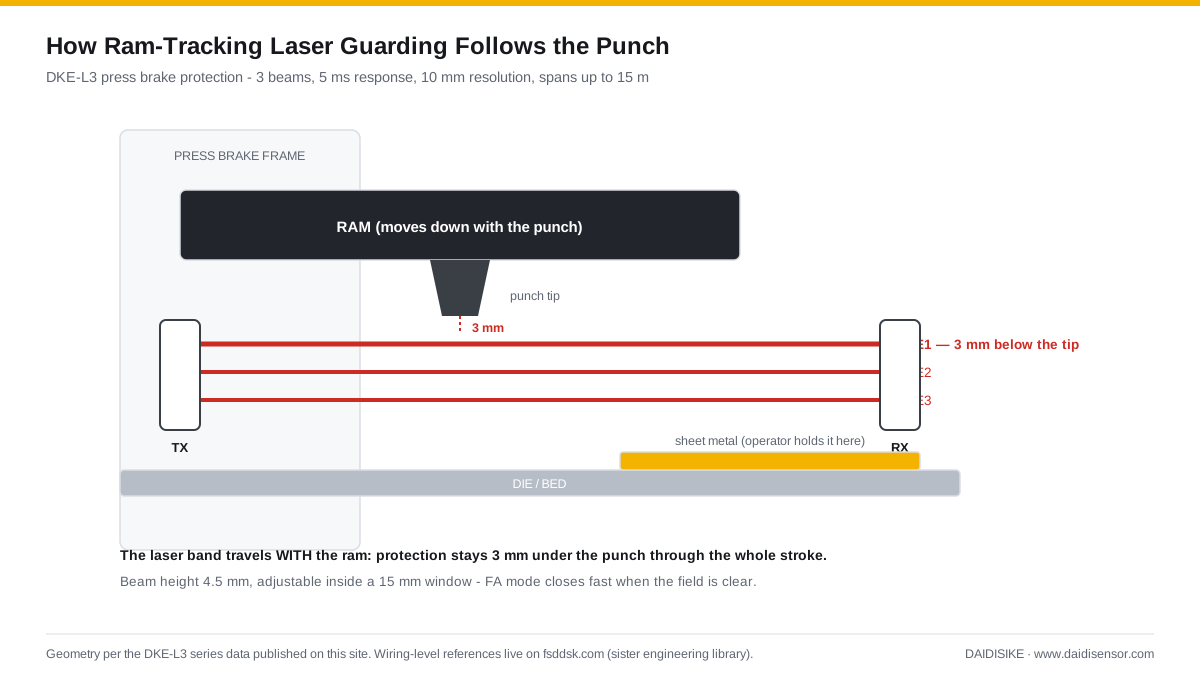
DKE-L3 uses ram-mounted transmitter and receiver brackets with the E1, E2 and E3 optical arrangement described in its instructions. Verify the applicable setup distance, tooling geometry, bracket alignment and operating mode from the exact version. A conceptual diagram is not a universal 3 mm installation prescription or proof that every hazard point is covered throughout the stroke.
The published optical geometry and FA fast-approach signal must be checked against the exact DKE-L3 instructions and the machine interface. The device response is not the machine stopping time; do not derive a safe working position from the nominal sensor response alone. Verify the laser classification and all operating precautions in the applicable manual.
Alignment across long beds is the practical worry, and it is why the system spans up to 15 m with bracket geometry designed for repeatable re-mounting after tool changes.
Guarding Power Presses and Hydraulic Presses with the DQS System
DQS combines a light-curtain configuration with a controller. Request the selected controller code, contact arrangement, input documentation and applicable safety evidence as one package. Do not assume Type 4, EDM or whole-machine compliance from the product family name; those requirements need explicit documentation for the selected configuration.
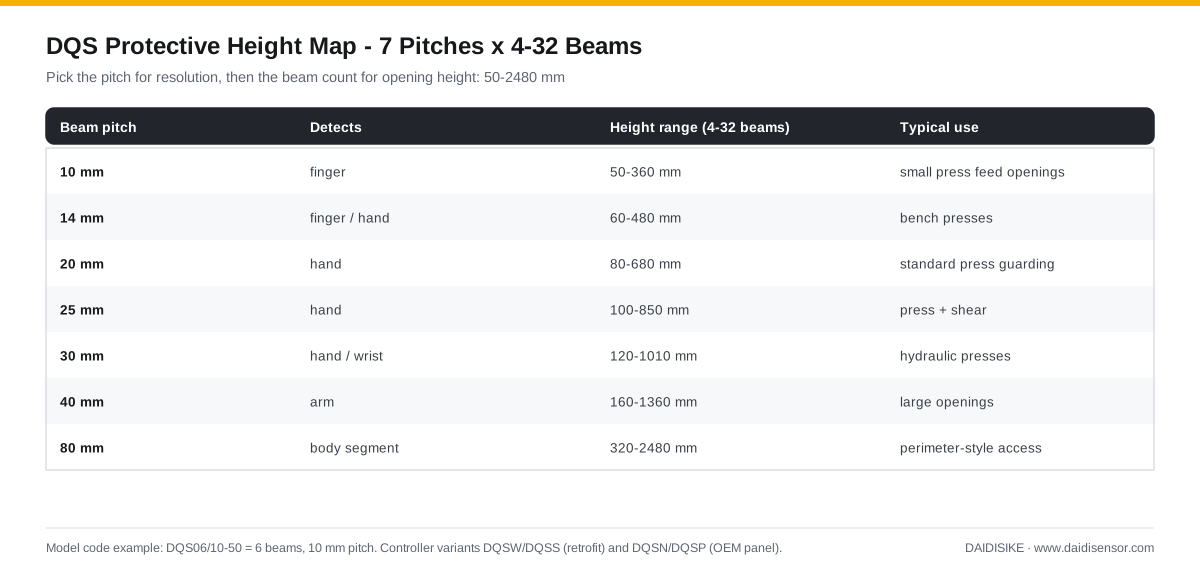
The controller family covers both retrofit and OEM builds. DQSW and DQSS are stand-alone boxes for adding protection to presses already on the floor; DQSN and DQSP are panel-mount versions for building into new machine cabinets. Output configuration is ordered by code — OC (1 NO + 1 NC), 2C (two NC) or 2O (two NO) — and detection distance is coded from class A (0.3–3 m) up to class H (0.3–40 m), so one series covers a bench press and a forty-meter transfer line alike.
Choose beam pitch, beam count and field height from the DQS model table. Ask separately for the minimum detectable object and applicable rating; pitch is not a synonym for detection capability.
Determine Safeguard Position from the Complete Stopping Chain
There is no category-wide correct mounting distance. Safeguard positioning depends on the applicable machine and positioning standards, approach geometry, documented detection capability and the total stopping chain: sensor, safety logic, output elements and the machine's measured stopping performance. Sensor response is one contribution, not the complete stopping time; machine stopping time alone is not the entire calculation either.
Collect the response information and measured machine performance for the intended operating conditions. The qualified machine integrator must determine and validate the final arrangement, including reach-over, reach-under, side access, rear access and restart risks. The press and press-brake procurement article helps assemble those inputs; its illustrative examples are not installation approval.
For pin-level output wiring — OSSD polarity, relay loop details, reset circuits — the DAIDISIKE engineering library on fsddsk.com maintains the full diagram set for every output type we ship.
What We Publish — and What to Ask the Factory For
The comparison above uses the published series data, and the three product pages contain the model lists. Certificate and functional-safety documents can be supplied directly on request, matched to the exact model and configuration. A missing document on the website is not a statement that no certificate exists. Final stopping-time-dependent positioning is a machine-integration task, not a generic catalogue value. If an essential field is missing, request the exact document or written confirmation before ordering.
| Stage | Information to provide | Expected result |
|---|---|---|
| 1. Preliminary model and quotation | Machine type and task; tool and opening layout; workpiece handling; controller/input information; supply and available mounting space; quantity | A proposed model and configuration, quotation scope and a list of unresolved information — not an approved installation |
| 2. Confirm the supplied equipment | Full sensor/controller codes; output version; pair or double-sided scope; bracket, cable and connector requirements; applicable instructions and evidence | Written list of included and optional items, matched documents and confirmed electrical/mechanical interfaces |
| 3. Final machine validation | Measured stopping performance; sensor/logic/output-element response; approach and bypass routes; operating, reset and restart arrangements | Positioning and complete safety-function validation by a qualified machine integrator before operation |
Use the inquiry form for the initial configuration, and the guarding procurement checklist to record the outstanding machine-integration questions.
Frequently Asked Questions
Can I use a standard safety light curtain on a press brake?
Possibly, depending on machine design, operating task, stopping performance and the applicable machine standard. A fixed light curtain and a ram-mounted laser system have different application constraints. Have the integrator validate the intended arrangement rather than assuming either option fits every press brake.
What is the difference between a press brake laser guard and a press light curtain?
A ram-mounted laser guard and a fixed light-curtain/controller arrangement monitor different geometries. Compare their exact setup instructions, documented detection capability, device response and output interfaces. A nominal optical offset is not a universal installation distance, and beam pitch must not be substituted for detection capability.
Do these systems include the safety relay?
DQS and DQV are controller-based configurations; confirm exactly which controller, contacts and accessories the quotation includes. DKE-L3 requires a documented evaluation and machine interface. Review the safety relay options only after checking exact input compatibility and required safety functions; a brand match is not approval of the combination.
How do I choose between DQSW, DQSS, DQSN and DQSP controllers?
W and S versions are stand-alone boxes for retrofitting presses already in service; N and P versions are panel-mount for OEM cabinets. Output codes: OC = 1 NO + 1 NC, 2C = two NC, 2O = two NO contacts.
What should I send to get an accurate quote?
For a preliminary quote, send machine type and task, tooling and opening layout, workpiece handling, controller/input details, supply, mounting space and quantity. State the required detection capability and safety performance if known; record any unknowns. Confirm the exact sensor/controller versions, cables and brackets on the quotation. Final positioning and safety validation require measured machine stopping performance plus the sensor, logic and output-element response information, reviewed by the qualified machine integrator.
Press & Press Brake Protection in Action — 5 Demonstration Videos
Wiring, setup and live operation filmed on the actual modules. Each clip links back to the series it demonstrates, so you can go straight from footage to specification.
Installing a Safety Light Curtain on a Punch Press — Mounting, Alignment & Test
Punch-press safety-light-curtain application demonstration for discussing mounting, alignment and the complete stopping function. Related product links are options to compare, not identification of the installed model. The clip does not establish measured stopping performance or a completed safety acceptance.
Related: DQC general-purpose safety light curtain · Press photoelectric safety guard
Punch Press Infrared Guarding — Light Curtain Stopping the Stroke in Real Time
A running power press protected by an infrared safety light curtain: the moment a hand breaks the beams, the stroke stops. Shows the reaction you should expect from properly wired point-of-operation guarding on stamping and blanking presses.
Related: Press & press-brake protection range
Pneumatic Automatic Feeder on a Pressing Machine — A50 / A100 / BX150 Running
An air feeder with pneumatic clamping advancing strip stock into the die at a fixed pitch, cycle after cycle. Automatic feeding keeps hands out of the point of operation — the feed area itself is then guarded with a safety light curtain.
Related: Press & press-brake protection
Press Feeding Peripherals Working Together — Uncoiler, Straightener & Feeder
The three stages of a stamping feed line in one view: the uncoiler pays off the coil, the straightener flattens it, and the feeder indexes it into the press. Understanding this flow helps you place guarding where people actually reach in.
Related: Press & press-brake protection
Automatic Feeder Cycling on a Stamping Press — Consistent Pitch Feeding
Close-up of an automatic feeder holding pitch accuracy on a running stamping press. Steady feeding raises output per shift and removes the manual hand-feeding that causes most press injuries.
Related: Press photoelectric safety guard
Selection Help & Related
📘 Not sure which series? How to Choose a Safety Light Curtain · Type 2 vs Type 4 Safety Light Curtains
Get a Quote
Ask about Press & Press Brake Protection — we reply within 24 hours.
💬 WhatsApp: +86 152 1890 9599