
DQS Press Photoelectric Safety Guard
Type 4 press light curtain plus dedicated controller: dual relay outputs wire straight into your press circuit.
▶ Watch it in action: Installing a Safety Light Curtain on a Punch Press — Mounting, Alignment & Test
 🔍 Click to enlarge · 1/24
Technical Specifications
| Series | DQS |
|---|---|
| Safety category | Type 4 |
| Beam pitch (resolution) | 10 / 14 / 20 / 25 / 30 / 40 / 80 mm |
| Sensing (detection) range | A = 0.3-3m ~ H = 0.3-40m (selected by order code) |
| Response time | ≤ 10 ms |
| Output | Via controller, dual relay outputs; NPN/PNP options; some controllers include EDM |
| Controller output contact rating | AC250V/5A or DC30V/5A |
| Sensor supply voltage | DC 12/24V |
| Controller supply voltage | AC110-220V ±15% |
| Protection rating | IP65 |
| Housing dimensions | approx. 35 × 51 mm |
Overview
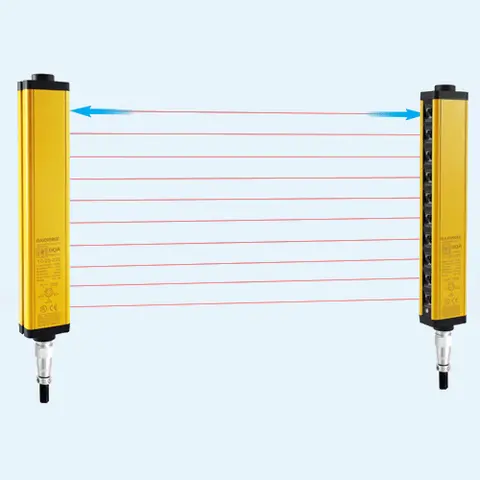
DQS is a Type 4 electro-sensitive protective equipment (ESPE) light curtain system built specifically for point-of-operation guarding on mechanical, pneumatic, and hydraulic power presses. It consists of an emitter/receiver light curtain pair and one of four controller variants (DQSW, DQSN, DQSS, DQSP), which convert the beam-interrupt signal into dual relay dry-contact outputs suitable for direct integration into a press's safety control circuit. It is intended for two buyer groups: machine builders/OEMs integrating point guarding into new press designs, and plant engineers retrofitting older mechanical or pneumatic presses that lack modern electrical safety circuits.
DQS ships as a complete guarding solution rather than a bare light curtain: the dedicated controller's dual relay dry-contact outputs wire directly into a press's clutch-brake or control circuit without a separate safety relay module or PLC. It offers seven beam-pitch options (10/14/20/25/30/40/80 mm) across 4 to 32 beams, covering protective heights from 50 mm to 2480 mm, with a response time of ≤10 ms, NPN/PNP output selection, and optional EDM (External Device Monitoring) on some controller variants.
Features & Benefits
Complete guarding solution, no separate safety relay or PLC needed
DQS ships as a light curtain plus dedicated safety controller (DQSW/DQSN/DQSS/DQSP) whose dual relay dry-contact outputs wire directly into a press control/clutch-brake circuit, so a facility retrofitting an older mechanical or pneumatic press can install it without adding a separate safety relay module or PLC logic.
≤10 ms response time shortens the required safety distance
Because minimum safety mounting distance is a function of response time plus stopping time, DQS's ≤10 ms response allows the light curtain to be positioned closer to the die opening than curtains with slower response, leaving more working space on the press bed for loading and unloading parts.
Type 4 rating, the category used for point-of-operation guarding
DQS is rated Type 4, the ESPE category commonly required for point-of-operation guarding applications on power presses.
Seven beam-pitch options let buyers match resolution to the die opening precisely
With beam pitches of 10/14/20/25/30/40/80 mm and 4-32 beams, DQS covers protective heights from 50 mm to 2480 mm across the model range, so buyers can select a resolution/height combination that fits their press opening instead of jumping to a coarser or oversized standard step.
External and built-in controller options serve both retrofit and OEM integration
DQSW/DQSS are external stand-alone controller enclosures suited to retrofitting existing presses without modifying original wiring, while DQSN/DQSP are built-in controllers suited to being panel-mounted inside a new machine's electrical cabinet by an OEM machine builder.
NPN/PNP output options and optional EDM for downstream contactor monitoring
DQS supports NPN and PNP output selection to suit sinking or sourcing control architectures, and some controller variants include EDM (External Device Monitoring), which checks the status of downstream contactors/relays and inhibits restart if a monitored contact has welded shut.
Universal AC110-220V (±15%) controller supply plus dual-voltage DC12/24V sensor supply
The controller accepts AC110-220V with ±15% tolerance and the sensor operates on DC12/24V, so the same part number can be used across 110V and 220V mains without changing model, and the tolerance band accommodates factory grids with voltage fluctuation.
IP65-rated, compact 35 x 51 mm housing
The IP65 rating protects against dust and water jets, relevant to the oil mist and metal particulate environment of a stamping shop, and the roughly 35 x 51 mm cross-section keeps the sensor housing compact alongside the press bed.
Applications
Models & Ordering Information
102 listed table entries across 7 beam-pitch options. Compare beam count and span, then confirm the complete ordering code. Beam pitch alone does not establish detection capability or suitability for personnel protection.
| Listed model entry | Beam pitch K (mm) | Number of beams N | Beam span H (mm) |
|---|---|---|---|
| DQS06/10-50 | 10 | 6 | 50 |
| DQS08/10-70 | 10 | 8 | 70 |
| DQS10/10-90 | 10 | 10 | 90 |
| DQS12/10-110 | 10 | 12 | 110 |
| DQS14/10-130 | 10 | 14 | 130 |
| DQS16/10-150 | 10 | 16 | 150 |
| DQS18/10-170 | 10 | 18 | 170 |
| DQS20/10-190 | 10 | 20 | 190 |
| DQS22/10-210 | 10 | 22 | 210 |
| DQS24/10-230 | 10 | 24 | 230 |
| DQS26/10-250 | 10 | 26 | 250 |
| DQS28/10-270 | 10 | 28 | 270 |
| DQS30/10-290 | 10 | 30 | 290 |
| DQS32/10-310 | 10 | 32 | 310 |
| Listed model entry | Beam pitch K (mm) | Number of beams N | Beam span H (mm) |
|---|---|---|---|
| DQS06/14-70 | 14 | 6 | 70 |
| DQS08/14-98 | 14 | 8 | 98 |
| DQS10/14-126 | 14 | 10 | 126 |
| DQS12/14-154 | 14 | 12 | 154 |
| DQS14/14-182 | 14 | 14 | 182 |
| DQS16/14-210 | 14 | 16 | 210 |
| DQS18/14-238 | 14 | 18 | 238 |
| DQS20/14-266 | 14 | 20 | 266 |
| DQS22/14-294 | 14 | 22 | 294 |
| DQS24/14-322 | 14 | 24 | 322 |
| DQS26/14-350 | 14 | 26 | 350 |
| DQS28/14-378 | 14 | 28 | 378 |
| DQS30/14-406 | 14 | 30 | 406 |
| DQS32/14-434 | 14 | 32 | 434 |
| Listed model entry | Beam pitch K (mm) | Number of beams N | Beam span H (mm) |
|---|---|---|---|
| DQS04/20-60 | 20 | 4 | 60 |
| DQS06/20-100 | 20 | 6 | 100 |
| DQS08/20-140 | 20 | 8 | 140 |
| DQS10/20-180 | 20 | 10 | 180 |
| DQS12/20-220 | 20 | 12 | 220 |
| DQS14/20-260 | 20 | 14 | 260 |
| DQS16/20-300 | 20 | 16 | 300 |
| DQS18/20-340 | 20 | 18 | 340 |
| DQS20/20-380 | 20 | 20 | 380 |
| DQS22/20-420 | 20 | 22 | 420 |
| DQS24/20-460 | 20 | 24 | 460 |
| DQS26/20-500 | 20 | 26 | 500 |
| DQS28/20-540 | 20 | 28 | 540 |
| DQS30/20-580 | 20 | 30 | 580 |
| DQS32/20-620 | 20 | 32 | 620 |
| Listed model entry | Beam pitch K (mm) | Number of beams N | Beam span H (mm) |
|---|---|---|---|
| DQS06/25-125 | 25 | 6 | 125 |
| DQS08/25-175 | 25 | 8 | 175 |
| DQS10/25-225 | 25 | 10 | 225 |
| DQS12/25-275 | 25 | 12 | 275 |
| DQS14/25-325 | 25 | 14 | 325 |
| DQS16/25-375 | 25 | 16 | 375 |
| DQS18/25-425 | 25 | 18 | 425 |
| DQS20/25-475 | 25 | 20 | 475 |
| DQS22/25-525 | 25 | 22 | 525 |
| DQS24/25-575 | 25 | 24 | 575 |
| DQS26/25-625 | 25 | 26 | 625 |
| DQS28/25-675 | 25 | 28 | 675 |
| DQS30/25-725 | 25 | 30 | 725 |
| DQS32/25-775 | 25 | 32 | 775 |
| Listed model entry | Beam pitch K (mm) | Number of beams N | Beam span H (mm) |
|---|---|---|---|
| DQS04/30-90 | 30 | 4 | 90 |
| DQS06/30-150 | 30 | 6 | 150 |
| DQS08/30-210 | 30 | 8 | 210 |
| DQS10/30-270 | 30 | 10 | 270 |
| DQS12/30-330 | 30 | 12 | 330 |
| DQS14/30-390 | 30 | 14 | 390 |
| DQS16/30-450 | 30 | 16 | 450 |
| DQS18/30-510 | 30 | 18 | 510 |
| DQS20/30-570 | 30 | 20 | 570 |
| DQS22/30-630 | 30 | 22 | 630 |
| DQS24/30-690 | 30 | 24 | 690 |
| DQS26/30-750 | 30 | 26 | 750 |
| DQS28/30-810 | 30 | 28 | 810 |
| DQS30/30-870 | 30 | 30 | 870 |
| DQS32/30-930 | 30 | 32 | 930 |
| Listed model entry | Beam pitch K (mm) | Number of beams N | Beam span H (mm) |
|---|---|---|---|
| DQS04/40-120 | 40 | 4 | 120 |
| DQS06/40-200 | 40 | 6 | 200 |
| DQS08/40-280 | 40 | 8 | 280 |
| DQS10/40-360 | 40 | 10 | 360 |
| DQS12/40-440 | 40 | 12 | 440 |
| DQS14/40-520 | 40 | 14 | 520 |
| DQS16/40-600 | 40 | 16 | 600 |
| DQS18/40-680 | 40 | 18 | 680 |
| DQS20/40-760 | 40 | 20 | 760 |
| DQS22/40-840 | 40 | 22 | 840 |
| DQS24/40-920 | 40 | 24 | 920 |
| DQS26/40-1000 | 40 | 26 | 1000 |
| DQS28/40-1080 | 40 | 28 | 1080 |
| DQS30/40-1160 | 40 | 30 | 1160 |
| DQS32/40-1240 | 40 | 32 | 1240 |
| Listed model entry | Beam pitch K (mm) | Number of beams N | Beam span H (mm) |
|---|---|---|---|
| DQS04/80-240 | 80 | 4 | 240 |
| DQS06/80-400 | 80 | 6 | 400 |
| DQS08/80-560 | 80 | 8 | 560 |
| DQS10/80-720 | 80 | 10 | 720 |
| DQS12/80-880 | 80 | 12 | 880 |
| DQS14/80-1040 | 80 | 14 | 1040 |
| DQS16/80-1200 | 80 | 16 | 1200 |
| DQS18/80-1360 | 80 | 18 | 1360 |
| DQS20/80-1520 | 80 | 20 | 1520 |
| DQS22/80-1680 | 80 | 22 | 1680 |
| DQS24/80-1840 | 80 | 24 | 1840 |
| DQS26/80-2000 | 80 | 26 | 2000 |
| DQS28/80-2160 | 80 | 28 | 2160 |
| DQS30/80-2320 | 80 | 30 | 2320 |
| DQS32/80-2480 | 80 | 32 | 2480 |
14 listed entries at 10 mm pitch · 102 across this table. Beam span is calculated as H = (N − 1) × K; it is not overall housing length or proof of detection capability. Some entries expand catalogue ranges. Confirm the complete ordering code and availability before ordering; inclusion is not a stock claim.
Controllers
Accessories
How to Select
- Choose beam pitch (10/14/20/25/30/40/80 mm) to match resolution to the die opening: finer pitch (10-14mm) suits small openings needing finger-level resolution, coarser pitch (40-80mm) suits larger openings where hand/arm-level detection is sufficient.
- Choose protective height by beam count (4-32) at the chosen pitch; the model number encodes this directly, e.g. DQS16/20-320 = 16 beams at 20mm pitch = 320mm protective height.
- Select sensing (operating) range via the detection-distance code (A-H) appended to the order code, and confirm the exact distance-band table with the factory before specifying.
- Choose controller form factor: external stand-alone (DQSW, DQSS) for retrofitting an existing press without modifying its control cabinet, or built-in/panel-mount (DQSN, DQSP) for OEM integration into a new machine's electrical cabinet.
- Choose output configuration — OC (one NO + one NC), 2C (two NC), or 2O (two NO) — appended to the controller code (e.g. DQSW-OC), to match the press's existing safety circuit logic.
- Choose NPN or PNP sensor-side output to match whether the press's control architecture is sinking (NPN) or sourcing (PNP).
- Confirm sensor supply DC12/24V and controller supply AC110-220V (±15%) match the plant's available power before ordering.
📘 Need the full method? How to Choose a Safety Light Curtain · Type 2 vs Type 4 Safety Light Curtains
When NOT to specify the DQS — and what to use instead
Guarding a press brake bend zone or shear blade where the guard must track the moving ram/tool tip
Why not: DQS is a fixed area-type Type 4 light curtain covering a set protective height (50-2480 mm); it does not move with a ram the way a beam-tracking device would.
Use instead: DKE-L3 ram-mounted laser guard
The die opening needs more than 32 beams or a protective height beyond 2480 mm
Why not: DQS's model range covers 4 to 32 beams per side, giving protective heights up to 2480 mm at 80 mm pitch.
Use instead: DQV series (same platform, extends to 72 beams and 5680 mm)
The machine has two separate hazardous access sides that both need light-curtain interlocking
Why not: DQS is built as a single-side light curtain with one controller and one output circuit.
Use instead: DQV double-sided photoelectric safety protection device
The downstream circuit needs a multi-mode safety relay (e-stop, door interlock, two-hand control) rather than a simple dry-contact/transistor trip signal
Why not: DQS controller output is limited to dual relay dry contacts or NPN/PNP transistor signals; it is not a configurable multi-function safety relay.
Use instead: DA31 or DQSRN safety relay module downstream of the DQS controller output
A formal ISO 13849 risk assessment requires documented PFHd/MTTFd/B10d/PL or Category figures beyond the Type 4 rating
Why not: The published spec gives a Type 4 (IEC 61496 ESPE category) rating but no PFHd, MTTFd, B10d, or PL/Category figure specific to DQS.
Use instead: Request this documentation from the factory before specifying
Specifications we do not publish yet
We only publish a figure once we are confident it is true. The items below are still being validated through further testing and real-world customer feedback, so for now we would rather leave them open than guess. If one of them matters to your design, ask us for the latest validated status.
- Detection accuracy figure separate from the beam-pitch resolution spec
- Operating temperature range
- Housing/lens material
- Certificate numbers and scope for the Type 4 / IEC 61496 rating
- PFHd, MTTFd, B10d, and Category/PL figures for formal ISO 13849 risk-assessment documentation
- Exact sensing-range distance-band table for order codes A through H
- Function and wiring of the optional DQCA-01 accessory
- EDM (External Device Monitoring) availability confirmed per specific controller/output-code combination
Frequently Asked Questions
What does DQS stand for and what is it used for?
Does DQS need a separate safety relay module to connect to my press?
What is the response time of DQS?
What beam pitch (resolution) options are available?
What protective heights does DQS cover?
What is the difference between DQSW, DQSN, DQSS, and DQSP controllers?
Does DQS support both NPN and PNP output?
What is EDM and does DQS have it?
What power supply does DQS require?
What is the difference between DQS and DQV?
What is the housing protection rating and size?
Is DQS certified to IEC 61496 Type 4 or other safety standards?
Related Categories and Example Products
Explore other functions that may be needed in a machine or line. The products below are category examples, not pre-validated electrical or safety combinations. Confirm each interface and application separately: Safety Light Curtains · Safety Relays · Safety Mats
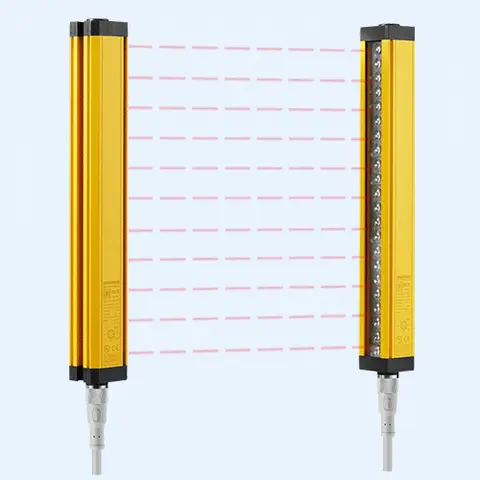
DCE Automation Safety Light Curtain
Compact through-beam safety light curtain in a 30 x 30 mm housing: 10/20/30/40 mm beam pitch, up to 72 beams, 0.3-3 m or 0.3-6 m sensing distance, NPN/PNP output. Catalogue-stated Type 4 design basis; confirm exact safety-document scope.
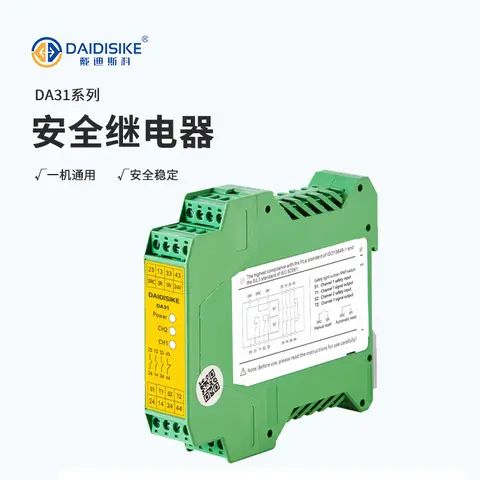
DA31 Emergency-Stop Safety Relay Module
Ultra-slim 22.6 mm Category 4/PL e/SIL 3 safety relay with dual-channel PNP/NPN input and a solid-state status output.
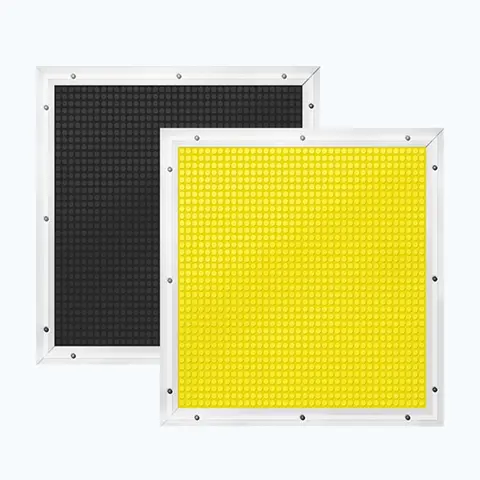
JT14 Safety Mat (Economical)
Economical pressure-sensitive safety mat with volt-free N.O. output for large-area or custom-shape floor guarding.
Related Products in Press & Press Brake Protection
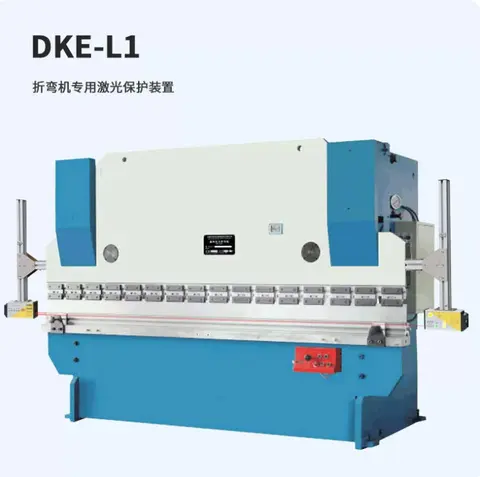
DKE-L3 Press Brake Laser Protection
Ram-mounted laser guarding that tracks the punch tip on press brakes and shears without blocking hand-fed work.
DQV Double-sided Photoelectric Safety Protection Device
Guards two hazardous machine sides at once with independent light-curtain sets and dual output channels.