
JT14 Safety Mat (Economical)
Economical pressure-sensitive safety mat with volt-free N.O. output for large-area or custom-shape floor guarding.
 🔍 Click to enlarge · 1/11
Technical Specifications
| Output | Passive volt-free normally open (N.O.) dry contact |
|---|---|
| Response time | ≤30ms |
| Actuating force | Adult ≥30kg |
| Compressive strength | 1000kg/cm² |
| Material | NBR rubber + aluminum trim edging |
| Mechanical life | 1,000,000 operations |
| Protection rating | IP65 |
| Standard sizes | 250*500 / 500*500 / 500*1000 / 750*1000 / 1000*1000 / 1100*1800 (mm) |
| Custom range | Length 200-1000mm x width 200-2000mm, free polygon shapes |
| Design standard | Series literature references ISO 13856-1 / PL d; verify document scope for the delivered configuration. No installed-system PL or third-party approval is established here. |
Overview
JT14 is a pressure-sensitive floor mat for presence detection around machines and robot cells. Foot pressure changes its passive, volt-free normally open (N.O.) contact. A compatible safety mat controller evaluates the signal and works with the machine's stop interface; the mat does not stop a machine by itself. Its NBR rubber surface and aluminum trim edging suit rectangular or custom-shaped floor layouts.
Published JT14 series data lists an adult body-weight reference of ≥30 kg, a mat contact response of ≤30 ms, a compressive strength reference up to 1000 kg/cm², IP65 protection and a mechanical life of 1,000,000 operations. Mat response is not total machine stopping time, and the load reference does not establish forklift or wheeled-traffic suitability. Six catalog sizes from 250×500 mm to 1100×1800 mm and custom outlines are listed; confirm the exact active area and mechanical arrangement on the approved order drawing. Earlier series literature references ISO 13856-1 and PL d per EN ISO 13849-1; these references do not establish the achieved Performance Level or certification of a complete installation.
JT14 Applications & Control Connections
Four diagrams show how JT14 detects foot pressure, fits into a guarded-machine layout, connects to the control system and uses an active sensing area. The 750×750 mm outline is a custom-size example, not an additional standard catalog size.
1. How the Safety Mat Works
Foot pressure changes the mat contact. A matched controller evaluates the input and sends a protective stop demand through the machine's stop interface. The mat cable is a sensing connection, not a motor-power circuit.
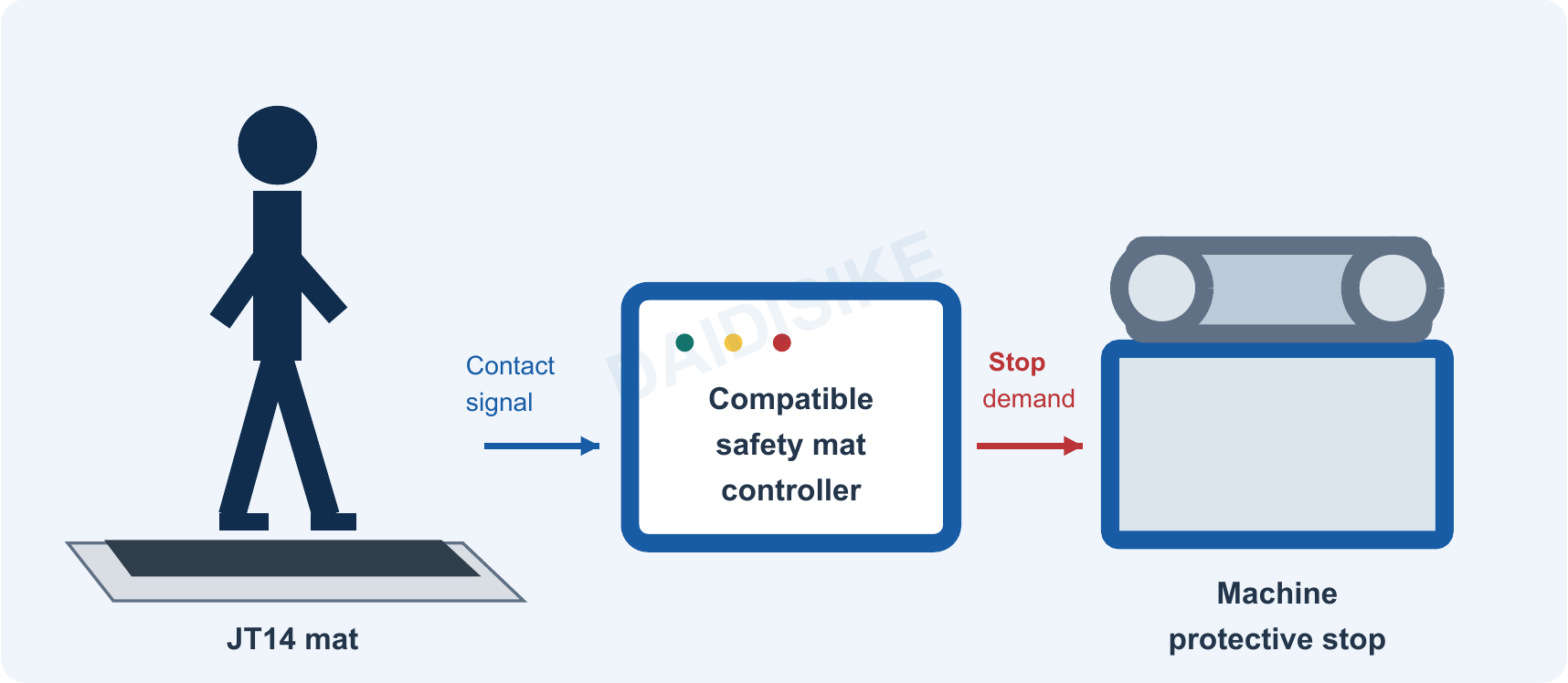
- Detect: a person steps on the active sensing area.
- Evaluate: the compatible controller monitors the mat input.
- Stop: the machine's protective stop function responds; stopping time also depends on the controller, drive and mechanical run-down.
- Prevent restart: occupancy must inhibit hazardous restart. Stepping off the mat is not a Start command.
2. Application Example: A Guarded Rotating Machine
JT14 can provide a local floor-sensing position alongside fixed guards, a protected access gate and a safety control system. The five numbered parts below perform different jobs.
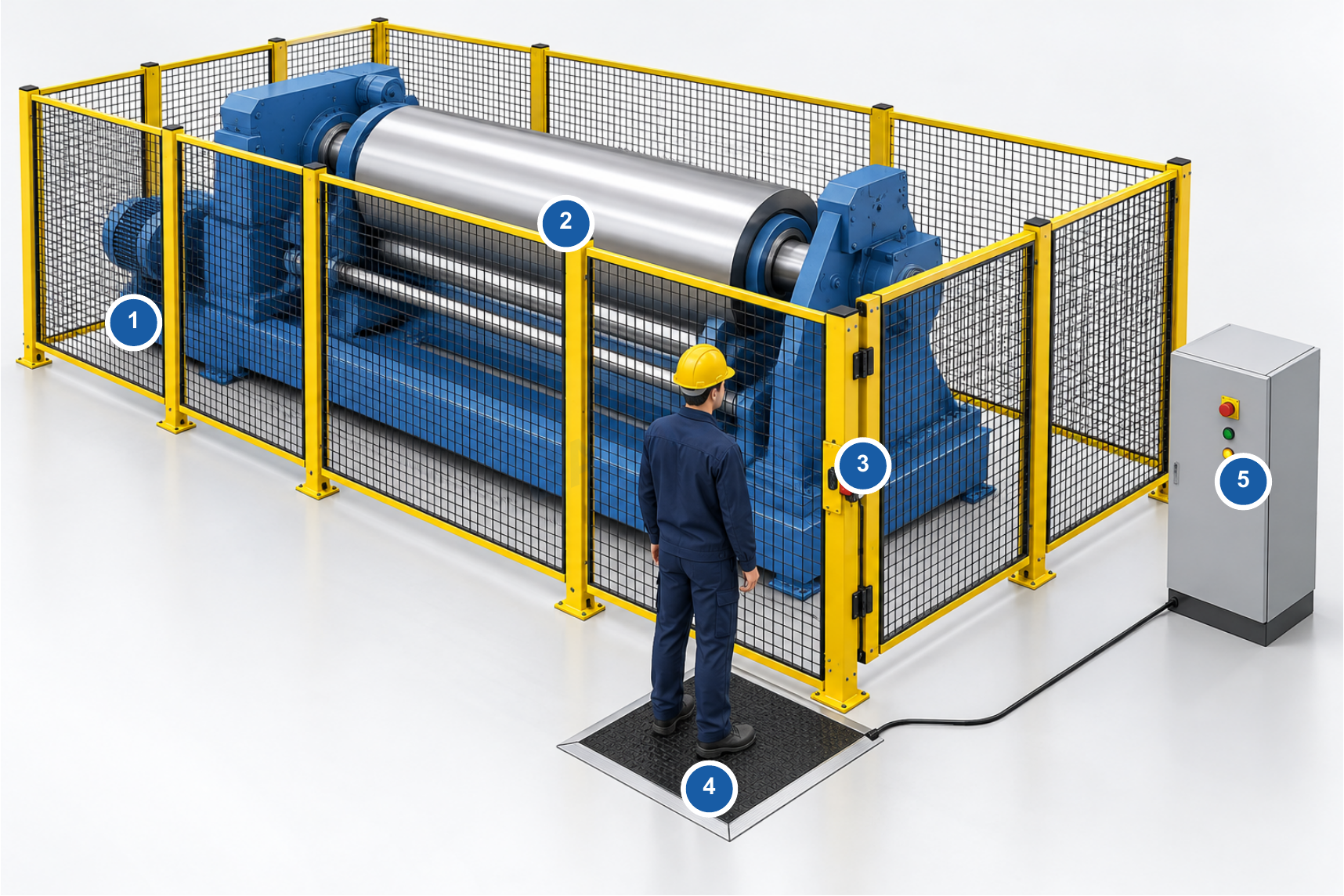
- 1 — Fixed guarding: separates people from the rotating hazard and restricts access around the sensing position.
- 2 — Rotating hazard: allow for inertia and run-down; a stop demand does not mean immediate standstill.
- 3 — Protected access gate: where a person could reach the hazard before it stops, suitable guard locking or another validated access-prevention measure is needed.
- 4 — JT14 safety mat: detects pressure at the selected position. Check gaps and bypass routes; more sensing coverage or guarding may be required.
- 5 — Safety control system: evaluates the mat, gate and emergency-stop functions and commands the machine's protective stop.
The complete layout must be assessed for the machine. A safety mat does not replace fixed guarding or maintenance isolation and lockout.
3. Control Connections
The mat connects to a compatible safety mat input. Gate protection and emergency stop are separate protective functions. The safety control system acts through the machine's final stop interface.
The N.O. mat contact is a sensing input, not a safety output. Use a controller matched to the delivered mat circuit, not an arbitrary relay input.
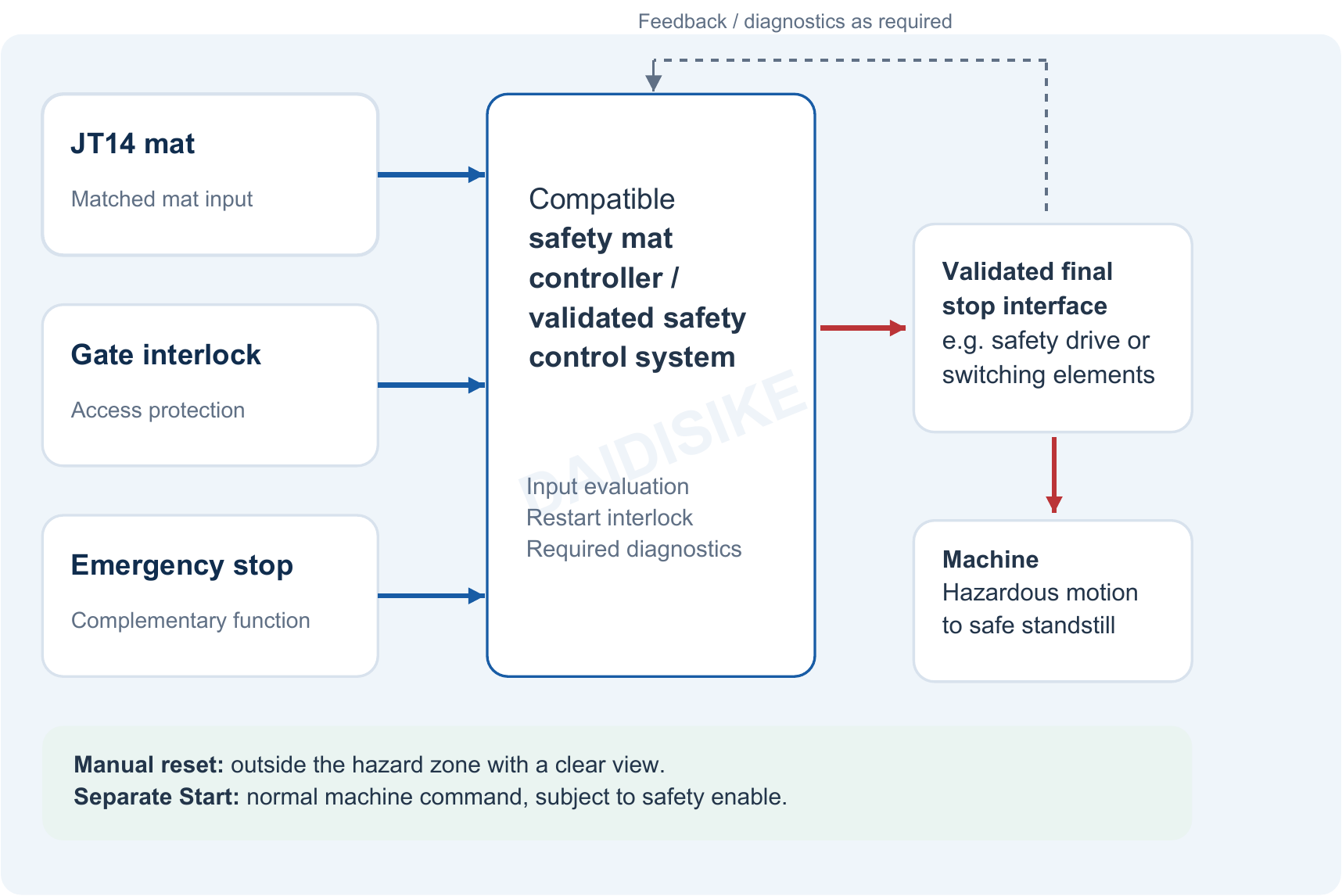
- Mat and cable: confirm the delivered cable pairing and circuit definition before wiring.
- Controller: match the input principle, fault detection and reset behavior to the mat circuit.
- Machine stop interface: use the specified safety drive or switching devices and required feedback monitoring.
- Reset and Start: place manual reset outside the hazard zone with a clear view. Reset must not start motion; provide a separate deliberate Start command.
Reset and Restart
Use the sequence protected area clear → specified manual reset → separate deliberate Start. Stepping off the mat, closing a gate or releasing an emergency stop must not automatically restart hazardous motion.
| Condition | System behavior |
|---|---|
| Mat occupied | Protective stop; hazardous restart inhibited. |
| Mat becomes clear | No automatic restart; confirm the whole protected area is clear. |
| Manual reset | Safety enable may be restored when all required conditions are satisfied; no hazardous motion starts. |
| Separate Start command | Operation may resume only with the safety enable and machine control conditions satisfied. |
4. Dimensions and Active Sensing Area
The 750×750 mm outline below is a custom-size example. Nominal size and active sensing area are different: aluminum trim and non-sensing borders must not be counted as protected floor coverage.
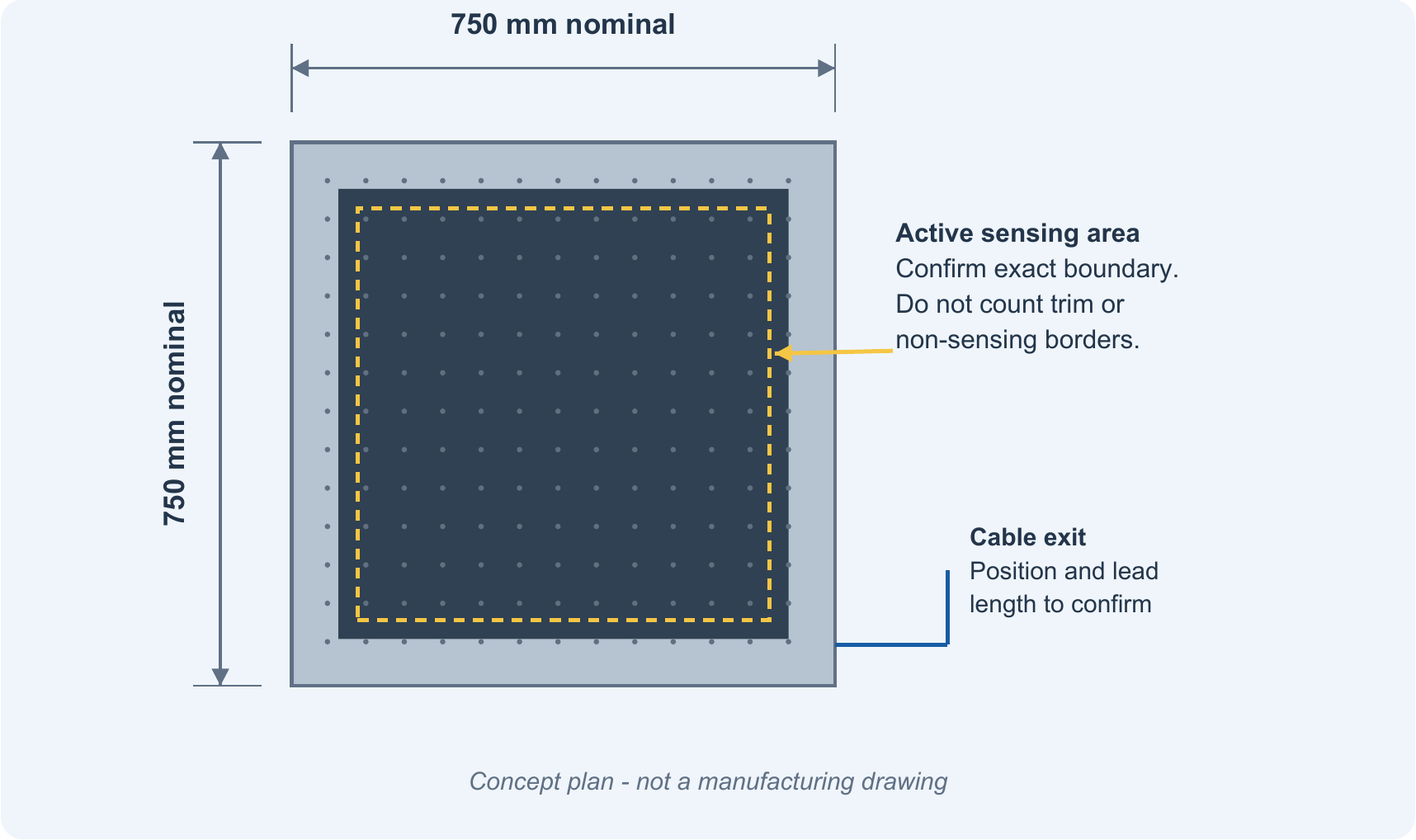
- Mounting: use a flat, clean, fully supported floor and the specified perimeter fixing method.
- Cable route: confirm the exit and lead length, then protect the cable from crushing, abrasion and trip hazards.
- Sensing core: do not cut, drill, fold or modify the mat.
- Coverage: check gaps, joints and routes around or over the mat; add sensing or guarding where required.
JT14 Sizes & Accessories
Choose a catalog size or ask about a custom outline to suit your machine layout.
- Sizes: six standard catalog sizes, with custom dimensions and polygon outlines available on request.
- Mechanical accessories: confirm the aluminum trim, fixing arrangement and cable length for your layout.
- Control: specify a safety mat controller compatible with the delivered mat circuit.
Installation & Routine Checks
Have a qualified integrator install and validate the complete safety function using the matched product and controller manuals.
- Before use: verify sensing coverage, complete stopping performance, fault response and safeguarding distance.
- Restart: verify occupancy prevents hazardous restart and that reset alone cannot start motion.
- Routine care: inspect the mat, trim and cable. Stop use if damage or unreliable detection is found.
Features & Benefits
Actuating force ≥ 30 kg
Published adult body-weight reference. Verify detection over the delivered active area and actual conditions; it is not a precise universal force threshold or a guarantee against nuisance trips.
Response time ≤ 30 ms
Fast signal output from actuation to contact switching. Total machine stopping time still depends on the connected equipment's braking performance, not the mat alone.
Load rating up to 1000 kg/cm²
Published series compressive-strength reference. Confirm the applicable test and permitted loading; do not infer suitability for forklifts, pallet trucks or other wheeled traffic.
IP65-rated sealed construction
Dust-tight and protected against water jets, suitable for floor areas that require washdown cleaning.
NBR rubber surface with aluminum trim edging; 1,000,000-operation mechanical life
The trim edging protects the perimeter of the sensing core — the most vulnerable point — and reduces trip hazard from a raw edge, while the rated mechanical life supports long-term repeated use.
Passive volt-free N.O. contact output
No independent power supply is required at the mat itself. Use a matched safety mat controller; the complete system must provide the required diagnostics and fault response.
ISO 13856-1 / PL d references in series literature
Request documents for the exact delivered configuration and verify their scope. A catalog reference is not proof of third-party certification or the achieved Performance Level of an installed safety function.
Custom sizes and free polygon shapes
Beyond the 6 catalog sizes, request custom dimensions and polygon outlines to follow the machine footprint. Confirm feasibility, active-area boundaries and all potential gaps on the approved layout.
Economical positioning for large-area or multi-zone guarding
Catalog-designated economical tier, offering a cost advantage when guarding large continuous areas or multiple work zones.
Applications
Models & Ordering Information
Standard Catalog Sizes
PDF & 3D CAD Downloads
Browse all downloadsJT14 Safety Mat Technical and Installation Guide
Confirm the document and CAD file match the exact ordered version before installation or mechanical design. Contact us if your model is not listed.
How to Select
- Choose from the 6 standard sizes (250×500 mm to 1100×1800 mm) named as JT14-Width*Length (mm).
- All 6 standard sizes are rectangular; for irregular boundaries such as machine bases, columns, or cable runs, request a custom free-polygon layout with your site outline dimensions.
- The mat outputs a passive volt-free N.O. contact. Specify a controller demonstrably suitable for the delivered mat circuit; confirm the complete model combination, input principle, diagnostics, cable pairing and matched terminal diagram before ordering.
- For washdown or wet floor areas the IP65 rating applies; confirm chemical or oil resistance separately if your environment requires it.
- If the risk assessment specifies a required Performance Level or pressure-sensitive protective-device requirements, request applicable documentation and verify its exact scope. The complete safety function still requires machine-specific design and validation.
When NOT to specify the JT14 — and what to use instead
Guarding a perimeter or vertical opening rather than a floor area
Why not: JT14 is a floor presence mat that detects step-on pressure; it does not sense intrusion into a vertical plane.
Use instead: A light curtain (DQC/DQA/DQT/DQT4) or ST27 laser scanner for perimeter/area guarding
Forklifts, pallet trucks, or other wheeled loads will drive over the guarded area regularly
Why not: JT14's compressive strength rating is up to 1000 kg/cm²; sustained wheeled-vehicle traffic beyond typical foot-traffic duty is not confirmed as within its rated use.
Use instead: Confirm loading with the factory; a hard guard fence or a light curtain may better suit vehicle-trafficked boundaries
Needing a self-contained safety function without an external compatible controller
Why not: JT14 is a passive sensing element, not a complete safety system. Input evaluation, required diagnostics and the validated machine stop interface must be provided externally.
Use instead: Specify a demonstrably compatible safety mat controller and validate the complete machine safety function; no DA31/DQSRN compatibility is assumed here.
Detecting a body weight lighter than an adult (e.g. a light object or small load) must reliably trip the mat
Why not: Actuating force is rated at '≥30 kg for an adult' — loads lighter than this are not guaranteed to trigger the contact.
Use instead: Consult the factory for lower-threshold sensing needs
The environment involves oil or specific cleaning chemicals beyond plain water washdown
Why not: IP65 protects against dust and water jets but 'does not by itself indicate resistance to specific cleaning chemicals or oils' per the product's own FAQ.
Use instead: Confirm chemical/oil resistance with the factory before specifying
Specifications we do not publish yet
We only publish a figure once we are confident it is true. The items below are still being validated through further testing and real-world customer feedback, so for now we would rather leave them open than guess. If one of them matters to your design, ask us for the latest validated status.
- Mat thickness (source catalogs conflict: 14mm vs 12mm)
- Standard size range consistency — one old-site source lists a 'JT14-300x300' style series not present among the current catalog's 6 standard sizes
- Detection/actuation repeatability figures
- Operating temperature range
- Number of internal switching zones per mat (single-zone vs multi-zone)
- Certificate numbers and issuing body for the stated ISO 13856-1 / PL d design basis
- PFHd, MTTFd, and B10d figures underlying the stated PL d rating
Frequently Asked Questions
What output does the JT14 safety mat provide?
What is the actuating force of the JT14?
How fast does the JT14 respond after being stepped on?
What sizes does the JT14 come in?
Is the JT14 waterproof?
What standard is the JT14 designed to?
Does the JT14 need its own power supply?
What is the mechanical life of the JT14?
Can the JT14 be shaped to fit an irregular guarded area?
How does the JT14 differ from a light curtain or laser scanner for floor protection?
Is the 750×750 mm outline all active sensing area?
Can I wire the JT14 using the functional diagram on this page?
Will stepping off the mat restart the machine?
Does one mat outside a rotating machine replace the guard?
Related Categories and Example Products
Explore other functions that may be needed in a machine or line. The products below are category examples, not pre-validated electrical or safety combinations. Confirm each interface and application separately: Safety Relays · Safety Light Curtains · Safety Edges
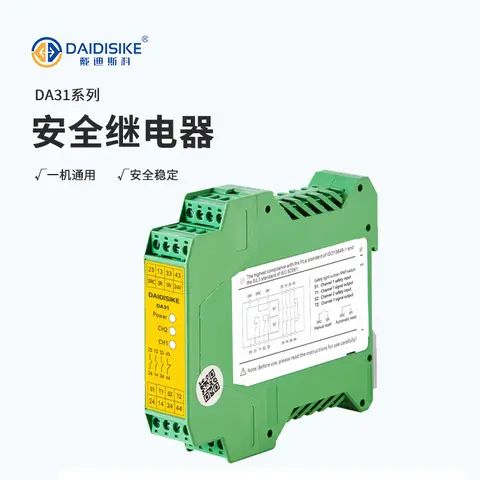
DA31 Emergency-Stop Safety Relay Module
Ultra-slim 22.6 mm Category 4/PL e/SIL 3 safety relay with dual-channel PNP/NPN input and a solid-state status output.
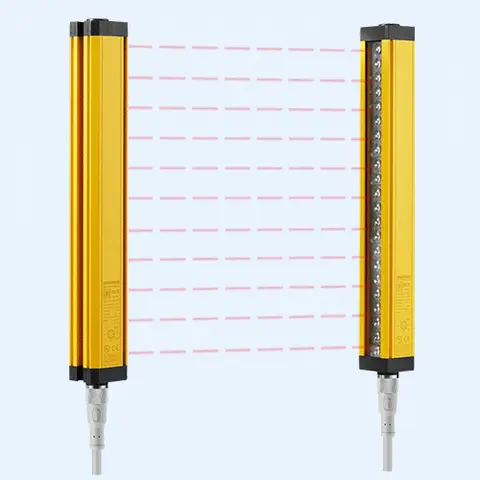
DCE Automation Safety Light Curtain
Compact through-beam safety light curtain in a 30 x 30 mm housing: 10/20/30/40 mm beam pitch, up to 72 beams, 0.3-3 m or 0.3-6 m sensing distance, NPN/PNP output. Catalogue-stated Type 4 design basis; confirm exact safety-document scope.
DDB Industrial Custom Safety Edges
Custom dual-output range with five standard DDB sections and six adhesive DDBT section options.