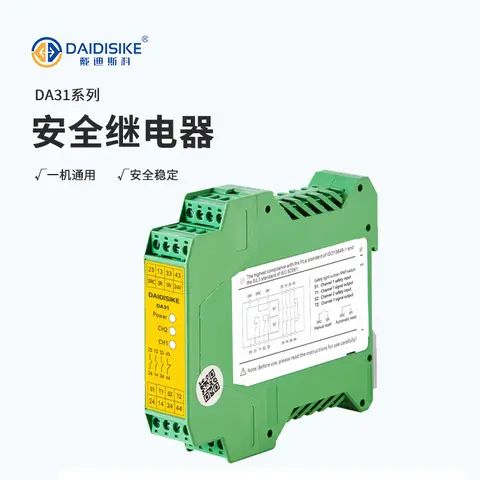
DQSRN Safety Relay Module
22.5 mm DIN-rail safety relay: dual-channel monitoring, manual or automatic reset, 3NO+1NC contacts and release response under 30 ms.
 🔍 Click to enlarge · 1/2
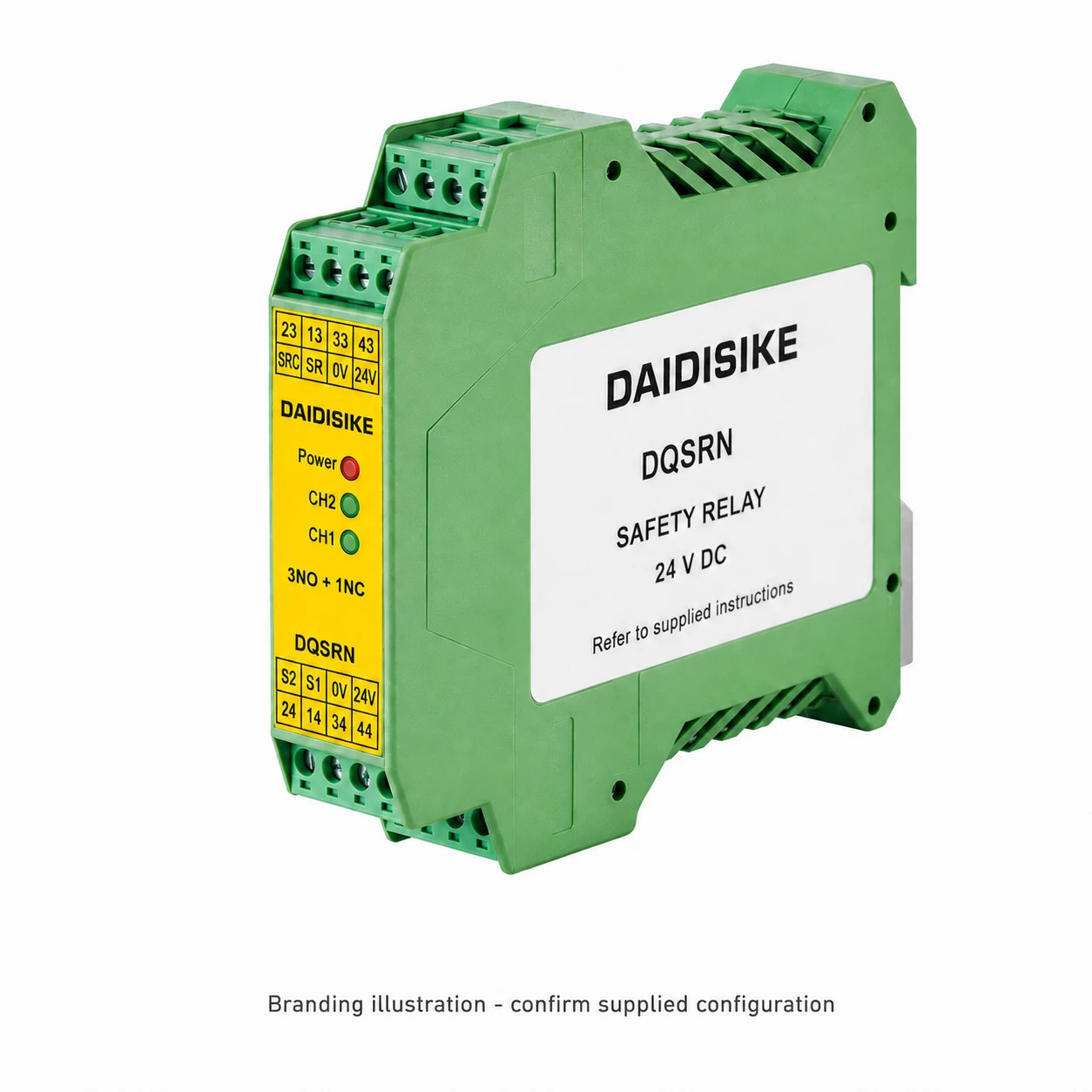
ℹ DAIDISIKE model selection: DQSRN for NPN-compatible inputs; DQSRP for PNP-compatible inputs. Order the matching model; these are not field-switchable input settings. The product image is an AI-assisted DQSRN branding illustration adapted from the supplied reference photograph, not a photograph of a shipped label or a wiring instruction. The dimension illustration is an outline reference. Confirm the exact supplied unit, wiring drawing and installation clearances before final panel design.
Technical Specifications
| Monitored input | DQSRN: NPN-compatible dual-channel monitored input. DQSRP: PNP-compatible dual-channel monitored input. Choose the matching model; these are not simultaneous or field-switchable modes. Two N.C. switch signals require the prescribed peripheral circuit. Exact wiring must match the supplied model. |
|---|---|
| Safety rating | Manufacturer-stated Category 4 / PL e per EN ISO 13849-1 and SIL 3 per IEC 61508; applicable certification scope and complete-circuit validation required. |
| Output contacts | 3 N.O. + 1 N.C., forcibly guided (positively driven) contacts |
| Contact material | AgSnO2 + 0.2 µm gold plating |
| Contact rating | AC-1 6A/250VAC; AC-15 4A/240VAC; 6A/24VDC and 4A/24VDC in the table's DG-1/DG-13 rows (utilization labels require clarification). Maximum 12A distributed across all safety output contacts, not per contact. |
| Minimum load | 10 mA / 5 V |
| Release response time | < 30 ms from input to output, per the confirmed technical parameter table; not total machine stopping time. |
| Supply voltage | DC24V (+10%/-20%) |
| Power consumption | 2.9 W |
| Housing / mounting | 117 x 100 x 22.5 mm overall dimensions; 22.5 mm DIN-rail width, confirmed by parameter table and dimension drawing. |
| Protection rating | Housing IP30; terminals IP20. The instructions recommend installation in an IP54 cabinet or enclosure. IP54 is not the relay's own rating. |
| Reset and EDM scope | Manual or automatic reset supported according to the confirmed instructions. External device monitoring (EDM) is not claimed. |
Overview
DQSRN is DAIDISIKE's DIN-rail safety monitoring relay for a compatible dual-channel safety input. The current confirmed manufacturer instructions describe monitoring transistor signals from safety light curtains and monitoring two normally-closed switch signals with the specified peripheral circuit. A safety demand releases its forcibly guided relay contacts; the complete circuit must be designed and validated to stop the hazardous motion.
DQSRN supports manual or automatic reset according to the confirmed instructions. Choose and validate the reset arrangement for the application; this page does not claim external device monitoring (EDM). The confirmed dimensions are 117 x 100 x 22.5 mm, with a release response time below 30 ms from input to output. The manufacturer states Category 4 / PL e and SIL 3; obtain the applicable certification scope and validate the complete safety function before specifying an achieved system rating.
Features & Benefits
Dual-channel safety signal monitoring
The current instructions describe two-channel transistor signal monitoring and monitoring of two N.C. switch signals with the prescribed peripheral circuit. Confirm signal polarity, device compatibility and the supplied wiring diagram before connecting an E-stop, light curtain or door interlock.
Manufacturer-stated Cat.4 / PL e / SIL 3 design scope
These are the manufacturer's stated relay ratings, not a substitute for the applicable certificate or a guarantee that every connected machine circuit achieves the same rating. Request the exact model's documentation and validate the complete safety function.
3 N.O. safety contacts + 1 N.C. auxiliary contact, forcibly guided design
Three normally-open relay contacts and one normally-closed contact are provided in a forcibly guided contact assembly. Use each contact only within the approved circuit and load ratings. A relay status contact or internal self-test does not establish external device monitoring (EDM), which is not claimed here.
AgSnO2 gold-plated contacts cover power-level and signal-level switching
The confirmed parameter table lists AgSnO2 with 0.2 µm gold plating, AC-15 4A/240VAC and a 10 mA/5 V minimum load. Check the applicable utilization category, external fuse and total simultaneous contact load; the listed 12A aggregate limit is not available on every contact individually.
Documented release response under 30 ms
The parameter table specifies release response below 30 ms from input to output. Use this as the relay contribution when assessing the whole safety chain; sensor, controller, actuator and machine stopping times also matter. A different response label in a product photograph is not a basis for claiming a faster release time.
22.5 mm DIN-rail width and 24V DC supply
The confirmed parameter table and dimension drawing give 117 x 100 x 22.5 mm. Supply is 24V DC (+10%/-20%) at 2.9 W. The housing is IP30 and terminals IP20; the instructions recommend an IP54 installation cabinet or enclosure, not a claim that the relay itself is IP54.
Compatible controller option for DAIDISIKE's passive safety devices
DQSRN is listed in the DQSA passive safety light curtain catalog as one of several compatible controllers, and JT14 safety mats (a passive dry-contact device) are documented as requiring connection to a safety relay such as DQSRN.
Applications
Models & Ordering Information
DQSRN / DQSRP safety relay models
PDF & 3D CAD Downloads
Browse all downloadsDQSRN / DQSRP Safety Relay User Manual
DQSRN: NPN-compatible input. DQSRP: PNP-compatible input. The PNP light-curtain wiring example applies to DQSRP only; use the drawing for your ordered model. Confirm the supplied revision and ratings before installation.
Confirm the document and CAD file match the exact ordered version before installation or mechanical design. Contact us if your model is not listed.
How to Select
- For a transistor-type safety device signal, order DQSRN for NPN-compatible inputs or DQSRP for PNP-compatible inputs. These are two model choices, not two interchangeable settings on one unit. Confirm the device's dual-channel arrangement and the matching supplied wiring diagram.
- For a normally-closed switch-type safety device, such as a mechanical safety door interlock switch, confirm a compatible DQSRN input configuration and the prescribed peripheral circuit for the two N.C. switch signals. This is not a separately established third order variant.
- If two-hand control is required, obtain explicit confirmation of a suitable function and circuit. Do not select DQSRN as a two-hand controller from a catalogue model label alone.
- Specify manual or automatic reset and validate that arrangement for the application. If the design requires EDM, obtain a documented solution; EDM is not claimed for DQSRN here.
- All documented versions operate on DC24V supply, so power-supply selection is compatible with standard PLC/relay-cabinet 24V sources.
- Use the confirmed parameter table for 117 x 100 x 22.5 mm dimensions, release response below 30 ms and IP30 housing/IP20 terminals. Confirm any requirement based on the photograph's different response or IP label before ordering; do not substitute those labels for the table's ratings.
📘 Need the full method? How to Choose a Safety Door Switch / Interlock
When NOT to specify the DQSRN — and what to use instead
Needing a device that itself senses a light-curtain beam break, e-stop pull, or door position
Why not: DQSRN is a downstream relay module that monitors a compatible dual-channel signal from an existing safety device; it does not itself detect an object or door position.
Use instead: Pair DQSRN with a DAIDISIKE light curtain (DQC/DQA/DQT/DQT4), a DX safety door lock, or an e-stop pushbutton wired to its input
The installation cannot accommodate the confirmed enclosure and wiring clearances
Why not: DQSRN measures 117 x 100 x 22.5 mm. Cabinet design must also leave the clearances and access needed for wiring and maintenance; width alone is not the full installation envelope.
Use instead: Check the current dimension drawing against the cabinet layout and obtain an alternative verified form factor if it does not fit.
Two-hand control device monitoring is the only function needed and a dedicated single-purpose module is preferred
Why not: The current instructions do not establish a dedicated two-hand control function or its required timing behavior. A related model name is not enough to confirm this function.
Use instead: Request a controller explicitly documented for the required two-hand safety function.
The specification requires a faster release time or a higher relay enclosure rating than the technical table
Why not: The confirmed table specifies release below 30 ms, housing IP30 and terminals IP20. A photograph contains a differently labelled response value and IP50, but its version and test conditions are not reconciled with the table.
Use instead: Obtain written confirmation for the exact shipped unit before relying on any faster response or higher enclosure rating; use the parameter-table figures for current selection.
The connected safety input device has its own PL or Category rating lower than Cat.4/PLe
Why not: Cat.4/PL e/SIL 3 are manufacturer-stated relay claims whose applicable certificate scope must be verified. They do not establish the achieved rating of the complete safety function, which depends on its architecture, component data, diagnostics and validation, not the relay label alone.
Use instead: Verify the PL/Category of every component in the safety chain before assuming the system reaches Cat.4/PLe
Specifications we do not publish yet
We only publish a figure once we are confident it is true. The items below are still being validated through further testing and real-world customer feedback, so for now we would rather leave them open than guess. If one of them matters to your design, ask us for the latest validated status.
- The confirmed technical table supports AgSnO2 + 0.2 µm gold plating and its AC ratings. The DC utilization rows are printed DG-1/DG-13; confirm the intended category labels and application load conditions rather than silently correcting them.
- The parameter table specifies release response <30 ms from input to output; the first-page photograph says Response Time <10 ms. The labels, version and test conditions are not reconciled, so the photograph is not used as a faster release specification.
- The parameter table specifies housing IP30 and terminals IP20, recommending an IP54 cabinet/enclosure. The first-page photograph says IP50; its version/applicability remains to be reconciled and is not a general product claim.
- Closed clarification: the current manufacturer instructions apply to the supplied DQSRN hardware. Dimensions are confirmed as 117 x 100 x 22.5 mm by the table and dimension drawing; the earlier 45 mm claim is superseded.
- Closed clarification: manual and automatic reset are supported according to the current confirmed instructions. This supersedes the earlier no-reset statement. EDM is not claimed.
- The table lists 80,000 electrical operations and an operating range of -25 to +85 degrees C, while the product photograph has a narrower environment label. Confirm duty, load and shipped-version applicability before using these as application limits.
- Certificate numbers and issuing body for the stated Cat.4/PLe/SIL3 rating
- Latest confirmed model mapping: DQSRN is the NPN-compatible model and DQSRP is the PNP-compatible model. This supersedes the earlier statement that both configurations used only the DQSRN name. The manual's PNP light-curtain example applies to DQSRP and is not a universal NPN/PNP wiring instruction. The exact supplied terminal drawing and N.C.-switch peripheral circuit must be confirmed; four DIP-selectable modes and a dedicated two-hand function are not established.
Frequently Asked Questions
Which model should I order for NPN or PNP safety input signals?
What safety input devices can DQSRN monitor?
What safety category and performance level is DQSRN rated for?
What is the output contact configuration?
What contact material does DQSRN use, and what loads can it switch?
What release response time is specified for DQSRN?
What power supply does DQSRN require?
Can DQSRN be used with DAIDISIKE's passive safety light curtains or safety mats?
What mounting format does DQSRN use?
Does DQSRN support manual reset, automatic reset and EDM?
What certifications does DQSRN carry?
Related Categories and Example Products
Explore other functions that may be needed in a machine or line. The products below are category examples, not pre-validated electrical or safety combinations. Confirm each interface and application separately: Safety Light Curtains · Safety Door Locks & Switches · Safety Mats
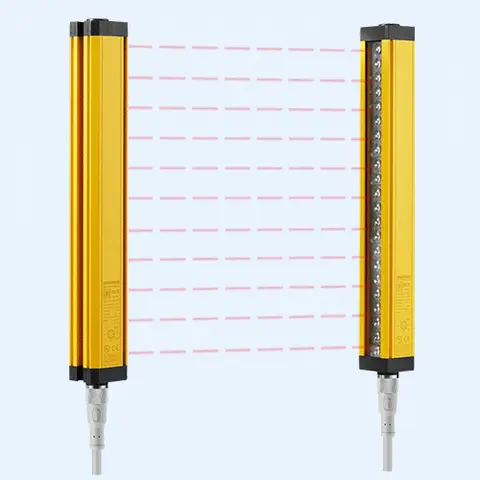
DCE Automation Safety Light Curtain
Compact through-beam safety light curtain in a 30 x 30 mm housing: 10/20/30/40 mm beam pitch, up to 72 beams, 0.3-3 m or 0.3-6 m sensing distance, NPN/PNP output. Catalogue-stated Type 4 design basis; confirm exact safety-document scope.
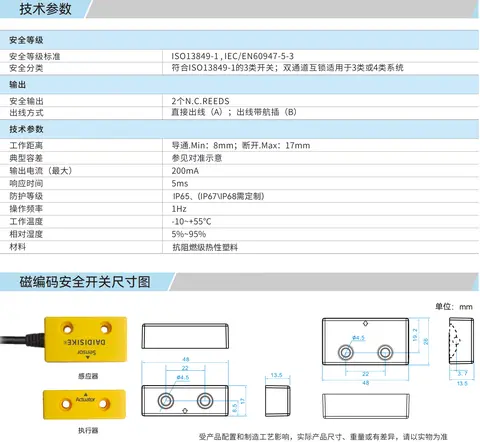
DX-C1 Magnetic Coded Safety Switch
Non-contact coded-magnet safety switch with 17 mm sensing range and high misalignment tolerance for guard doors.
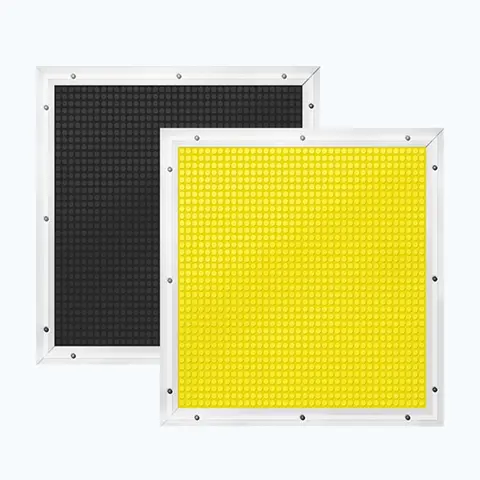
JT14 Safety Mat (Economical)
Economical pressure-sensitive safety mat with volt-free N.O. output for large-area or custom-shape floor guarding.