
DQSA Area Protection Light Curtain
One emitter/receiver pair and passive mirrors fold the beam around 2-4 sides of a danger zone -- built to a Category 4 / Type 4 design basis (IEC 61496-1/2, EN 61496-3:2019, EN ISO 13849-1:2015 Cat 4 PLd); certification documents available on request.
▶ Watch it in action: Robot Cell Perimeter Guarding with Infrared Safety Light Curtains
 🔍 Click to enlarge · 1/26
Technical Specifications
| Curtain Type | Mirror-reflection area/perimeter guard -- one emitter, one receiver, and 1-3 passive deflection mirrors forming a 2/3/4-sided protected zone |
|---|---|
| Safety Design Basis | Catalog states the safety-rating requirements of IEC 61496-1/2, EN 61496-3:2019 Type 4, and EN ISO 13849-1:2015 Category 4 PLd, citing TUV and UL certification and a GB/T19001-2016 (idt ISO 9001:2015) quality-management-system certification -- design/test basis only, not a certification claim by us. Certification documents are available on request. (The ISO 9001-equivalent certification concerns the manufacturer's quality management system, not a product safety certification.) |
| Beam Spacing | 40 / 80 mm |
| Number of Beams | 4 to 72 (40 mm pitch); 4 to 50 (80 mm pitch), step of 2 |
| Protection Height (H) | 120-2840 mm (40 mm pitch, H = 40 x (beam count - 1)); 240-3920 mm (80 mm pitch, H = 80 x (beam count - 1)) |
| Maximum Protected Distance | Single face (no mirrors): <= 40 m. Two-face: <= 20 m. Three-face: <= 15 m. Four-face: <= 12 m |
| Mirror Faces | 2, 3, or 4, selectable |
| Positioning Aid | Visible laser positioning aid, for alignment on long-range or multi-face installations |
| Response Time | < 15 ms, including controller |
| Output | Order-code transistor output: A = NPN normally closed, B = PNP normally closed, C = NPN normally open, D = PNP normally open; or J = relay output (AC250V 5A contact rating). Catalog separately states dual-channel NPN or PNP output is available, with the user responsible for ensuring the downstream machine control circuit is safety-reliable. |
| Supply Voltage | AC220V/110V (50/60 Hz) or DC24V (voltage tolerance printed incompletely in the catalog as '±%50/60Hz' -- confirm exact tolerance with factory) |
| Power Consumption | <= 15 W |
| Operating Temperature | -10 to +50 degrees C |
| Ambient Conditions | 20 degrees C reference, RH <= 85% |
| Insulation Resistance | > 100 megohms |
| Dielectric Strength | AC150V, 60s (as printed in the catalog; this figure reads low for a typical light-curtain withstand-voltage test -- confirm with factory) |
| Ambient Light Immunity | 10,000 lux at incidence angle > 5 degrees |
| Relay Life | > 1,000,000 cycles, replaceable |
| Connection | Optional aviation connector with M12 cable |
| Construction | Surface-mount (SMD) electronics per catalog, stated to improve shock resistance; 'well-known brand components' used throughout |
| Mounting Accessories | Floor-stand columns DQSA-01 / DQSA-02 (adjustable height 300-3000 mm); reflector/bracket selection by model-code bracket letter (L = floor-stand reflector, T = tube-mount simplified reflector) |
| Order Code Structure | DQSA{beam count}/{spacing}-{height} {output: A/B/C/D/J} {controller position: W external / N internal, blank = N} {mirror faces: 2/3/4} {bracket: L/T} |
Overview
DQSA is an area/perimeter-guarding light curtain built around a mirror-reflection principle: one emitter and one receiver are installed on adjacent sides of a guarded area, and passive (unpowered) deflection mirrors on the remaining sides fold the beam path around the perimeter, forming a 2, 3 or 4-sided protected zone. The catalog states its design basis as the safety-rating requirements of IEC 61496-1/2, EN 61496-3:2019 Type 4, and EN ISO 13849-1:2015 Category 4 PLd, citing TUV and UL certification and a GB/T19001-2016 (idt ISO 9001:2015) quality-management-system certification for the manufacturer. These are stated as the design/test basis; certification documents are available on request.
Maximum protected distance is capped by how many sides are folded: up to 40 m for a single face with no mirrors, 20 m for two faces, 15 m for three faces, and 12 m for four faces, per the catalog's own diagrams. It is available in 40 mm or 80 mm beam spacing, with beam counts from 04 to 72 axes and protection heights from 120 mm up to 3920 mm depending on model, and includes a visible laser positioning aid to speed alignment on long-range or multi-face installations.
Output can be ordered as NPN/PNP transistor (normally open or closed, selected by order code) or a relay contact (AC250V 5A); the catalog explicitly notes that with transistor output, the user must ensure the downstream machine control circuit is safety-reliable. An optional aviation connector with M12 cable is available for simplified wiring, and the catalog states the electronics use surface-mount (SMD) construction for shock resistance.
Features & Benefits
One pair, multiple sides
Guard two, three or four sides of a work cell with a single emitter/receiver pair and 1-3 passive deflection mirrors, instead of one curtain pair per side. The mirrors need no power and no cabling, so hardware cost, wiring labor and PLC input-point count all drop compared with fencing every side individually.
Two beam-spacing options
40mm spacing is suited to arm/limb detection, 80mm to body detection, so perimeter guarding can be specified to the resolution required by the risk assessment rather than over- or under-specifying.
Direct transistor or relay output, controller position selectable
The order code selects NPN/PNP transistor output (normally open or closed) or a relay output (AC250V 5A) directly, plus whether the controller sits internally (N, the default) or externally (W). The catalog's separate controller/accessory list (DQCA, DQET, DQCA2, DQSN, DQSRN, DQSWS) names other DAIDISIKE curtain series as compatible rather than DQSA explicitly, so exact controller compatibility for DQSA should be confirmed with the factory before ordering.
Wide beam-count range
Available from 04 to 72 beam axes, with protection heights from 120mm up to 3920mm depending on model, letting one product family scale from a small material-transfer opening to a full-height cell perimeter.
Complete off-the-shelf mounting system
Floor-stand columns (DQSA-01, DQSA-02), tube-mount kits (DQSA-07), side and front right-angle brackets (DQSA-08, DQSA-09), mirror columns (DQSA-10) and an external controller mounting bracket (DQCA-06) are all available, so a floor-standing perimeter guard can be assembled without custom brackets.
Structured ordering code
The full order code (DQSA{beams}/{spacing}-{height} plus output letter A/B/C/D or relay J, controller location W external or N internal, mirror-face count 2/3/4, and bracket type L or T) lets a buyer specify the exact configuration in one part number.
Applications
Models & Ordering Information
59 listed table entries across 2 beam-pitch options. Compare beam count and span, then confirm the complete ordering code. Beam pitch alone does not establish detection capability or suitability for personnel protection.
Protection height 120mm-2840mm. Full table (beams/H/curtain height l/mirror height J): 4/120/201/351, 6/200/281/431, 8/280/361/511, 10/360/441/591, 12/440/521/671, 14/520/601/751, 16/600/681/831, 18/680/761/911, 20/760/841/991, 22/840/921/1071, 24/920/1001/1151 ... 68/2680/2761/2911, 70/2760/2840/2991, 72/2840/2921/3071. Naming rule: DQSA + beam count + "/" + spacing(mm) + "-" + protection height(mm).
| Listed model entry | Beam pitch K (mm) | Number of beams N | Beam span H (mm) |
|---|---|---|---|
| DQSA04/40-120 | 40 | 4 | 120 |
| DQSA06/40-200 | 40 | 6 | 200 |
| DQSA08/40-280 | 40 | 8 | 280 |
| DQSA10/40-360 | 40 | 10 | 360 |
| DQSA12/40-440 | 40 | 12 | 440 |
| DQSA14/40-520 | 40 | 14 | 520 |
| DQSA16/40-600 | 40 | 16 | 600 |
| DQSA18/40-680 | 40 | 18 | 680 |
| DQSA20/40-760 | 40 | 20 | 760 |
| DQSA22/40-840 | 40 | 22 | 840 |
| DQSA24/40-920 | 40 | 24 | 920 |
| DQSA26/40-1000 | 40 | 26 | 1000 |
| DQSA28/40-1080 | 40 | 28 | 1080 |
| DQSA30/40-1160 | 40 | 30 | 1160 |
| DQSA32/40-1240 | 40 | 32 | 1240 |
| DQSA34/40-1320 | 40 | 34 | 1320 |
| DQSA36/40-1400 | 40 | 36 | 1400 |
| DQSA38/40-1480 | 40 | 38 | 1480 |
| DQSA40/40-1560 | 40 | 40 | 1560 |
| DQSA42/40-1640 | 40 | 42 | 1640 |
| DQSA44/40-1720 | 40 | 44 | 1720 |
| DQSA46/40-1800 | 40 | 46 | 1800 |
| DQSA48/40-1880 | 40 | 48 | 1880 |
| DQSA50/40-1960 | 40 | 50 | 1960 |
| DQSA52/40-2040 | 40 | 52 | 2040 |
| DQSA54/40-2120 | 40 | 54 | 2120 |
| DQSA56/40-2200 | 40 | 56 | 2200 |
| DQSA58/40-2280 | 40 | 58 | 2280 |
| DQSA60/40-2360 | 40 | 60 | 2360 |
| DQSA62/40-2440 | 40 | 62 | 2440 |
| DQSA64/40-2520 | 40 | 64 | 2520 |
| DQSA66/40-2600 | 40 | 66 | 2600 |
| DQSA68/40-2680 | 40 | 68 | 2680 |
| DQSA70/40-2760 | 40 | 70 | 2760 |
| DQSA72/40-2840 | 40 | 72 | 2840 |
| Listed model entry | Beam pitch K (mm) | Number of beams N | Beam span H (mm) |
|---|---|---|---|
| DQSA04/80-240 | 80 | 4 | 240 |
| DQSA06/80-400 | 80 | 6 | 400 |
| DQSA08/80-560 | 80 | 8 | 560 |
| DQSA10/80-720 | 80 | 10 | 720 |
| DQSA12/80-880 | 80 | 12 | 880 |
| DQSA14/80-1040 | 80 | 14 | 1040 |
| DQSA16/80-1200 | 80 | 16 | 1200 |
| DQSA18/80-1360 | 80 | 18 | 1360 |
| DQSA20/80-1520 | 80 | 20 | 1520 |
| DQSA22/80-1680 | 80 | 22 | 1680 |
| DQSA24/80-1840 | 80 | 24 | 1840 |
| DQSA26/80-2000 | 80 | 26 | 2000 |
| DQSA28/80-2160 | 80 | 28 | 2160 |
| DQSA30/80-2320 | 80 | 30 | 2320 |
| DQSA32/80-2480 | 80 | 32 | 2480 |
| DQSA34/80-2640 | 80 | 34 | 2640 |
| DQSA36/80-2800 | 80 | 36 | 2800 |
| DQSA38/80-2960 | 80 | 38 | 2960 |
| DQSA40/80-3120 | 80 | 40 | 3120 |
| DQSA42/80-3280 | 80 | 42 | 3280 |
| DQSA44/80-3440 | 80 | 44 | 3440 |
| DQSA46/80-3600 | 80 | 46 | 3600 |
| DQSA48/80-3760 | 80 | 48 | 3760 |
| DQSA50/80-3920 | 80 | 50 | 3920 |
35 listed entries at 40 mm pitch · 59 across this table. Beam span is calculated as H = (N − 1) × K; it is not overall housing length or proof of detection capability. Some entries expand catalogue ranges. Confirm the complete ordering code and availability before ordering; inclusion is not a stock claim.
How to read the DQSA model code
Matched controllers
Mounting accessories
Cables & connectors
PDF & 3D CAD Downloads
Browse all downloadsDQSA Area Protection Light Curtain Technical Data Sheet
DQSA Area Protection Light Curtain User Manual
Find the file for your exact model
Open the download center with this series selected. Search the full model, check the file details, and download the matching CAD file.
Confirm the document and CAD file match the exact ordered version before installation or mechanical design. Contact us if your model is not listed.
How to Select
- Choose beam spacing by required detection resolution: 40mm for arm/limb-level detection, 80mm for body-level detection, based on the risk assessment of the guarded area.
- Choose the beam count and model by protection height: the 40mm-spacing series runs from DQSA04/40-120 to DQSA72/40-2840 (120mm-2840mm protection height, beams 04-72); the 80mm-spacing series runs from DQSA04/80-240 to DQSA50/80-3920 (240mm-3920mm protection height, beams 04-50).
- Choose the mirror-face count (2/3/4, via DQSA-10 mirror/reflector) and mounting brackets by the number of sides to be guarded: DQSA-01/02 floor-stand columns with L-type brackets for floor-mounted reflectors, or DQSA-07 tube-mount kits with T-type brackets for simplified installation; DQSA-08 side and DQSA-09 front right-angle brackets are available for corner mounting.
- Choose output type (A/B/C/D transistor NPN/PNP, or J relay) and controller position (W external or N internal, default) directly in the order code; confirm with the factory which of DQCA/DQET/DQCA2/DQSN/DQSRN/DQSWS is the intended matched controller for your specific DQSA configuration, since the accessories list's own descriptions name other DAIDISIKE series rather than DQSA explicitly.
- Specify the full order code in one string: DQSA{beam count}/{spacing}-{height} {output type A/B/C/D/relay J} {controller location W/N} {mirror-face count 2/3/4} {bracket type L/T}.
- Select matching cables and connectors (e.g. DQSN5xx/DQA5xx, DQSW5xx, DQC5xx, DQT70x/DQE70x series) based on installation distance and connection type.
📘 Need the full method? How to Choose a Safety Light Curtain · Type 2 vs Type 4 Safety Light Curtains
When NOT to specify the DQSA — and what to use instead
A single straight-line opening needs guarding, not a multi-sided perimeter
Why not: DQSA's mirror-reflection design exists specifically to fold one beam path around 2-4 sides; for a single opening it adds mirror-alignment complexity with no benefit over a direct through-beam curtain.
Use instead: A standard single-pair safety light curtain such as DQC (general-purpose) or DQA (long-range).
The risk assessment calls for finer than 40 mm resolution (e.g., true finger detection)
Why not: DQSA's finest beam spacing is 40 mm, which the catalog positions for arm/limb-level detection; 80 mm is body-level only. Neither is a finger-detection resolution.
Use instead: DQC or DQA at a 10-25 mm pitch for finger/hand-level detection requirements.
The downstream machine control circuit has not been verified as safety-rated
Why not: The catalog explicitly states that with dual NPN/PNP transistor output, the user must ensure the downstream control circuit is safety-reliable -- DQSA's transistor output alone does not guarantee a safe machine stop.
Use instead: Route the output through a safety-rated relay such as DA31 or DQSRN (certification documents available on request) before it reaches the machine's final switching elements.
You require documented PFHd/MTTFd/DCavg figures for an ISO 13849-1 machine-level calculation today
Why not: The catalog states the Category 4 / PLd design basis and cites IEC 61496-1/2 and EN 61496-3:2019 Type 4, but does not publish PFHd, MTTFd or DCavg numbers on these pages.
Use instead: Request the certification documents and safety datasheet from the factory before finalizing an ISO 13849-1 machine risk calculation.
Mirror faces would be exposed to heavy vibration, frequent knocks, or a misalignment-prone mounting surface
Why not: The passive mirrors must stay precisely aligned with the emitter/receiver; the catalog's visible laser positioning aid exists specifically because alignment on long-range or multi-face installs is a known difficulty.
Use instead: A direct through-beam safety curtain pair per side (no mirrors) where vibration or knock risk is high, or add the visible laser aid and verify alignment stability during commissioning.
The perimeter exceeds the catalog's stated maximum protected distance for the chosen face count
Why not: Maximum protected distance is capped by face count: <= 40 m single face, <= 20 m two-face, <= 15 m three-face, <= 12 m four-face, per the catalog.
Use instead: Reduce the face count, split the zone into two DQSA sets, or confirm an extended-range configuration with the factory.
Specifications we do not publish yet
We only publish a figure once we are confident it is true. The items below are still being validated through further testing and real-world customer feedback, so for now we would rather leave them open than guess. If one of them matters to your design, ask us for the latest validated status.
- PFHd, MTTFd and DCavg figures for a full ISO 13849-1 Category 4 / PLd machine-level calculation are not published on these pages; the catalog states the category but not these supporting numbers.
- TUV and UL certificate numbers and their exact scope (which DQSA configurations they cover) are not given on these pages. Certification documents are available on request.
- Supply-voltage tolerance — the printed figure is incomplete; ask us for the confirmed value
- Dielectric-strength (withstand-voltage) test figure — ask us for the confirmed value before compliance testing
- Whether the DQCA/DQET/DQCA2/DQSN/DQSRN cabinet controllers and the DQSA-07/DQSA-10 mounting/reflector accessories are confirmed-compatible with DQSA specifically is unclear: their catalog descriptions name 'DQS', 'DQC', 'DQA', 'DQE', 'DQT', 'DQV' rather than 'DQSA' explicitly, even though the accessory model numbers (DQSA-07, DQSA-10) carry the DQSA prefix.
- GB/T19001-2016 idt ISO 9001:2015 is a quality-management-system certificate for the manufacturer, not a product safety certification; whether a separate product-specific safety certificate exists needs confirming
- Exact aviation-connector pinout and part numbers for the optional M12 connection are not itemized on these pages.
Frequently Asked Questions
What is the difference between DQSA and a standard single-pair safety light curtain?
Does DQSA output a usable signal on its own?
What beam spacing options are available and how do I choose?
How many mirror faces can DQSA use?
Can DQSA switch a high-power load directly without a separate relay?
What beam counts and protection heights are available?
What mounting accessories are available for a free-standing installation?
Does the DQSA order code specify the full configuration?
Is DQSA suitable for a single-entry access opening instead of a perimeter?
Can you provide safety certification documents for DQSA?
Related Categories and Example Products
Explore other functions that may be needed in a machine or line. The products below are category examples, not pre-validated electrical or safety combinations. Confirm each interface and application separately: Safety Relays · Safety Door Locks & Switches · Press & Press Brake Protection
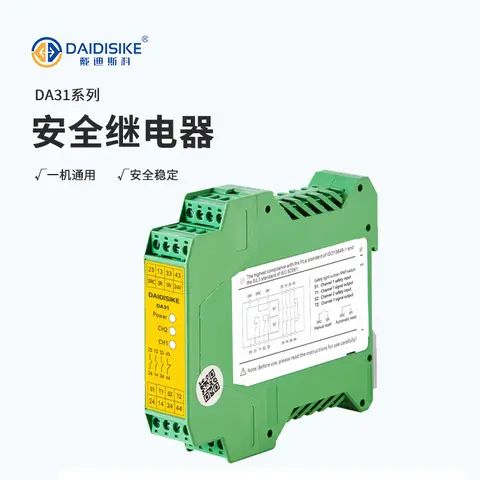
DA31 Emergency-Stop Safety Relay Module
Ultra-slim 22.6 mm Category 4/PL e/SIL 3 safety relay with dual-channel PNP/NPN input and a solid-state status output.
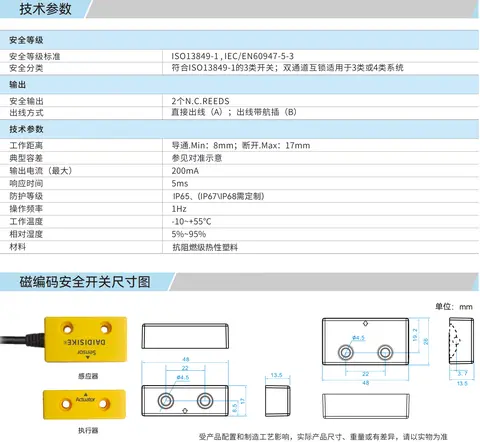
DX-C1 Magnetic Coded Safety Switch
Non-contact coded-magnet safety switch with 17 mm sensing range and high misalignment tolerance for guard doors.
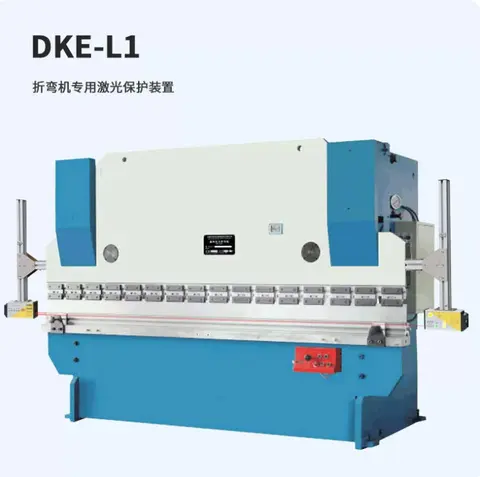
DKE-L3 Press Brake Laser Protection
Ram-mounted laser guarding that tracks the punch tip on press brakes and shears without blocking hand-fed work.
Related Products in Safety Light Curtains
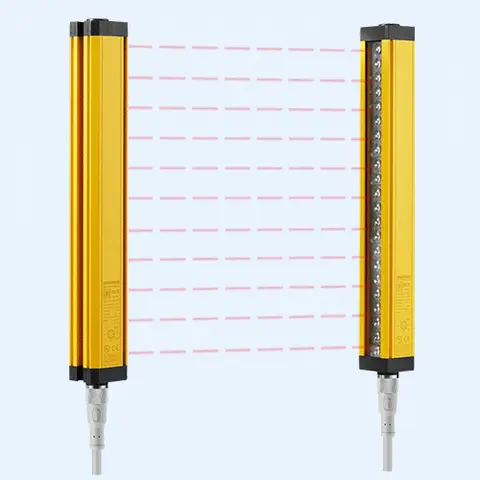
DCE Automation Safety Light Curtain
Compact through-beam safety light curtain in a 30 x 30 mm housing: 10/20/30/40 mm beam pitch, up to 72 beams, 0.3-3 m or 0.3-6 m sensing distance, NPN/PNP output. Catalogue-stated Type 4 design basis; confirm exact safety-document scope.
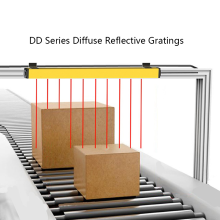
DD / DDOF Single-Sided Area Light Curtain
One housing, no far-side receiver: order DD for diffuse sensing to 2000 mm, or DDOF for per-beam TOF ranging to 4000 mm with zero dead zone and one-key distance teaching. 48 standard models, 4-50 beams.
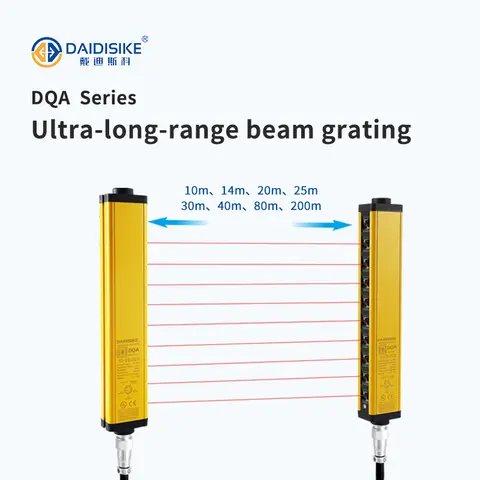
DQA Long-distance Safety Light Curtain
Long-range through-beam safety light curtain for large presses, hydraulic and shearing machines: a transmitter/receiver pair spanning up to 40 m, in 8 beam pitches from 10 to 200 mm, with NPN, PNP or relay output and a selectable single- or dual-output signal. Designed to the Type 4 architecture of IEC 61496 and Category 4 of ISO 13849-1.
DQB Ultra-thin (Side-emitting) Safety Light Curtain
Ultra-thin side-emitting safety light curtain with a 15 x 30 mm cross-section for gaps too narrow for standard units.