
DKE-L3 Press Brake Laser Protection
Ram-mounted laser guarding that tracks the punch tip on press brakes and shears without blocking hand-fed work.
▶ Watch it in action: Punch Press Infrared Guarding — Light Curtain Stopping the Stroke in Real Time
 🔍 Click to enlarge · 1/14
Technical Specifications
| Model | DKE-L3 |
|---|---|
| Protection principle | Three laser beams (E1/E2/E3); beam E1 set 3 mm below the punch tip |
| Protection range (transmitter-receiver max distance) | Up to 15 m |
| Resolution | 10 mm |
| Response time | 5 ms |
| Light source | Infrared, approximately 780 nm, Class 1 laser |
| Beam height | 4.5 mm (adjustable within 15 mm) |
| Operating modes | 3 modes (including box bending mode; guard on/off switch) |
| Operating voltage | +12-24VDC (range 12-26V) |
| Transmitter connector | 9-pin aviation connector |
| Receiver connector | 15-pin aviation connector |
| Protection rating | IP65 |
| Output - FA (fast approach enable) | Pin 7, high level |
| Output - OSSD2 | Pin 8, high level |
| Output - OSSD1 | Pin 9, high level |
| Input - Foot switch | Pin 4, high-level active |
| Input - Slow speed 1 | Pin 5, high-level active |
| Input - Slow speed 2 | Pin 6, high-level active |
| Communication interfaces | No RS485, RS232, or analog output |
Overview
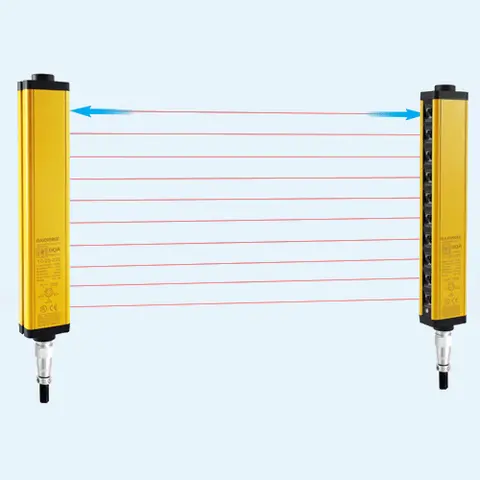
DKE-L3 is a laser-based Active Opto-electronic Protective Device (AOPD) purpose-built for press brakes and guillotine shears, where a conventional area-type safety light curtain is impractical because the operator must hold and feed the workpiece close to the die. The system consists of a transmitter and a receiver, both mounted to move with the ram, projecting three laser beams (E1/E2/E3) that track the tool tip as it descends.
It is intended for press brake OEMs building new machines and for workshops retrofitting existing hydraulic or electro-hydraulic press brakes and shears to add point-of-operation guarding. Beam E1 is set just 3 mm below the punch tip, the system responds in 5 ms with 10 mm resolution, and it covers up to 15 m between transmitter and receiver on a wide 12-24 VDC supply with an IP65-rated housing.
Features & Benefits
Point-of-operation guarding that moves with the ram, not a fixed curtain
Three laser beams (E1/E2/E3) are mounted beside the ram and descend with it; beam E1 is set just 3 mm below the punch tip, so the protective band always sits at the actual danger point. Because the beams track the tool rather than covering a fixed area, operators can still support and feed the workpiece close to the die.
Dedicated FA (fast approach) output for high-speed closing without sacrificing safety
Receiver pin 7 outputs FA (high level) whenever the protective field is clear, permitting the ram to close at high speed; the moment a beam is obstructed, the FA signal is withdrawn and the machine must stop or continue only at a selectable safe slow speed via pins 5/6.
Dual OSSD safety outputs for standard safety-circuit integration
Receiver pins 8 and 9 provide OSSD2 and OSSD1 respectively (both high-level active), giving the CNC or hydraulic safety circuit a dual-channel interface.
5 ms response time and 10 mm resolution for finger-level detection
The system is rated at 5 ms response and 10 mm resolution, fine enough to detect a finger-sized object during the closing stroke.
Box/tray bending mode keeps guarding active on flanged workpieces
When bending box-shaped or flanged parts, the rising side walls would normally block the side beams; DKE-L3 includes a dedicated box bending mode (one of three operating modes) plus a guard on/off switch, so operators are not forced to bypass protection to keep working.
Eye-safe Class 1 infrared laser (~780 nm)
The beams use a Class 1 infrared laser source at approximately 780 nm, the lowest laser hazard classification, requiring no additional laser safety measures or eyewear on the shop floor.
Up to 15 m transmitter-to-receiver range
A single system spans up to 15 m between transmitter and receiver, covering long press brakes and guillotine shears.
Thin, adjustable beam profile for tooling changes
The beam height is 4.5 mm and can be adjusted within a 15 mm window, allowing the guard band to be re-set close to the punch tip after a tool change.
Wide-range 12-24 VDC supply, IP65 housing, integrated foot-switch input
The system runs on 12-24 VDC (tolerant 12-26 V), the housing is IP65-rated, and receiver pin 4 accepts a foot-switch input directly, simplifying wiring for both OEM fitment and field retrofit.
Applications
Models & Ordering Information
DKE-L3 Series
How to Select
- Choose DKE-L3 for press brakes (ram-tracking point-of-operation guarding) or guillotine shears (blade guarding); for punch presses that need a fixed area-type light curtain instead, use this manufacturer's DQS/DQV series.
- Confirm the required transmitter-to-receiver span is within the 15 m maximum range; for extra-long machines, check with the factory whether multiple systems need to be combined.
- Confirm the machine's CNC or hydraulic safety circuit can accept the receiver's 15-pin FA output (pin 7) and dual OSSD outputs (pins 8/9), and can supply high-level inputs for the foot switch (pin 4) and the two slow-speed selections (pins 5/6); the system has no RS485, RS232, or analog output.
- Confirm a 12-24 VDC (12-26 V tolerant) power supply is available on site.
- For box or tray bending work, confirm the built-in box bending mode (one of three operating modes) meets the application.
- The IP65 housing suits typical workshop dust and oil environments; confirm suitability with the factory for unusually corrosive or high-pressure washdown environments.
📘 Need the full method? How to Choose a Safety Light Curtain · Type 2 vs Type 4 Safety Light Curtains
When NOT to specify the DKE-L3 — and what to use instead
Guarding a punch press or other fixed-die stamping press instead of a press brake or shear
Why not: DKE-L3's three laser beams are mounted beside the ram and move with it (beam E1 set 3 mm below the punch tip) — a ram-tracking design that a fixed-opening punch press does not need.
Use instead: DQS or DQV fixed area-type photoelectric light curtain
The machine's CNC or hydraulic safety circuit needs an RS485, RS232, or analog interface rather than discrete OSSD/FA signals
Why not: The spec table lists 'Communication interfaces: No RS485, RS232, or analog output' — DKE-L3 only provides the 15-pin discrete FA/OSSD/input signals.
Use instead: Consult the factory about an alternative interface; no model in this catalog currently adds these buses to DKE-L3
Transmitter-to-receiver span longer than 15 m is required
Why not: Protection range is rated 'up to 15 m' maximum between transmitter and receiver.
Use instead: Consult the factory on combining multiple DKE-L3 systems for extra-long machines
The safety circuit needs its own relay/evaluation logic rather than a device that only outputs OSSD/FA signals
Why not: DKE-L3 is the sensing device; it outputs dual OSSD signals (pins 8/9) and an FA signal (pin 7) but contains no internal safety relay logic of its own.
Use instead: DA31 or DQSRN safety relay module to evaluate DKE-L3's OSSD outputs
A formal ISO 13849 risk assessment requires documented PFHd/MTTFd/B10d/PL or Category figures
Why not: The current source data for DKE-L3 covers response time, resolution, laser class, voltage and IP rating, but does not publish PFHd, MTTFd, B10d, or a PL/Category figure.
Use instead: Request this documentation from the factory before specifying
Specifications we do not publish yet
We only publish a figure once we are confident it is true. The items below are still being validated through further testing and real-world customer feedback, so for now we would rather leave them open than guess. If one of them matters to your design, ask us for the latest validated status.
- Detection accuracy figure, and whether it is the same metric as the 10 mm resolution spec or a separate parameter
- Operating temperature range
- Overall transmitter/receiver housing dimensions
- Housing/enclosure material
- Certificate numbers and issuing body for any laser-safety or machine-safety compliance claim
- Quantified ram stopping distance/time once a beam is obstructed during the closing stroke
- IP65 suitability confirmation for corrosive or high-pressure washdown environments beyond typical workshop dust/oil conditions
- Guidance for combining multiple systems on machines longer than the 15 m single-system span
Frequently Asked Questions
What does DKE-L3 actually protect on a press brake?
Why use a laser guard instead of a standard safety light curtain on a press brake?
How fast does the system respond to an obstruction?
What happens when the beams are blocked during the closing stroke?
How does DKE-L3 interface with the press brake's safety circuit?
Can DKE-L3 handle box or tray bending where the side flanges block the beams?
Is the laser safe for operators to work near all day?
What is the maximum distance between the transmitter and receiver?
What power supply does DKE-L3 need?
Is DKE-L3 the right choice for a punch press instead of a press brake?
Can you provide certification documents for DKE-L3, such as CE?
Related Categories and Example Products
Explore other functions that may be needed in a machine or line. The products below are category examples, not pre-validated electrical or safety combinations. Confirm each interface and application separately: Safety Light Curtains · Safety Relays · Safety Mats
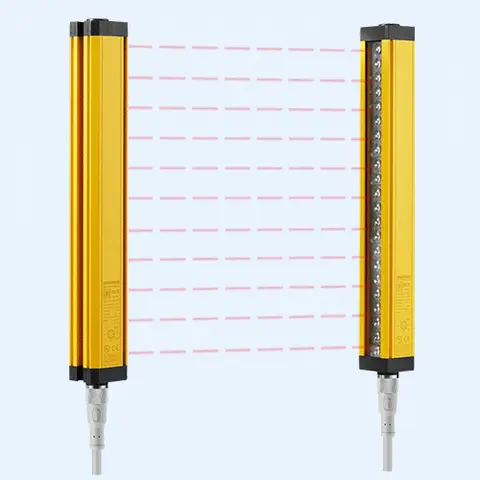
DCE Automation Safety Light Curtain
Compact through-beam safety light curtain in a 30 x 30 mm housing: 10/20/30/40 mm beam pitch, up to 72 beams, 0.3-3 m or 0.3-6 m sensing distance, NPN/PNP output. Catalogue-stated Type 4 design basis; confirm exact safety-document scope.
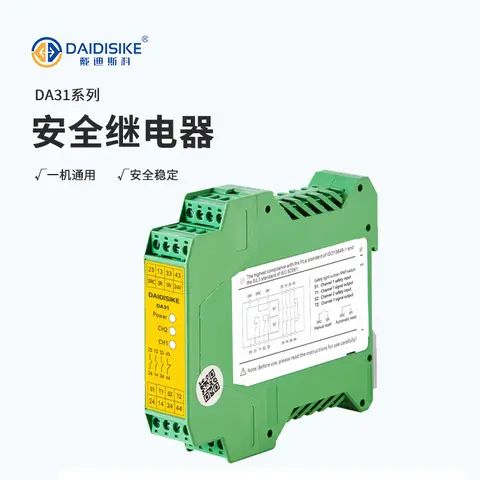
DA31 Emergency-Stop Safety Relay Module
Ultra-slim 22.6 mm Category 4/PL e/SIL 3 safety relay with dual-channel PNP/NPN input and a solid-state status output.
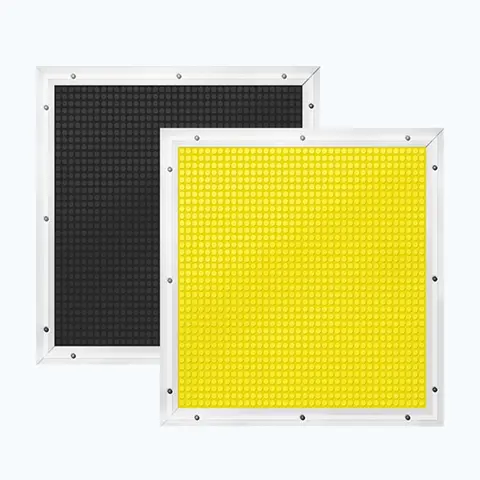
JT14 Safety Mat (Economical)
Economical pressure-sensitive safety mat with volt-free N.O. output for large-area or custom-shape floor guarding.
Related Products in Press & Press Brake Protection
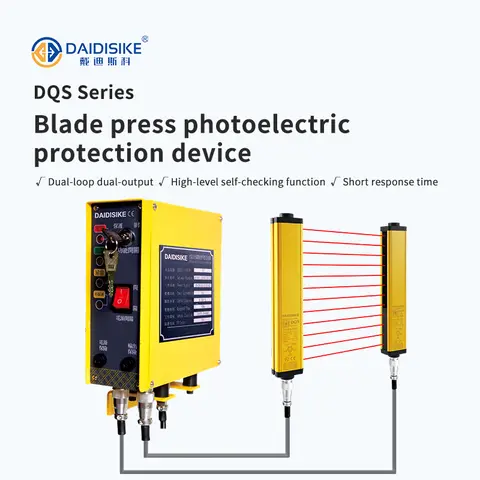
DQS Press Photoelectric Safety Guard
Type 4 press light curtain plus dedicated controller: dual relay outputs wire straight into your press circuit.
DQV Double-sided Photoelectric Safety Protection Device
Guards two hazardous machine sides at once with independent light-curtain sets and dual output channels.