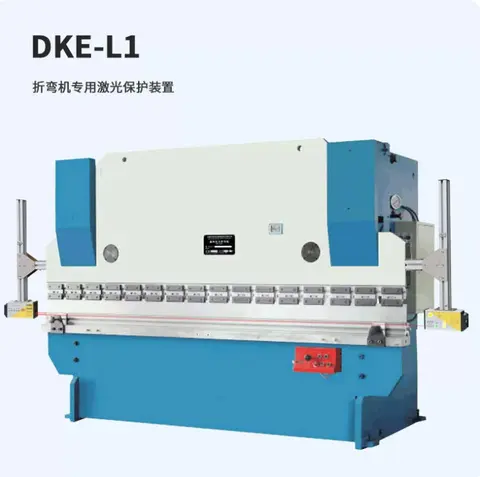
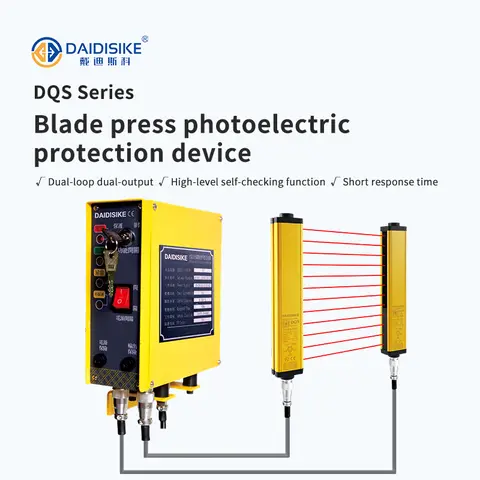
DQV Double-sided Photoelectric Safety Protection Device
Guards two hazardous machine sides at once with independent light-curtain sets and dual output channels.
▶ Watch it in action: Punch Press Infrared Guarding — Light Curtain Stopping the Stroke in Real Time
 🔍 Click to enlarge · 1/7
Technical Specifications
| Series | DQV |
|---|---|
| Beam pitch (resolution) | 10 / 20 / 40 / 80 mm |
| Detection (operating) range | 0.3-3m standard / 0.3-6m / 0.3-30m optional |
| Response time | ≤ 10 ms |
| Output | Via controller, dual relay / dual transistor |
| Controller operating voltage | AC110-220V |
| Ingress protection rating | IP65 |
| Sensor housing dimensions | 35 × 51 mm |
Overview
DQV is the double-sided variant in the DQS/DQV photoelectric safety protection platform. Unlike a single-side light curtain that only guards one opening, DQV pairs two light-curtain sets — each configured to its own beam count, pitch and protective height per the DQV{beams}/{pitch}-{height} ordering code — and connects them to a shared controller that produces two independent output circuits.
It is intended for machines such as punch presses, press brakes, or hydraulic presses that have two hazardous access points (for example an operator-facing side and a feed/rear side, or two facing workstations) that both need light-curtain interlocking. Each side scales up to 72 beams and 5680 mm protective height at 80 mm pitch, with beam pitch selectable independently per side from 10 to 80 mm, and the shared controller responds in ≤10 ms.
Features & Benefits
One control system, two guarded sides
Two light-curtain sets run from a single controller instead of requiring two standalone single-side curtains with two separate controllers. This reduces hardware count, wiring runs, and control-cabinet space while unifying management of both protected sides.
Two independent output channels
Each protected side has its own output circuit through the controller — dual relay dry contacts or dual transistor outputs — so the two sides trigger their stop signal independently of each other.
Each side scales to a wide opening
Every protected side is selected independently via the DQV{beams}/{pitch}-{height} code, up to 72 beams and 5680 mm protective height at 80 mm pitch, so both sides of a large machine can be fully covered.
Four pitch options per side (10/20/40/80 mm)
Beam pitch can be selected per side from finger-level (10 mm) to body-level (80 mm) detection resolution, matching the hazard level of each opening independently.
≤10 ms response time
Response time is rated ≤10 ms, which supports a shorter calculated minimum safety distance for both protected sides.
Four controller form factors (W/N/S/P)
External (W), built-in (N), external-panel (S, the double-sided photoelectric safety protector configuration), and built-in-panel (P) controller variants let the installation match cabinet space and mounting constraints on site.
Shares the DQS platform mechanics
Same 35 × 51 mm sensor housing, IP65 ingress protection rating, and AC110-220V controller supply as the single-side DQS series, so facilities already using DQS have a low learning curve when adding double-sided protection.
Applications
Models & Ordering Information
8 listed table entries across 4 beam-pitch options. Compare beam count and span, then confirm the complete ordering code. Beam pitch alone does not establish detection capability or suitability for personnel protection.
Beam count range 12-72 at 10 mm pitch, per side; protective height = (beam count - 1) × 10 mm.
| Listed model entry | Beam pitch K (mm) | Number of beams N | Beam span H (mm) |
|---|---|---|---|
| DQV12/10-110 | 10 | 12 | 110 |
| DQV72/10-710 | 10 | 72 | 710 |
| Listed model entry | Beam pitch K (mm) | Number of beams N | Beam span H (mm) |
|---|---|---|---|
| DQV06/20-100 | 20 | 6 | 100 |
| DQV72/20-1420 | 20 | 72 | 1420 |
| Listed model entry | Beam pitch K (mm) | Number of beams N | Beam span H (mm) |
|---|---|---|---|
| DQV04/40-120 | 40 | 4 | 120 |
| DQV72/40-2840 | 40 | 72 | 2840 |
| Listed model entry | Beam pitch K (mm) | Number of beams N | Beam span H (mm) |
|---|---|---|---|
| DQV04/80-240 | 80 | 4 | 240 |
| DQV72/80-5680 | 80 | 72 | 5680 |
2 listed entries at 10 mm pitch · 8 across this table. Beam span is calculated as H = (N − 1) × K; it is not overall housing length or proof of detection capability. Some entries expand catalogue ranges. Confirm the complete ordering code and availability before ordering; inclusion is not a stock claim.
Controller variants
How to Select
- Determine beam pitch (detection resolution) per side: choose 10 mm for finger-level detection, 20/40 mm for hand/arm-level, or 80 mm for body-level detection on each protected side independently — the two sides do not need to use the same pitch.
- Determine protective height per side: select the beam count/height combination from the model list for the chosen pitch (for example, at 10 mm pitch, models range from DQV12/10-110 to DQV72/10-710; at 80 mm pitch, from DQV04/80-240 to DQV72/80-5680) to match the opening height that needs covering on that side.
- Determine detection range: standard operating range is 0.3-3 m, with 0.3-6 m and 0.3-30 m available as options — pick based on the physical distance between the light-curtain pair on each side.
- Determine controller form factor: W (external/built-in), N (built-in), S (external-panel, double-sided photoelectric safety protector configuration), or P (built-in-panel) — chosen according to cabinet space and mounting requirements.
- Confirm output type needed: the controller provides dual relay dry-contact or dual transistor outputs per side — confirm which matches the machine's existing safety-relay/PLC input wiring before ordering.
- Confirm power supply: the controller operates on AC110-220V — confirm this matches available supply at the installation site.
📘 Need the full method? How to Choose a Safety Light Curtain · Type 2 vs Type 4 Safety Light Curtains
When NOT to specify the DQV — and what to use instead
Only one side of the machine needs light-curtain guarding
Why not: DQV runs two independent light-curtain sets and two output circuits from a shared controller — hardware a single-sided opening does not need.
Use instead: DQS single-side photoelectric safety guard (same platform)
The guard needs to track a moving ram/tool tip rather than cover two fixed openings
Why not: DQV is a fixed area-type light curtain pairing; its beams are set at a fixed protective height per the DQV{beams}/{pitch}-{height} code, not a beam system that travels with the ram.
Use instead: DKE-L3 ram-mounted laser guard
Each guarded side needs a multi-mode safety relay (e-stop, door interlock, two-hand control) rather than a dry-contact/transistor trip signal
Why not: The DQV controller output is limited to dual relay dry contacts or dual transistor signals per side.
Use instead: DA31 or DQSRN safety relay module downstream of each DQV output circuit
A formal ISO 13849 risk assessment requires documented PFHd/MTTFd/B10d/PL or Category figures
Why not: The published DQV spec table lists response time, IP rating, and voltage, but no PFHd, MTTFd, B10d, or Category/PL figure.
Use instead: Request this documentation from the factory before specifying
A beam pitch between the 10/20/40/80 mm steps (e.g. 14, 25, or 30 mm) is required on a double-sided machine
Why not: DQV's pitch options are limited to 10, 20, 40, and 80 mm, narrower than the single-side DQS platform's seven pitch steps.
Use instead: Consult the factory; DQS offers the intermediate 14/25/30 mm pitches for single-side applications
Specifications we do not publish yet
We only publish a figure once we are confident it is true. The items below are still being validated through further testing and real-world customer feedback, so for now we would rather leave them open than guess. If one of them matters to your design, ask us for the latest validated status.
- Detection accuracy figure separate from the beam-pitch resolution spec
- Sensor supply voltage (only the AC110-220V controller voltage is currently specified)
- Operating temperature range
- Housing/lens material
- Certificate numbers and scope for any Type/PL/SIL claim referenced for DQV
- PFHd, MTTFd, B10d, and Category/PL figures for formal risk-assessment documentation
- Whether the two protected sides can be ordered with different controller form factors (W/N/S/P) on one shared unit
Frequently Asked Questions
What does "double-sided" mean for the DQV photoelectric safety protection device?
Can the two sides of a DQV system have different beam pitch or protective height?
What is the maximum protective height DQV supports?
What output does the DQV controller provide?
What is the response time of the DQV system?
What ingress protection rating does the sensor housing have?
What voltage does the DQV controller require?
What controller mounting options are available?
Is DQV the same as buying two DQS single-side light curtains?
What detection range options does DQV offer?
Can DQV provide safety certification documents such as Type 4, PLe, or SIL3?
Related Categories and Example Products
Explore other functions that may be needed in a machine or line. The products below are category examples, not pre-validated electrical or safety combinations. Confirm each interface and application separately: Safety Light Curtains · Safety Relays · Safety Mats
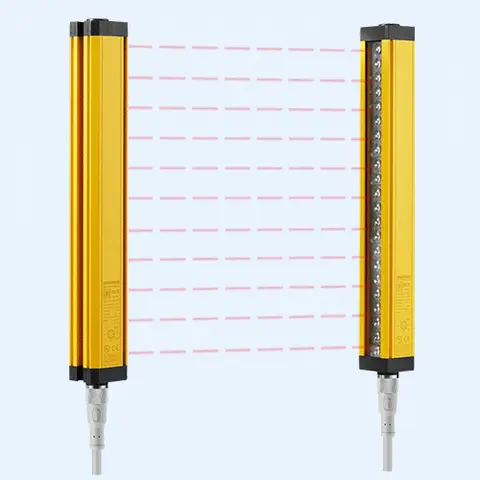
DCE Automation Safety Light Curtain
Compact through-beam safety light curtain in a 30 x 30 mm housing: 10/20/30/40 mm beam pitch, up to 72 beams, 0.3-3 m or 0.3-6 m sensing distance, NPN/PNP output. Catalogue-stated Type 4 design basis; confirm exact safety-document scope.
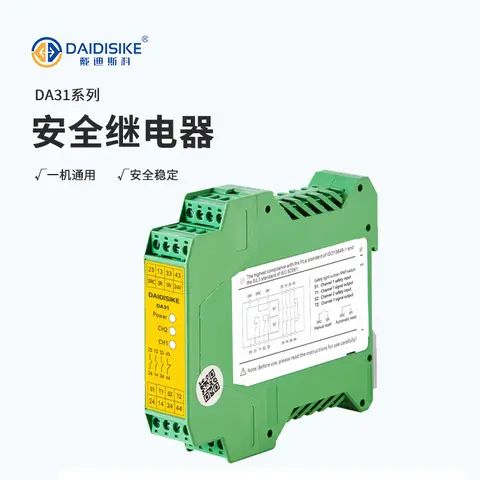
DA31 Emergency-Stop Safety Relay Module
Ultra-slim 22.6 mm Category 4/PL e/SIL 3 safety relay with dual-channel PNP/NPN input and a solid-state status output.
JT14 Safety Mat (Economical)
Economical pressure-sensitive safety mat with volt-free N.O. output for large-area or custom-shape floor guarding.