
DD / DDOF Single-Sided Area Light Curtain
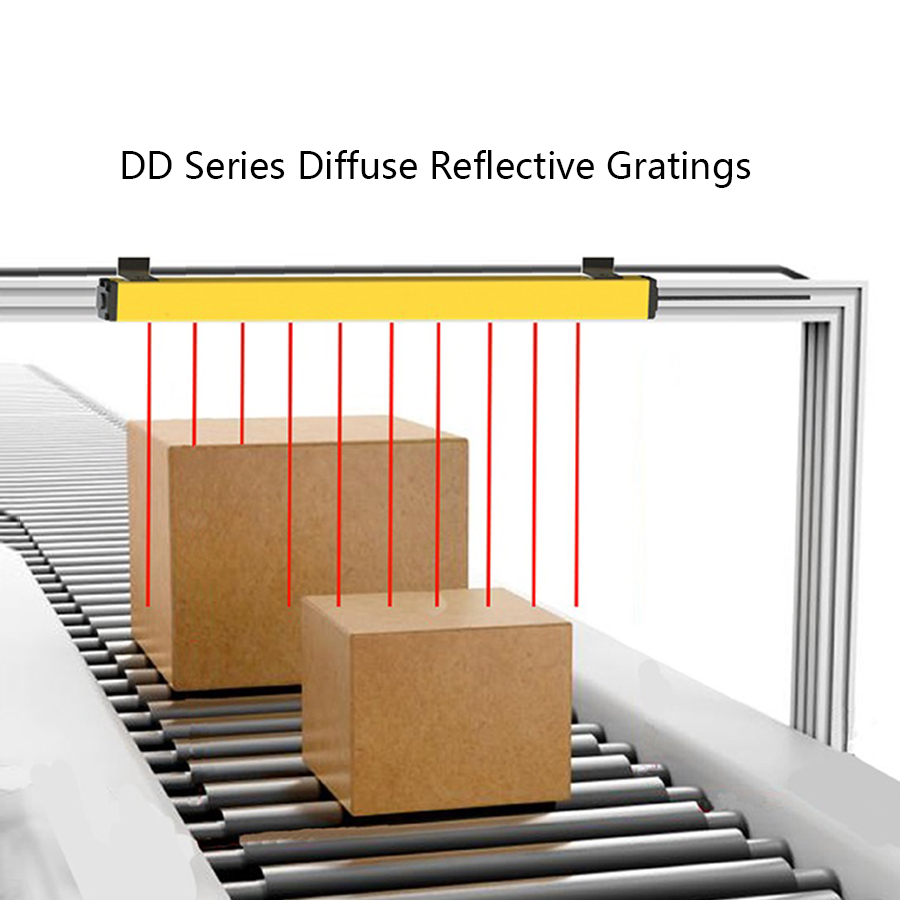
One housing, no far-side receiver: order DD for diffuse sensing to 2000 mm, or DDOF for per-beam TOF ranging to 4000 mm with zero dead zone and one-key distance teaching. 48 standard models, 4-50 beams.
▶ Watch it in action: Diffuse-Reflection Light Curtain for Part Counting & Edge Detection
 🔍 Click to enlarge · 1/13
Technical Specifications
| Series structure | Two order prefixes on one mechanical platform: DDOF = TOF time-of-flight type (per-beam distance ranging); DD = diffuse reflection type (returned-energy sensing). Same housing, tiers, wiring and mounting for both. |
|---|---|
| Mounting principle | Emitter and receiver integrated in a single housing; installs and wires on one side only - no far-side receiver, reflector or alignment |
| Maximum sensing distance | DDOF: up to 4000 mm with no dead zone. DD: up to 2000 mm, dead zone possible. |
| Background suppression | DDOF only: each beam axis ranges independently and reports only targets inside the taught distance window - background colour and target reflectivity do not shift the trigger point, and distance attenuation on dark targets is small |
| Distance setting | DDOF: one-key distance teaching. DD: steps 1-9 matched to working distance (hold 1 s to save, auto-save after 30 s) plus self-learning at default step 0 (2 s press, fixed backgrounds only) |
| Beam pitch | 40 mm, fixed across all 48 standard models |
| Beam count / tiers | 4-50 beams in even steps - 24 standard tiers per series; any even count in between to order |
| Detection height H | H = beam count x 40 mm: 160 mm (4 beams) to 2000 mm (50 beams), per the 2026-08 factory table |
| Overall length L | L = H + 49 mm: 209 mm to 2049 mm (verified against every row of the factory table) |
| Housing | 35 x 35 mm aluminium extrusion cross-section with T-slot mounting channel; 12 mm end caps top and bottom |
| Dead lengths on the housing | Top: half a beam pitch (20 mm). Bottom (cable-exit end): half a pitch + 25 mm (45 mm). Plan the critical detection edge away from the cable end. |
| Output | NPN and PNP transistor outputs both fitted on separate wires; connect the polarity your PLC input needs and insulate the other |
| Output logic | Normally-open ex-factory; normally-closed stored via the power-on button routine (cut power, hold the button, re-power while holding, let go at the red LED) |
| Wiring / wire colours | Brown = +24 V; Blue = 0 V; Black = NPN signal; White = PNP signal (2026-08 factory wiring diagram); pigtail cable termination |
| Indicators | Power shows on the green LED, signal on the red; the built-in digital readout displays the live step number |
| Intended use (factory statement) | Area and object detection only. Not a safety component: must not be used for personnel safety protection - applies to DD and DDOF equally. |
Overview
This page covers one purchasing decision with two answers. The DD / DDOF family is a reflective area light curtain that puts the emitter and the receiver in the same 35 x 35 mm housing, so the whole sensor bolts to one side of the opening and nothing at all is mounted opposite it. What you must decide at order time is the sensing engine inside: the DD prefix buys the diffuse version, the DDOF prefix buys the time-of-flight version, and the two are otherwise identical twins - same 24-tier height table, same mounting holes, same wiring, same price logic of paying only for the beams you need.
Here is the buying rule our sales engineers actually use. Count how many of these apply to your line: targets change colour or gloss between production runs; the surface behind the detection field moves or varies; the span to cover is longer than 2000 mm; a dead zone at the sensing limit would miss product. Zero items - order DD and save the difference. One or more - order DDOF, because the time-of-flight version prices in exactly those four problems: it ranges every beam individually, triggers only inside a distance window you teach with one key press, reaches 4000 mm, and has no dead zone.
Sizing is a one-line calculation you can do while reading this. Detection height H = beam count x 40 mm, and the housing adds 49 mm on top of H. The 24 standard tiers run from 4 beams (160 mm of coverage, 209 mm housing) to 50 beams (2000 mm of coverage, 2049 mm housing) in even steps, under either prefix - DDOF2040 and DD2040 both put 20 beams across an 800 mm field. Between-tier beam counts are a normal custom order, not a special project.
Two commitments before you specify. First, every number on this page comes from the manufacturer's 2026-08 selection sheet; where that sheet is silent - response time, ingress rating, supply tolerance - we say so below instead of guessing, and we will put the confirmed figures in writing against your order number. Second, this family is an object-detection instrument. It counts, positions, and monitors areas; it is not certified to IEC 61496 or ISO 13849 and must never be the device that stops a machine to protect a person. That job belongs to a certified safety light curtain such as the DQT4.
Features & Benefits
One order-code letter group decides everything hard
Most area-sensor mis-purchases trace to one cause: an energy-based sensor sent into a distance-based problem. This family makes the fix a prefix. Same bracket, same holes, same cable colours - a line that outgrows its DD (new black totes, a moved background wall, a wider span) upgrades to the DDOF tier-for-tier without touching the mechanical installation.
4000 mm and zero dead zone on the DDOF
Doubling the reach of the diffuse version matters most at doorways, wide conveyors and pallet lanes where the sensor must sit well back. Just as valuable: the DDOF has no dead zone, so there is no near-field band where product slips past undetected - a real failure mode on energy-based sensors positioned close to the material path.
Teach the window once, survive every changeover
The DDOF's working distance is taught with a single key press, and because judgment is by measured distance, next week's product in a different colour or film does not move the trigger point. On lines that change SKUs daily, this is the difference between a sensor you commission once and a sensor someone re-tunes every Monday.
Nothing to install on the far side - literally nothing
No receiver column, no reflector panel, no far-side conduit run, no beam alignment session with two technicians and a radio. For retrofits, open edges, walls and one-sided door frames, the second-side work simply does not exist on the bill of labour.
Both PLC polarities in the same cable
Black wire NPN, white wire PNP, both live on every unit. Panel builders stock one part number for Japanese-style sinking inputs and European sourcing inputs alike, and the commissioning tech connects whichever wire the input card wants.
A height tier every 80 mm, and custom counts between
24 standard tiers per series mean the next size up is never far away, and any even beam count between 4 and 50 is a routine custom order. You pay for the field height you need instead of rounding up to a distant catalogue size.
DD steps 1-9 plus self-learning for the simple cases
Where the background is a fixed baffle and the product is consistent, the DD's nine intensity steps and its 2-second self-learning routine cover commissioning without instruments - and the live step number stays visible on the built-in digital display for anyone auditing the setting later.
Priced and documented like a component, not a project
Factory-direct pricing, a published English selection manual compiled from the 2026-08 factory sheet, and open declaration of which parameters the factory has not printed - so your engineering file contains data, not marketing.
Applications
Models & Ordering Information
DDOF series - TOF time-of-flight type (4000 mm, no dead zone)
DD series - diffuse reflection type (2000 mm)
PDF & 3D CAD Downloads
Browse all downloadsDD / DDOF Area Light Grid - English Selection Manual
Compares the two engines, prints every tier of both series, walks the height mathematics with the dead lengths, documents the four-wire hookup and how to store NC output, covers steps and self-learning, and closes with scenario-driven picks plus the usage boundary.
Find the file for your exact model
Open the download center with this series selected. Search the full model, check the file details, and download the matching CAD file.
Confirm the document and CAD file match the exact ordered version before installation or mechanical design. Contact us if your model is not listed.
How to Select
- Step 1 - Choose the prefix with four questions: do target colours or finishes vary? does the background move or change? is the span over 2000 mm? is a dead zone unacceptable? Any yes = DDOF; all no = DD. This single choice outweighs every other line on the order.
- Step 2 - Convert the height to cover into a beam count: divide the field height by 40 mm and round up to the next even number between 4 and 50. Check H = beams x 40 covers the zone and L = H + 49 fits the mounting space including cable-exit clearance.
- Step 3 - Place the dead lengths deliberately: the top of the housing loses 20 mm and the cable end loses 45 mm of sensing. Orient the cable end toward the less critical edge of the field before drilling anything.
- Step 4 - Wire the polarity your PLC wants: black wire for NPN (sinking) inputs, white wire for PNP (sourcing) inputs, insulate the unused one. If the output participates in any interlock logic, switch to normally-closed with the power-on button procedure so a cut cable reads as blocked rather than clear.
- Step 5 - Commission by type: DDOF - teach the distance window with one key press so it ends before the background. DD - step through 1-9 against the real target and save (1 s hold), or self-learn at step 0 only where the background is truly fixed.
- Step 6 - Close the open parameters in writing: response time, IP rating, supply tolerance and temperature range are not printed on the factory sheet. Have us confirm them for your model and quantity before the design freezes - and if any part of the requirement is protecting a person, stop here: that requirement moves to a certified device, which is exactly what the DQT4 line is for.
📘 Need the full method? How to Choose a Safety Light Curtain · Type 2 vs Type 4 Safety Light Curtains
When NOT to specify the DD — and what to use instead
The requirement is stopping hazardous machine motion when a person or body part enters - press brakes, robot cells, any guarded danger zone
Why not: The factory sheet limits the whole family - DD and DDOF alike - to area detection and states it must not be used for safety protection. No IEC 61496 Type, ISO 13849 PL or IEC 62061 SIL rating exists for either series, and the DDOF's stronger detection does not substitute for certification.
Use instead: A certified through-beam safety light curtain - DQT4 for stated Type 4 architecture, or DQC/DQA - wired through a safety relay.
A DD (diffuse) model is being considered for black, glossy, transparent or colour-varying targets
Why not: Energy-based sensing reads dark and specular surfaces as weak returns and bright backgrounds as strong ones; detection then depends on the product's finish and the week's SKU mix.
Use instead: The DDOF prefix of this same family - per-beam distance ranging is colour-independent. For transparent film specifically, sample-test first or consider a through-beam arrangement.
The span to cover exceeds 4 metres
Why not: 4000 mm is the DDOF's ceiling and 2000 mm the DD's; neither is a long-range curtain.
Use instead: A long-distance through-beam light curtain such as the DQA series (selectable ranges to 40 m).
The design file requires a confirmed IP rating, response time or temperature range before sign-off
Why not: None of these is printed on the 2026-08 factory sheet for this family; assuming values is how sensors end up failing acceptance audits.
Use instead: Written factory confirmation via us before freezing the design - or a series whose datasheet publishes the full environmental table.
The controller needs a volt-free relay contact
Why not: This family documents transistor outputs only (NPN + PNP); no relay output version is listed.
Use instead: An interposing relay module driven by the transistor output, or a series with a documented relay option.
Full selection table - all 24 tiers, both series
H = beam count x 40 mm; L = H + 49 mm. Values from the 2026-08 factory selection sheet, identical for both prefixes. Any even beam count in between is available to order.
| Beams | DDOF model (TOF) | DD model (diffuse) | Detection height H (mm) | Overall length L (mm) |
|---|---|---|---|---|
| 4 | DDOF0440 | DD0440 | 160 | 209 |
| 6 | DDOF0640 | DD0640 | 240 | 289 |
| 8 | DDOF0840 | DD0840 | 320 | 369 |
| 10 | DDOF1040 | DD1040 | 400 | 449 |
| 12 | DDOF1240 | DD1240 | 480 | 529 |
| 14 | DDOF1440 | DD1440 | 560 | 609 |
| 16 | DDOF1640 | DD1640 | 640 | 689 |
| 18 | DDOF1840 | DD1840 | 720 | 769 |
| 20 | DDOF2040 | DD2040 | 800 | 849 |
| 22 | DDOF2240 | DD2240 | 880 | 929 |
| 24 | DDOF2440 | DD2440 | 960 | 1009 |
| 26 | DDOF2640 | DD2640 | 1040 | 1089 |
| 28 | DDOF2840 | DD2840 | 1120 | 1169 |
| 30 | DDOF3040 | DD3040 | 1200 | 1249 |
| 32 | DDOF3240 | DD3240 | 1280 | 1329 |
| 34 | DDOF3440 | DD3440 | 1360 | 1409 |
| 36 | DDOF3640 | DD3640 | 1440 | 1489 |
| 38 | DDOF3840 | DD3840 | 1520 | 1569 |
| 40 | DDOF4040 | DD4040 | 1600 | 1649 |
| 42 | DDOF4240 | DD4240 | 1680 | 1729 |
| 44 | DDOF4440 | DD4440 | 1760 | 1809 |
| 46 | DDOF4640 | DD4640 | 1840 | 1889 |
| 48 | DDOF4840 | DD4840 | 1920 | 1969 |
| 50 | DDOF5040 | DD5040 | 2000 | 2049 |
2026-08 factory selection sheet
Specifications we do not publish yet
We only publish a figure once we are confident it is true. The items below are still being validated through further testing and real-world customer feedback, so for now we would rather leave them open than guess. If one of them matters to your design, ask us for the latest validated status.
- Response time is not published on the 2026-08 factory sheet.
- Supply-voltage tolerance and current draw are not published (the wiring diagram labels +24 V and 0 V only).
- IP ingress-protection rating is not published for this family.
- Operating and storage temperature ranges are not published.
- Cable length and housing material grade are not published (cross-section and end-cap dimensions are).
- Minimum detectable object size is not published; it depends on pitch and the set distance - state your smallest target in the inquiry.
- Output load rating of the transistor outputs is not published - confirm before driving anything heavier than a PLC input.
- No safety certification (IEC 61496 / ISO 13849 / IEC 62061) exists for this family - by design, as it is an area-detection instrument; do not request or expect an ESPE certificate for it.
Frequently Asked Questions
How do I order the TOF version - is it a suffix or a different series?
In one sentence each, when do I buy DD and when do I buy DDOF?
Are the DDOF and DD mechanically interchangeable on the same bracket?
What exactly does the background suppression on the DDOF do?
How tall a field can one unit cover, and what if my height is between tiers?
Is the output NPN or PNP - and what do I do with the wire I don't use?
How do I get normally-closed output, and why would I want it?
Can I use the self-learning mode at a doorway or on a lifting platform?
What response time does this series have?
Is this an IP65 sensor? Can it go outdoors or in washdown areas?
Can the DDOF, with its better detection, be used as a safety device?
What documentation ships with an export order?
Related Categories and Example Products
Explore other functions that may be needed in a machine or line. The products below are category examples, not pre-validated electrical or safety combinations. Confirm each interface and application separately: Safety Relays · Safety Door Locks & Switches · Press & Press Brake Protection
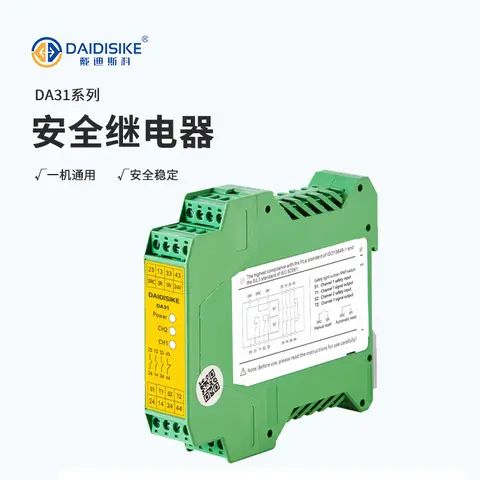
DA31 Emergency-Stop Safety Relay Module
Ultra-slim 22.6 mm Category 4/PL e/SIL 3 safety relay with dual-channel PNP/NPN input and a solid-state status output.
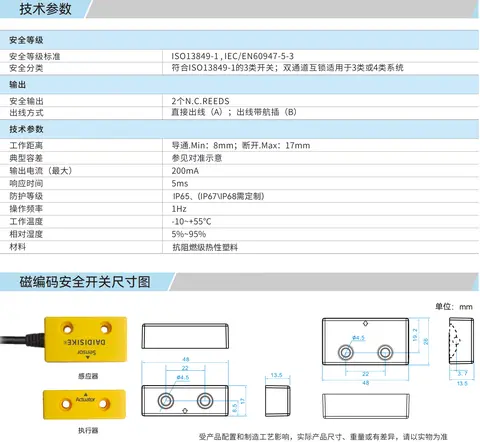
DX-C1 Magnetic Coded Safety Switch
Non-contact coded-magnet safety switch with 17 mm sensing range and high misalignment tolerance for guard doors.
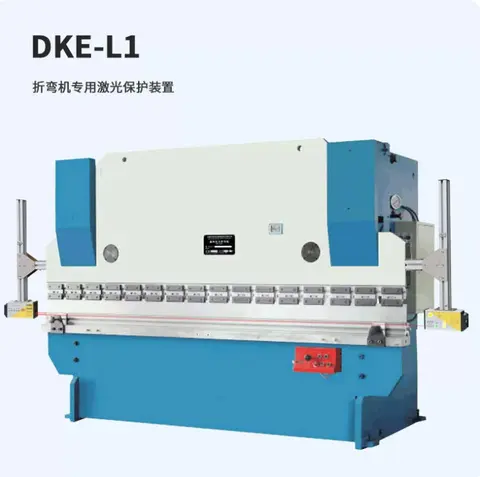
DKE-L3 Press Brake Laser Protection
Ram-mounted laser guarding that tracks the punch tip on press brakes and shears without blocking hand-fed work.
Related Products in Safety Light Curtains
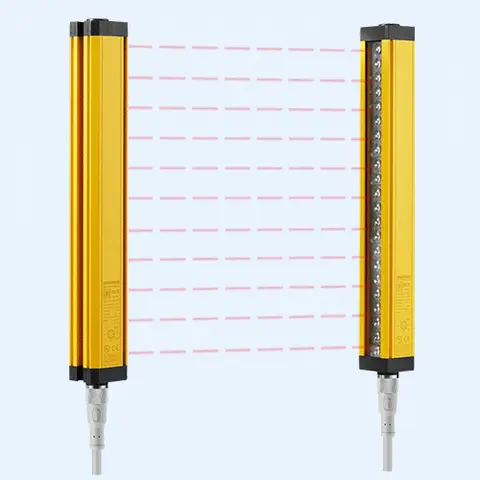
DCE Automation Safety Light Curtain
Compact through-beam safety light curtain in a 30 x 30 mm housing: 10/20/30/40 mm beam pitch, up to 72 beams, 0.3-3 m or 0.3-6 m sensing distance, NPN/PNP output. Catalogue-stated Type 4 design basis; confirm exact safety-document scope.
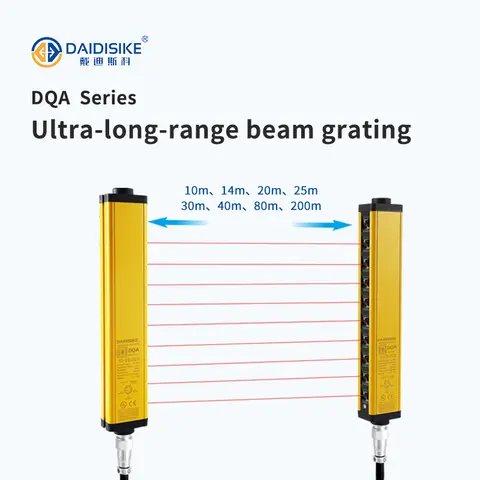
DQA Long-distance Safety Light Curtain
Long-range through-beam safety light curtain for large presses, hydraulic and shearing machines: a transmitter/receiver pair spanning up to 40 m, in 8 beam pitches from 10 to 200 mm, with NPN, PNP or relay output and a selectable single- or dual-output signal. Designed to the Type 4 architecture of IEC 61496 and Category 4 of ISO 13849-1.
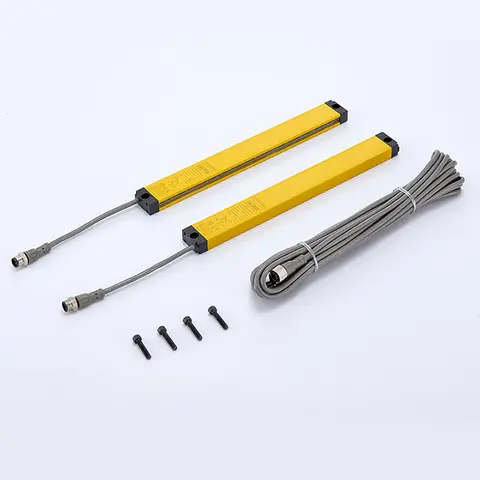
DQB Ultra-thin (Side-emitting) Safety Light Curtain
Ultra-thin side-emitting safety light curtain with a 15 x 30 mm cross-section for gaps too narrow for standard units.
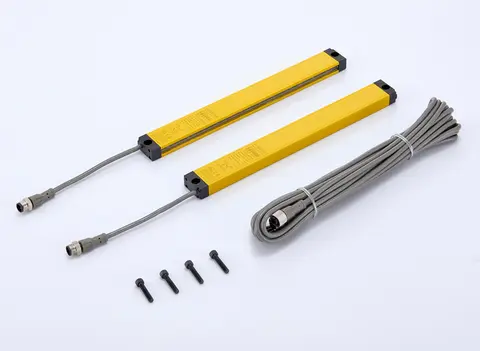
DQBT Ultra-thin Optical-sync Safety Light Curtain
Ultra-thin safety light curtain with optical sync between emitter and receiver — no interconnecting sync cable — in 10/20/40 mm beam pitch, transistor NPN/PNP output, 0.3-3 m detection distance.