
DQBT Ultra-thin Optical-sync Safety Light Curtain
Ultra-thin safety light curtain with optical sync between emitter and receiver — no interconnecting sync cable — in 10/20/40 mm beam pitch, transistor NPN/PNP output, 0.3-3 m detection distance.
 🔍 Click to enlarge · 1/7
Technical Specifications
| Series | DQBT Ultra-thin Optical-sync Safety Light Curtain |
|---|---|
| Curtain Type | Through-beam (opposed mode) -- separate emitter and receiver, synchronized optically |
| Synchronization | Optical synchronization -- no interconnecting sync cable between emitter and receiver |
| Beam Pitch | 10 / 20 / 40 mm |
| Number of Beams | 8-100 (10 mm pitch, step 2); 6-198 printed cleanly, table extends to a 200-beam-equivalent row (20 mm pitch, step 2 -- see modelGroups note on a model-number print inconsistency at the top of this range); 4-24 printed cleanly, table extends to a 200-beam-equivalent row (40 mm pitch, step 2 -- see modelGroups note on a print inconsistency above 24 beams) |
| Protected Height | 70-990 mm (10 mm pitch); 100-3940 mm printed cleanly, up to 3980 mm per table (20 mm pitch); 120-920 mm printed cleanly, up to 7960 mm per table (40 mm pitch). Protected height = pitch x (beam count - 1) |
| Detection / Sensing Distance | 0.3-3 m for every configuration listed in the DQBT spec table (no selectable long-range code) |
| Response Time | <= 15 ms (catalog feature list also markets this as "0.01 second" fast response) |
| Output | Transistor output, NPN or PNP, NC or NO, selected by code: A = NPN NC, B = PNP NC, C = NPN NO, D = PNP NO |
| Wiring | Emitter/transmitter: 3-core (shield, 0V, +12-24VDC). Receiver: 5-core (shield, 0V, +12-24VDC, OSSD1, OSSD2) |
| Interference Immunity | Catalog states shielding of approximately 99% of interference signals; stated resistance to electromagnetic interference, strobe lighting and welding arc light |
| Self-check / Protection | Continuous self-check; polarity, short-circuit and overload protection, per the catalog |
| Housing Cross-section | 15 mm x 30 mm per the DQBT dimension drawing (the same drawing separately labels one width callout as 15.6 mm; both figures are transcribed as printed) |
| Curtain Length Formula | L (total curtain length, mm) = P + H + J + 12 + 12, where H = protected height. P = 5mm / J = 10mm at 10mm pitch; P = 15mm / J = 10mm at 20mm and 40mm pitch. Z (mounting hole center distance) = L - 11mm |
| Connector | Optional M12 aviation connector, 30 x 15 mm design, per the catalog feature list |
| Construction | Surface-mount (SMT) electronics, stated by the catalog to improve vibration resistance |
| Design / Test Basis | IEC 61496-1/2 safety level; EN13849-1:2015; EN61496-3:2019; management-system certification GB/T19001-2016 idt ISO9001:2015 (quality management, not a product safety certificate), per the catalog. The same feature list names TÜV and UL; no certificate numbers or a Type/Category/PLe/SIL architecture level are stated for DQBT. Certification documents are available on request. |
Overview
DQBT is DAIDISIKE's ultra-thin safety light curtain built around optical synchronization: the emitter and receiver lock together using an optical signal instead of a wired sync line, so each tower only needs its own local power/output wiring. The catalog positions it for hydraulic presses, oil presses, shearing machines, injection molding machines, and other equipment or installation spaces where running a cross-machine sync cable is impractical.
The series is offered in three beam pitches — 10, 20 and 40 mm — with beam counts and protected heights tabulated per pitch in the catalog's DQBT spec sheet. Every configuration in that table carries the same 0.3-3 m detection/sensing distance; DQBT does not offer the long-range, code-selectable distance option that the DQA series does.
Output is transistor-type, NPN or PNP, normally open or normally closed (catalog codes A/B/C/D), wired 3-core on the emitter side and 5-core on the receiver side. The catalog states the unit shields about 99% of interference signals, includes continuous self-check plus polarity/short-circuit/overload protection, uses surface-mount electronics, and offers an optional M12 aviation-connector interface (30 x 15 mm).
Features & Benefits
Optical Synchronization — No Interconnecting Cable
Emitter and receiver synchronize via an optical signal instead of a wired sync line, so each side only needs local power/signal wiring. There is no cross-machine cable run to install, route or later repair.
Minimal 3-Wire Hook-up Per Side
Wiring terminates in 3-core or 5-core cable per side, keeping field wiring simple for panel builders and installers.
Up to 100 Beams at 10mm Pitch
The 10mm-pitch range runs from DQBT08/10-70 to DQBT100/10-990, giving fine-resolution detection over a tall protected height in a single unit rather than stacking multiple curtains.
NPN/PNP Selectable Output
Output logic can be selected to match the customer's existing control/PLC input wiring convention (sinking or sourcing), simplifying integration into different control panels.
Three Pitch Options for Fine-to-Coarse Detection
10mm, 20mm and 40mm beam pitches are available. Obtain the confirmed minimum detectable object for the selected model; pitch alone does not establish finger, hand or body detection capability.
Slim, Low-Profile Housing
DQBT is positioned in the catalogue as an ultra-thin series, suited to installations where a compact housing cross-section is needed to fit tight mechanical envelopes.
Applications
Models & Ordering Information
6 listed table entries across 3 beam-pitch options. Compare beam count and span, then confirm the complete ordering code. Beam pitch alone does not establish detection capability or suitability for personnel protection.
Beam count runs 8 to 100 in steps of 2, printed cleanly in the catalog; protected height (mm) = (beam count - 1) x 10. Detection/sensing distance is 0.3-3 m for every row.
| Listed model entry | Beam pitch K (mm) | Number of beams N | Beam span H (mm) |
|---|---|---|---|
| DQBT08/10-70 | 10 | 8 | 70 |
| DQBT100/10-990 | 10 | 100 | 990 |
| Listed model entry | Beam pitch K (mm) | Number of beams N | Beam span H (mm) |
|---|---|---|---|
| DQBT06/20-100 | 20 | 6 | 100 |
| DQBT198/20-3940 | 20 | 198 | 3940 |
| Listed model entry | Beam pitch K (mm) | Number of beams N | Beam span H (mm) |
|---|---|---|---|
| DQBT04/40-120 | 40 | 4 | 120 |
| DQBT24/40-920 | 40 | 24 | 920 |
2 listed entries at 10 mm pitch · 6 across this table. Beam span is calculated as H = (N − 1) × K; it is not overall housing length or proof of detection capability. Some entries expand catalogue ranges. Confirm the complete ordering code and availability before ordering; inclusion is not a stock claim.
How to read the DQBT model code
PDF & 3D CAD Downloads
Browse all downloadsDQBT Safety Light Curtain User Manual
DQBT Safety Light Curtain Technical Data Sheet
Confirm the document and CAD file match the exact ordered version before installation or mechanical design. Contact us if your model is not listed.
How to Select
- Start with the required minimum detectable object. Compare the 10/20/40 mm beam-pitch options only after obtaining the selected model's detection capability and safety documentation; do not substitute pitch for detection resolution.
- Within the chosen pitch, select the beam count whose protected height matches the opening or passage to be guarded.
- Select NPN or PNP output to match the sinking or sourcing input convention of the existing PLC or safety control panel.
- Confirm 3-core or 5-core wiring based on whether the installation needs additional local functions beyond basic power/signal.
- Because synchronization is optical, no cable routing needs to be reserved between the emitter and receiver towers — only local power/signal wiring is needed on each side.
📘 Need the full method? How to Choose a Safety Light Curtain · Type 2 vs Type 4 Safety Light Curtains
When NOT to specify the DQBT — and what to use instead
Routing a sync cable between the emitter and receiver is easy and cost is not a concern
Why not: Optical synchronization is a wiring-convenience feature, not an added protection function -- a standard wired-sync ultra-thin curtain covers the same detection duty and is a more conventional, field-proven interconnect.
Use instead: The DQB ultra-thin safety light curtain (wired sync) where a sync cable run is not a constraint.
The mounting geometry calls for a front-emitting beam layout rather than end-to-end through-beam towers
Why not: DQBT is a standard through-beam (opposed-mode) curtain per the catalog's own dimension and wiring drawings -- it is not a front-emitting design.
Use instead: The DQZ front-emitting safety light curtain series.
The transmitter-to-receiver span exceeds about 3 m
Why not: Every configuration in DQBT's own spec table lists a 0.3-3 m detection/sensing distance, with no selectable long-range code (unlike DQA, which offers coded options up to 0.3-40 m).
Use instead: The DQA long-distance safety light curtain series for spans beyond 3 m.
The installation involves washdown, high-pressure hosing, or outdoor/wet exposure
Why not: The DQBT catalog pages read do not state an IP/environmental protection rating for DQBT itself. (The IP65 figure visible in a product photo on the DQBT feature page belongs to a nameplate that reads "DQB", not DQBT, so it is not carried over as a DQBT spec.)
Use instead: The DQR waterproof safety light curtain series for wet or washdown areas, or confirm an IP rating for DQBT with the factory before specifying it outdoors.
A verified minimum-object detection capability is required
Why not: The finest listed beam pitch is 10 mm, but the reviewed DQBT table does not establish the actual minimum detectable object. A 10 mm spacing claim must not be used as a detection rating.
Use instead: Confirm with the factory whether a finer-pitch series is available, or verify the 10 mm pitch (and its actual minimum detectable object size) meets your risk assessment.
The application needs a confirmed operating temperature/humidity range or a stated supply voltage and current draw
Why not: The DQBT pages read do not state an operating temperature/humidity range, supply voltage or current consumption for this series (unlike DQA, which publishes -10 to +40 degrees C and DC 12/24V / 200mA).
Use instead: Confirm these figures with the factory before specifying DQBT for temperature-extreme or precisely power-budgeted installations.
Specifications we do not publish yet
We only publish a figure once we are confident it is true. The items below are still being validated through further testing and real-world customer feedback, so for now we would rather leave them open than guess. If one of them matters to your design, ask us for the latest validated status.
- IP/environmental protection rating for DQBT itself is not stated in the current catalog, so we do not assert IP65 for DQBT
- Operating temperature range, storage temperature, and humidity specifications for DQBT are not given in the current catalog.
- Supply voltage and current consumption for DQBT are not stated in the current catalog
- TÜV and UL certificate numbers, and the exact Type/Category/PLe/SIL safety architecture level, are not stated for DQBT -- the catalog names IEC61496-1/2, EN13849-1:2015, EN61496-3:2019 and GB/T19001-2016 idt ISO9001:2015, but (unlike the DQT4 page, which explicitly states Type 4 / Cat.4 / PLe / SIL3) does not give a Type/Category/PLe/SIL rating for DQBT. Certification documents are available on request.
- PFHd, MTTFd and DCavg figures needed to integrate DQBT into a full ISO 13849-1 machine safety calculation are not published in the current catalog.
- Exact order codes for the highest-beam-count configurations (200 beams at 20 mm pitch; 26-200 beams at 40 mm pitch) — ask us to confirm the exact model number before ordering
- Cable length options and the aviation-connector pinout beyond the optional M12, 30x15mm connector note are not detailed in the current catalog.
- Housing and end-cap material for DQBT are not stated in the current catalog (contrast with DQA, which states aluminium alloy housing with ABS-reinforced nylon end caps).
Frequently Asked Questions
What makes the DQBT different from a standard wired-sync safety light curtain?
Do I still need to run any cable between the emitter and receiver?
What beam pitch options does DQBT offer?
What is the maximum number of beams available?
What output types does DQBT support?
How is the DQBT model number structured?
How many wires does DQBT use?
Can DQBT be used where the emitter and receiver are mounted on different equipment frames?
What certifications does DQBT carry?
Related Categories and Example Products
Explore other functions that may be needed in a machine or line. The products below are category examples, not pre-validated electrical or safety combinations. Confirm each interface and application separately: Safety Relays · Safety Door Locks & Switches · Press & Press Brake Protection
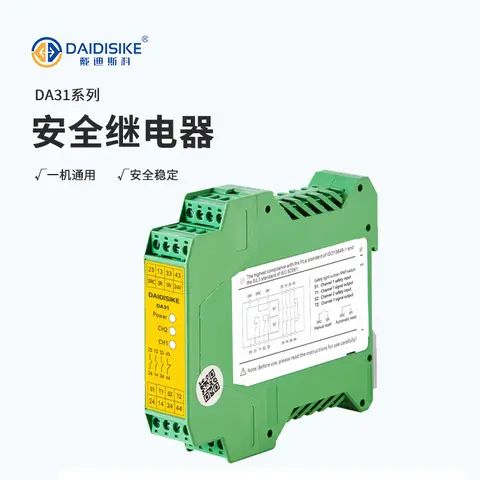
DA31 Emergency-Stop Safety Relay Module
Ultra-slim 22.6 mm Category 4/PL e/SIL 3 safety relay with dual-channel PNP/NPN input and a solid-state status output.
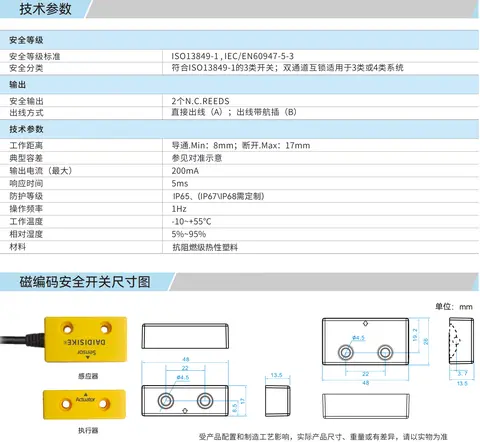
DX-C1 Magnetic Coded Safety Switch
Non-contact coded-magnet safety switch with 17 mm sensing range and high misalignment tolerance for guard doors.
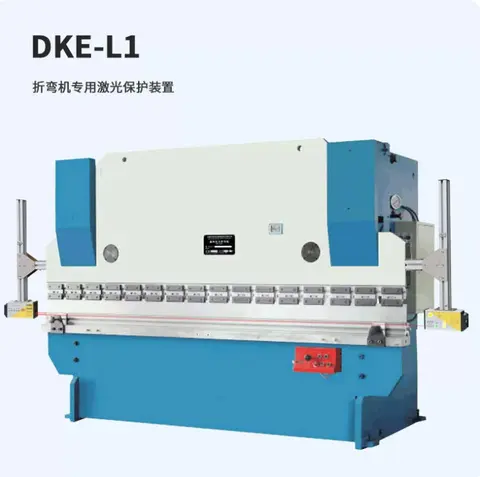
DKE-L3 Press Brake Laser Protection
Ram-mounted laser guarding that tracks the punch tip on press brakes and shears without blocking hand-fed work.
Related Products in Safety Light Curtains
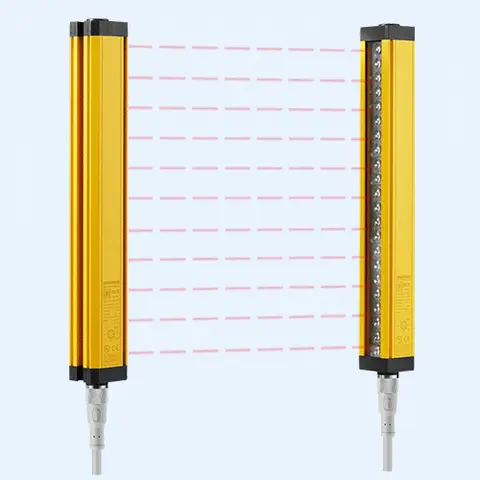
DCE Automation Safety Light Curtain
Compact through-beam safety light curtain in a 30 x 30 mm housing: 10/20/30/40 mm beam pitch, up to 72 beams, 0.3-3 m or 0.3-6 m sensing distance, NPN/PNP output. Catalogue-stated Type 4 design basis; confirm exact safety-document scope.
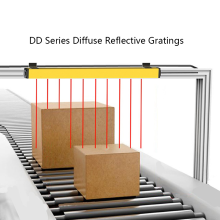
DD / DDOF Single-Sided Area Light Curtain
One housing, no far-side receiver: order DD for diffuse sensing to 2000 mm, or DDOF for per-beam TOF ranging to 4000 mm with zero dead zone and one-key distance teaching. 48 standard models, 4-50 beams.
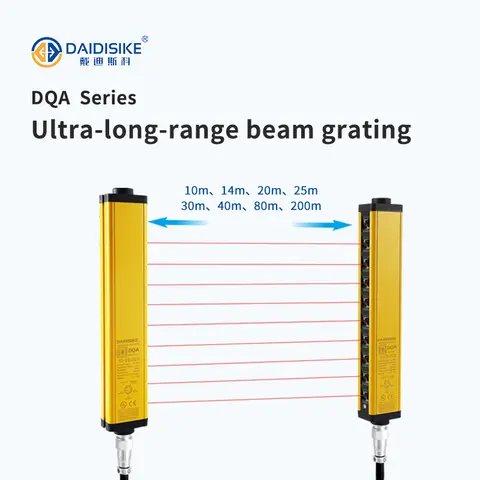
DQA Long-distance Safety Light Curtain
Long-range through-beam safety light curtain for large presses, hydraulic and shearing machines: a transmitter/receiver pair spanning up to 40 m, in 8 beam pitches from 10 to 200 mm, with NPN, PNP or relay output and a selectable single- or dual-output signal. Designed to the Type 4 architecture of IEC 61496 and Category 4 of ISO 13849-1.
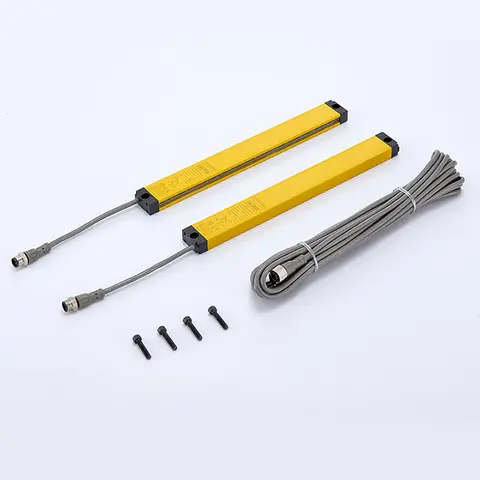
DQB Ultra-thin (Side-emitting) Safety Light Curtain
Ultra-thin side-emitting safety light curtain with a 15 x 30 mm cross-section for gaps too narrow for standard units.