
DQA Long-distance Safety Light Curtain
Long-range through-beam safety light curtain for large presses, hydraulic and shearing machines: a transmitter/receiver pair spanning up to 40 m, in 8 beam pitches from 10 to 200 mm, with NPN, PNP or relay output and a selectable single- or dual-output signal. Designed to the Type 4 architecture of IEC 61496 and Category 4 of ISO 13849-1.
▶ Watch it in action: Pre-Wired Safety Light Curtain Kit with Aviation Connectors — Unbox to Hook-Up
 🔍 Click to enlarge · 1/16
Technical Specifications
| Curtain Type | Through-beam (opposed mode) — separate transmitter and receiver |
|---|---|
| Safety Design Basis | Type 4 architecture (IEC 61496-1/-3); Category 4 (ISO 13849-1). Catalog cites EN 61496-3:2019 Type 4, EN 13849-1:2015. Certification documents available on request. |
| EMC Certification | Holds TÜV SÜD Attestation of Conformity No. E8A 104143 0001 (Rev. 00) for electromagnetic compatibility under EU Directive 2014/30/EU, tested to EN 61000-6-2:2005 and EN 61000-6-4:2007/A1:2011. Certificate held by Foshan DAIDISIKE; covers the DQA, DQR, DQRF, DQC, DQZ, DQE and DQT series. (This is an EMC certificate; it does not certify the machine-safety / ESPE function.) |
| Beam Pitch | 10 / 14 / 20 / 25 / 30 / 40 / 80 / 200 mm |
| Detection Accuracy (min. detectable object) | 18 / 22 / 28 / 33 / 38 / 48 / 88 / 208 mm (= beam pitch + 8 mm) |
| Number of Beams | 6, 8 … 32 (10/14/25 mm pitch); 4, 6 … 32 (20/30/40/80 mm); 4, 6 … 18 (200 mm) |
| Protected Height | Beam pitch x (number of beams - 1) |
| Sensing Distance | Catalogue ranges selectable by model code: 0.3-3 / 0.3-6 / 0.3-10 / 0.3-15 / 0.3-20 / 0.3-25 / 0.3-30 / 0.3-40 m (codes A-H). The legacy 30-3000 / 30-6000 mm text conflicts at the lower limit; confirm the exact model's minimum sensing distance. 30 mm and 0.3 m are not equivalent. |
| Response Time | <= 15 ms |
| Ambient Light Immunity | 10,000 lux (incidence angle >= 5 degrees) |
| Dimensions | 51 x 35 mm x L (L = transmitter / receiver length) |
| Enclosure Rating | IP65 |
| Controller | DQCA / DQCA2 |
| Supply Voltage | DC 12/24 V; AC 110-220 V (relay-output version) |
| Current Consumption | <= 200 mA |
| Output | NPN / PNP type, sink current 500 mA, residual voltage < 1.5 V, with polarity, short-circuit and overload protection |
| Output State | ON when beams clear (receiver indicator green) |
| Indicators | Transmitter: power (red). Receiver: output — clear (green) / blocked (red) |
| Light Source | Modulated infrared LED |
| Connection | Circular aviation connector with dedicated cable; transmitter 4-core, receiver 5-core |
| Housing Material | Aluminium alloy; end caps ABS-reinforced nylon |
| Ambient Light Tolerance | Incandescent: 3,000 lux at receiver face; sunlight: 10,000 lux at receiver face |
| Operating Temperature | -10 to +40 degrees C (non-condensing); storage -25 to +55 degrees C |
| Ambient Humidity | Operating 35-85% RH; storage 35-95% RH |
Overview
The DQA is DAIDISIKE's long-range through-beam (opposed-mode) safety light curtain: a separate transmitter and receiver bar that project a plane of modulated infrared beams across a machine opening. Breaking any beam switches the output and stops the machine. It is designed to the Type 4 architecture of IEC 61496-1 and -3 and to Category 4 of ISO 13849-1 (the catalog also cites EN 61496-3:2019 Type 4 and EN 13849-1:2015). It is built for presses, hydraulic and oil presses, shearing machines, automatic doors and other large machinery, and for danger zones that need protection over a long span.
What sets the DQA apart from a standard-range curtain is reach: the sensing distance is selectable by model code from 0.3-3 m up to 0.3-40 m, so one transmitter/receiver pair can guard a wide opening that a short-range curtain cannot span. It is configured from 4 to 32 beam axes across eight pitch steps (10, 14, 20, 25, 30, 40, 80 and 200 mm); above 32 axes the DQT series (up to 72 axes) takes over.
Output is flexible: NPN or PNP, normally open or normally closed, or a relay (volt-free) output, wired via the transmitter's 4-core and the receiver's 5-core aviation connector, with a single- or dual-output-signal option. The 51 x 35 mm aluminium housing is rated IP65, self-checks continuously, and rejects ambient light to 10,000 lux at an incidence angle of 5 degrees or more.
Features & Benefits
Purpose-Built Long-Range Series
The DQA is the catalog-designated long-distance variant of Daidisike's safety light curtain line, intended for spans beyond the standard-range DQC series (0.3-3 m standard, customizable to 6 m).
Full 10-200 mm Pitch Range at Long Range
The complete 8-step pitch lineup (10/14/20/25/30/40/80/200 mm) available in the standard DQC series is also offered in DQA, so a 10 mm beam-pitch option with a published 18 mm minimum detectable object does not have to be sacrificed for a longer detection range.
Scalable 4-32 Beam-Axis Configuration
Beam-axis count scales from 4 to 32 across every pitch option, e.g., DQA06/10-50 through DQA32/10-310 at 10 mm pitch, letting the protected height be matched to the actual opening or machine side.
Systematic Model Naming
Model numbers follow DQA + beam-axis count + "/" + pitch + "-" + protected height, so the part number itself encodes the physical protected height and beam pitch, simplifying selection and re-ordering.
Dedicated End-Mounting Brackets for Long Spans
In addition to the common DQCA-01/02/03/05 brackets, DQA-specific end-mounting accessories (DQA-01/DQA-02) are available for two-end installation, aimed at stable mounting and easier beam alignment over a long transmitter-receiver span.
Transistor Output with Single/Dual Signal Selection
The catalog documents transistor output (labeled PNP in the wiring diagram) with a choice of single or dual output signal, wired via 5-core or 7-core cable.
Applications
Models & Ordering Information
16 listed table entries across 8 beam-pitch options. Compare beam count and span, then confirm the complete ordering code. Beam pitch alone does not establish detection capability or suitability for personnel protection.
Beam-axis count from 6 to 32; protected height (mm) = beam-axis count x 10 - 10.
| Listed model entry | Beam pitch K (mm) | Number of beams N | Beam span H (mm) |
|---|---|---|---|
| DQA06/10-50 | 10 | 6 | 50 |
| DQA32/10-310 | 10 | 32 | 310 |
| Listed model entry | Beam pitch K (mm) | Number of beams N | Beam span H (mm) |
|---|---|---|---|
| DQA06/14-70 | 14 | 6 | 70 |
| DQA32/14-434 | 14 | 32 | 434 |
| Listed model entry | Beam pitch K (mm) | Number of beams N | Beam span H (mm) |
|---|---|---|---|
| DQA04/20-60 | 20 | 4 | 60 |
| DQA32/20-620 | 20 | 32 | 620 |
| Listed model entry | Beam pitch K (mm) | Number of beams N | Beam span H (mm) |
|---|---|---|---|
| DQA06/25-125 | 25 | 6 | 125 |
| DQA32/25-775 | 25 | 32 | 775 |
| Listed model entry | Beam pitch K (mm) | Number of beams N | Beam span H (mm) |
|---|---|---|---|
| DQA04/30-90 | 30 | 4 | 90 |
| DQA32/30-930 | 30 | 32 | 930 |
| Listed model entry | Beam pitch K (mm) | Number of beams N | Beam span H (mm) |
|---|---|---|---|
| DQA04/40-120 | 40 | 4 | 120 |
| DQA32/40-1240 | 40 | 32 | 1240 |
| Listed model entry | Beam pitch K (mm) | Number of beams N | Beam span H (mm) |
|---|---|---|---|
| DQA04/80-240 | 80 | 4 | 240 |
| DQA32/80-2480 | 80 | 32 | 2480 |
| Listed model entry | Beam pitch K (mm) | Number of beams N | Beam span H (mm) |
|---|---|---|---|
| DQA04/200-600 | 200 | 4 | 600 |
| DQA18/200-3400 | 200 | 18 | 3400 |
2 listed entries at 10 mm pitch · 16 across this table. Beam span is calculated as H = (N − 1) × K; it is not overall housing length or proof of detection capability. Some entries expand catalogue ranges. Confirm the complete ordering code and availability before ordering; inclusion is not a stock claim.
How to read the DQA model code
Compare Beam Pitch and Minimum Detectable Object
PDF & 3D CAD Downloads
Browse all downloadsDQA / DQT Safety Light Curtain Series Brochure
Find the file for your exact model
Open the download center with this series selected. Search the full model, check the file details, and download the matching CAD file.
Confirm the document and CAD file match the exact ordered version before installation or mechanical design. Contact us if your model is not listed.
How to Select
- Model number structure is DQA + beam-axis count (2 digits) + "/" + pitch (mm) + "-" + protected height (mm); protected height = beam-axis count x pitch - pitch.
- Select the required minimum detectable object before choosing pitch: DQA 10/14 mm pitches correspond to 18/22 mm detection capability, not 10/14 mm finger detection. Match the published detection figure, protective height, total stopping time and exact-model documentation to the application.
- For a given pitch, pick the beam-axis count (4-32, per the catalog's listed steps) whose protected height matches the physical opening or machine side to be guarded.
- Select DQA when the required transmitter-to-receiver span exceeds the standard DQC range (0.3-3 m standard, customizable to 6 m); use DQC when the span fits within that standard range.
- The catalog documents transistor (PNP) output with a choice of single or dual output signal, using 5-core or 7-core wiring; confirm other output options with the factory before ordering.
- For standard mounting use the common DQCA-01/02/03/05 brackets; for two-end mounting on long spans, use the dedicated DQA-01/DQA-02 brackets.
- DQA is available up to 32 beam axes per pitch; if more beam axes are required, select the DQT series (up to 72 axes) instead.
📘 Need the full method? How to Choose a Safety Light Curtain · Type 2 vs Type 4 Safety Light Curtains
When NOT to specify the DQA — and what to use instead
You need true 14 mm finger detection capability
Why not: The finest DQA pitch is 10 mm, but its detection accuracy — the minimum object it reliably detects — is 18 mm (pitch + 8 mm). That is a hand-level rather than a strict 14 mm finger-detection figure, even though the catalog labels the 10/14 mm pitches as finger protection.
Use instead: Confirm the required detection capability against your ISO 13855 risk assessment; ask us for a finer-resolution series if 14 mm finger detection is mandatory.
Short-range guarding on a compact machine, 0.3-3 m span
Why not: The DQA is the long-range variant, with sensing distance selectable up to 0.3-40 m. On a small machine you pay for reach you do not use, and the long-range optics are not the most economical choice for a short span.
Use instead: The standard-range DQC series for typical 0.3-3 m machine guarding, or a compact ultra-thin series (DQB / DQZ) where mounting space is tight.
Washdown, high-pressure hosing or wet environments
Why not: The DQA housing is rated IP65 — dust-tight and protected against low-pressure water jets, but not against high-pressure jetting or immersion.
Use instead: The DQR waterproof safety light curtain series for wet or washdown areas.
Ambient temperature outside -10 to +40 degrees C, or condensing conditions
Why not: The DQA operating range is -10 to +40 degrees C, non-condensing. Outside that band, or where the optical faces can condense or ice, detection is not guaranteed.
Use instead: A heated or sheltered enclosure that holds the curtain within spec, or confirm a wide-temperature option with us.
More than 32 beam axes are needed for the protected height
Why not: DQA model numbers stop at 32 beam axes. A taller field at a given pitch needs more axes than the DQA provides.
Use instead: The DQT series, which extends the same platform to 72 beam axes.
The machine control needs a relay (volt-free) output but an NPN/PNP variant was ordered, or vice versa
Why not: Output type is fixed by the model code letter (A/B/C/D = NPN/PNP solid-state, J = relay) and cannot be changed in the field. A solid-state PNP output will not drive a circuit expecting a volt-free relay contact.
Use instead: Order the J (relay-output) variant for volt-free contacts, or the matching A/B/C/D code for the sinking/sourcing and NO/NC logic your controller expects.
Specifications we do not publish yet
We only publish a figure once we are confident it is true. The items below are still being validated through further testing and real-world customer feedback, so for now we would rather leave them open than guess. If one of them matters to your design, ask us for the latest validated status.
- PFHd, MTTFd and DCavg figures needed to integrate the DQA into a full ISO 13849-1 machine calculation. The catalog states Category 4 but does not publish these numbers.
- Safety-distance calculation guidance (ISO 13855) and the exact response time per beam count — the catalog gives only the <= 15 ms maximum.
- The front cover of the catalog advertises sensing distance up to 50 m, but the model-code table stops at code H = 0.3-40 m. The maximum orderable sensing distance needs confirming.
- Machine-safety (ESPE) certification: the TÜV SÜD certificate on file (E8A 104143 0001) covers EMC (Directive 2014/30/EU) only. An IEC 61496 EU-Type Examination certificate from a notified body — the document that would substantiate a Type 4 / Category 4 safety-function claim — and any UL listing are not yet on hand. Certification documents available on request.
- The difference between the DQCA and DQCA2 controllers, and which models require an external controller versus operating stand-alone.
- Muting and fixed/floating blanking function availability and configuration.
- Cable length options and the aviation-connector pinout.
- Available cable exit / connector variants and maximum cable run.
Frequently Asked Questions
What is the DQA safety light curtain used for?
What beam pitch options does the DQA series offer?
How many beam axes can a DQA safety light curtain have?
How do I read a DQA model number?
What output signal type does the DQA use?
What is the difference between DQA and the standard DQC safety light curtain?
What is the difference between DQA and DQT?
What mounting accessories are available for DQA?
Is the DQA suitable for outdoor or washdown environments?
What is the maximum operating (detection) distance for DQA?
Related Categories and Example Products
Explore other functions that may be needed in a machine or line. The products below are category examples, not pre-validated electrical or safety combinations. Confirm each interface and application separately: Safety Relays · Safety Door Locks & Switches · Press & Press Brake Protection
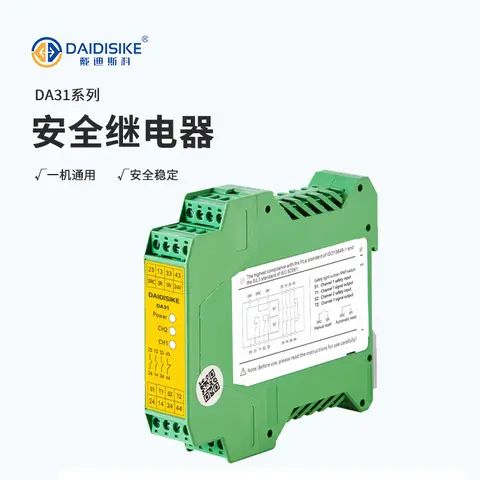
DA31 Emergency-Stop Safety Relay Module
Ultra-slim 22.6 mm Category 4/PL e/SIL 3 safety relay with dual-channel PNP/NPN input and a solid-state status output.
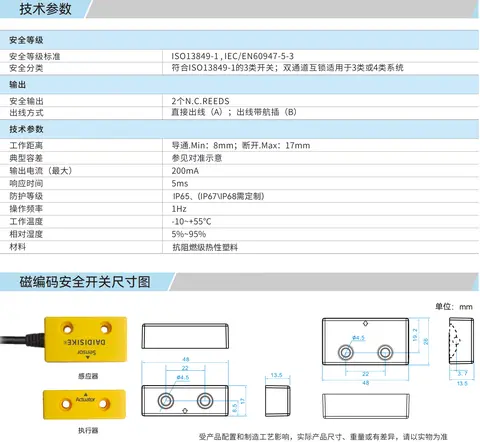
DX-C1 Magnetic Coded Safety Switch
Non-contact coded-magnet safety switch with 17 mm sensing range and high misalignment tolerance for guard doors.
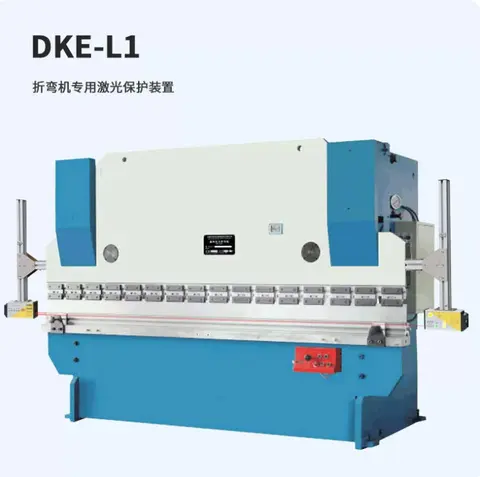
DKE-L3 Press Brake Laser Protection
Ram-mounted laser guarding that tracks the punch tip on press brakes and shears without blocking hand-fed work.
Related Products in Safety Light Curtains
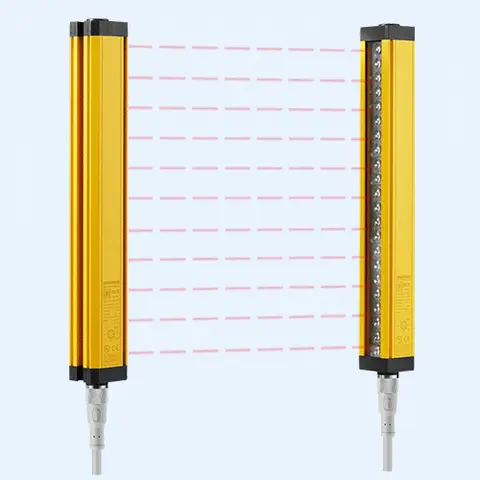
DCE Automation Safety Light Curtain
Compact through-beam safety light curtain in a 30 x 30 mm housing: 10/20/30/40 mm beam pitch, up to 72 beams, 0.3-3 m or 0.3-6 m sensing distance, NPN/PNP output. Catalogue-stated Type 4 design basis; confirm exact safety-document scope.
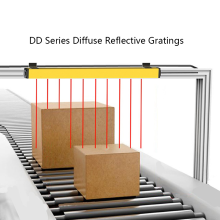
DD / DDOF Single-Sided Area Light Curtain
One housing, no far-side receiver: order DD for diffuse sensing to 2000 mm, or DDOF for per-beam TOF ranging to 4000 mm with zero dead zone and one-key distance teaching. 48 standard models, 4-50 beams.
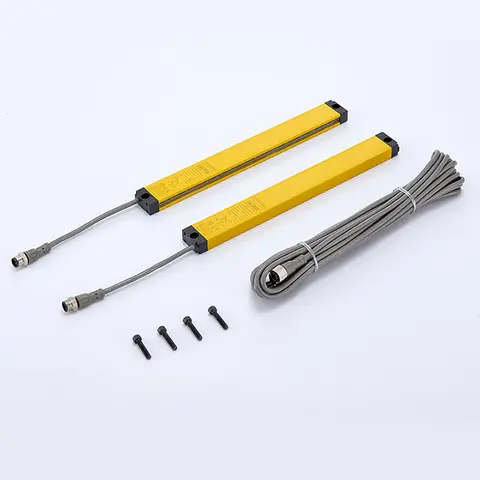
DQB Ultra-thin (Side-emitting) Safety Light Curtain
Ultra-thin side-emitting safety light curtain with a 15 x 30 mm cross-section for gaps too narrow for standard units.
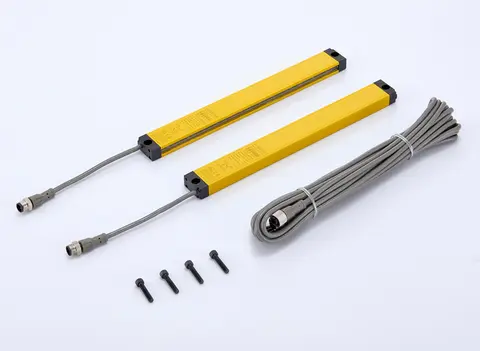
DQBT Ultra-thin Optical-sync Safety Light Curtain
Ultra-thin safety light curtain with optical sync between emitter and receiver — no interconnecting sync cable — in 10/20/40 mm beam pitch, transistor NPN/PNP output, 0.3-3 m detection distance.