
DD-303N / DD-403N Wide-slot Photoelectric Sensor
13 mm through-beam slot sensor giving real tolerance for thick or fluttering parts, still detecting down to 2.2×0.5 mm.
 🔍 Click to enlarge · 1/7
Technical Specifications
| Detection method | Through-beam (slot/fork), 13 mm gap |
|---|---|
| Light source | GaAs infrared LED, 940 nm |
| Output type | NPN output; DD-403N-1 variant confirmed Light-ON (normally open) |
| Minimum detectable object | 2.2×0.5 mm |
| Hysteresis (differential travel) | 0.05 mm max |
| Response frequency | 100 Hz min |
| Supply voltage | DC 5-24V ±10% |
| Current consumption | 15 mA max |
| Protection rating | IP50 |
Overview
The DD-303N and DD-403N are through-beam (slot/fork) photoelectric sensors with a 13 mm detection gap, using a 940 nm GaAs infrared emitter and NPN output. They detect via light interruption between the emitter and receiver mounted in the same slot body, and are built for machine builders and OEMs handling objects that do not travel through the gap on a perfectly fixed, narrow path.
The 13 mm slot is wider than the 5 mm gap used across the rest of the company's slot-sensor line, giving real tolerance for thicker parts or material that flutters or wanders slightly within the gap, without sacrificing sensitivity to fine objects down to 2.2×0.5 mm. Hysteresis is 0.05 mm maximum for a crisp switching point, response frequency is 100 Hz minimum, and the sensor runs on a DC 5-24V (±10%) supply drawing 15 mA maximum.
Features & Benefits
13 mm Wide Slot for Real Mechanical Tolerance
The detection gap is 13 mm, wider than the 5 mm slot used across the rest of the company's slot-sensor line. Thicker workpieces or material that flutters or wanders slightly within the gap can be detected reliably without mechanical fine-tuning.
Fine-Object Sensitivity Despite the Wider Gap
Even with the wider slot, the sensor still resolves objects as small as 2.2×0.5 mm, such as a thin sheet edge or a small protruding tab.
0.05 mm Max Hysteresis for a Crisp Switching Point
Differential travel is 0.05 mm maximum, so the on/off switching point stays tight as the target moves in and out of the beam, useful for edge position or float-flag applications that need a clean, non-chattering trigger.
940 nm GaAs Infrared Emitter
The gallium-arsenide infrared LED operates at 940 nm, outside the visible spectrum, reducing direct interference from ordinary shop lighting.
Wide 5-24 VDC Supply, Low 15 mA Draw
The sensor accepts a 5-24 VDC (±10%) supply and consumes 15 mA maximum, so it runs directly from low-voltage board-level rails or standard 24V industrial circuits, keeping power budget low even with multiple units installed on one machine.
NPN Output with a Confirmed Light-ON Variant
The base models use NPN output; the DD-403N-1 variant is confirmed to switch ON when the beam is received (Light-ON, normally open), letting customers match output logic to their control-signal requirement.
Applications
Models & Ordering Information
Base Series (NPN Output)
Output-Logic Variants
How to Select
- All models are NPN output; choose DD-403N-1 for confirmed Light-ON (normally open) switching logic.
- The 13 mm slot is the widest in the company's slot-sensor line, so prioritize this series when detected parts are thick, flutter, or have loose path tolerance.
- Sensitivity is not sacrificed by the wider slot: minimum detectable object remains 2.2×0.5 mm.
- Supply voltage DC 5-24V (±10%) accepts either 5V board-level power or a 24V industrial circuit; budget 15 mA max per unit.
- IP50 is dust-protected only, with no water protection, so it is intended for indoor, dry-environment use only.
📘 Need the full method? NPN vs PNP Sensor Outputs Explained
When NOT to specify the DD-303N — and what to use instead
The part or wire to be detected is smaller than roughly 2.2x0.5 mm
Why not: The DD-303N/DD-403N's minimum detectable object is 2.2x0.5 mm; the 13 mm gap is optimized for width tolerance, not for resolving objects finer than that figure.
Use instead: a micro-slot model such as DD-L25/L45, which is built around a smaller minimum detectable object
The target is thicker or wider than the 13 mm gap, or cannot be routed through a fixed U-shaped slot at all
Why not: This is a through-beam slot sensor with a fixed 13 mm detection gap; anything that will not physically pass between the emitter and receiver in that gap cannot be detected.
Use instead: a standard through-beam photoelectric sensor with separate emitter/receiver units for larger or free-standing objects that won't fit any slot
The application needs a PNP output or an on-site NO/NC wiring selection
Why not: The specs list NPN output as standard, with only the DD-403N-1 variant confirmed for Light-ON (normally open) logic; no PNP version or field-selectable logic is documented for this series.
Use instead: the DD-670 series, which offers N/P/NA/R output-and-logic variants across its housing styles
The equipment operates outdoors, in a washdown area, or anywhere water spray is expected
Why not: Protection rating is IP50, which the selection guide notes is dust-protected only with no water protection, intended for indoor, dry-environment use.
Use instead: an IP65-rated slot sensor such as DD-L25/L45 for splash-exposed installations
The line needs to count fast-moving or closely-spaced small parts
Why not: Response frequency is only specified as 100 Hz minimum, which the FAQ describes as suited to position/presence detection at low-to-moderate speeds rather than high-speed counting.
Use instead: a slot sensor with a documented sub-millisecond response time, such as FS-KNS (0.3 ms max.), for high-speed counting duty
Specifications we do not publish yet
We only publish a figure once we are confident it is true. The items below are still being validated through further testing and real-world customer feedback, so for now we would rather leave them open than guess. If one of them matters to your design, ask us for the latest validated status.
- Slot depth (how far the object can be inserted into the fork) is not stated in the source material
- MTBF / rated mechanical or electrical lifetime is not stated
- Operating and storage temperature range is not stated
- Cable length and connector/terminal type are not stated
- PNP output availability for this series is not confirmed either way
- DD-303N-1 switching logic (Light-ON vs Dark-ON) is explicitly noted in the source as not yet confirmed for publication
- No certification documents are published on the product page; available on request only, specific standards/marks not stated
- External housing dimensions and mounting-hole pattern are not stated
Frequently Asked Questions
What is the detection gap size of the DD-303N / DD-403N?
What is the minimum object size these sensors can detect?
What is the hysteresis (differential travel) of the sensor?
What light source and wavelength do these sensors use?
What is the output type, NPN or PNP?
What is the supply voltage and current consumption?
What is the response frequency, and is it suitable for high-speed counting?
Is this sensor waterproof or suitable for wet/washdown environments?
Is there a Light-ON (normally open) output variant?
How is this sensor different from the company's standard 5 mm slot sensors?
Can you provide certification documents for the DD-303N / DD-403N?
Related Categories and Example Products
Explore other functions that may be needed in a machine or line. The products below are category examples, not pre-validated electrical or safety combinations. Confirm each interface and application separately: Photoelectric Sensors · Fiber Optic Sensors · Proximity Sensors
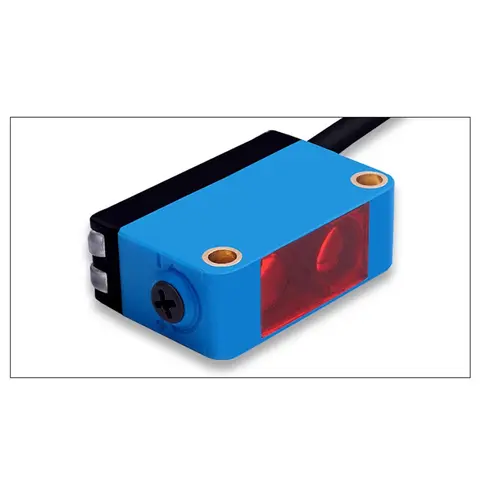
BGS-CX441 / BGS-CX442 Background Suppression Photoelectric Sensor
Wire-adjustable BGS sensor with 2 mm or 15 mm spot, 10-300 mm range, published black/white differential distance.
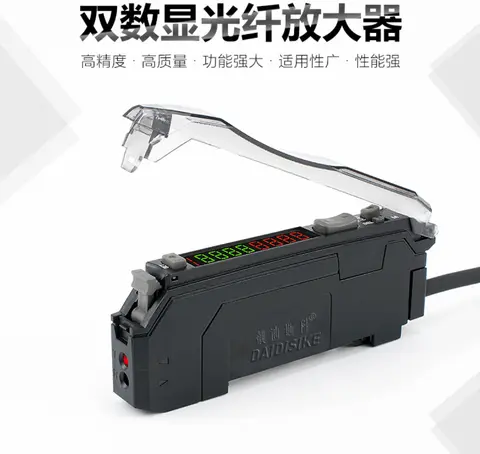
Fiber Amplifier (Digital Fiber Optic Sensor Amplifier)
Digital fiber optic amplifiers with NPN/PNP output, from potentiometer economy models to 25µs dual-display smart units.
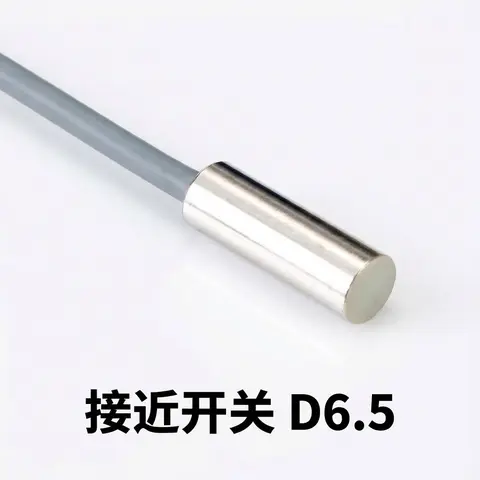
D6.5 Series Inductive Proximity Sensors (Ultra-Short 18mm / Y-Type / 35mm / 45mm)
6.5mm-diameter inductive proximity sensors for tight-clearance mounting where M8 sensors won't fit.
Related Products in Slot Sensors
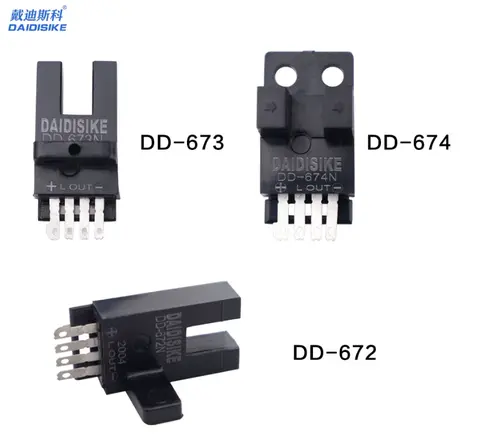
DD-670 Series Slot Photoelectric Sensor (Pin/Plug-in Connector Type)
Plug-in connector slot photoelectric sensor, 5 mm slot, 20 models across 5 housing styles, 4 NPN/PNP output versions.
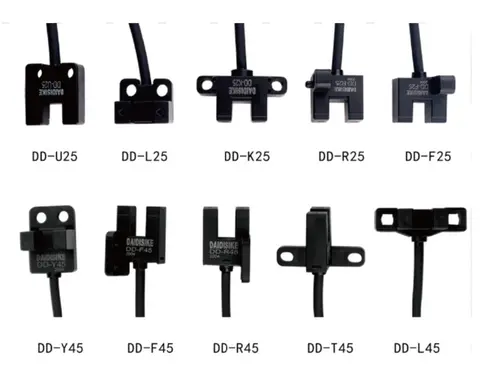
DD-L25/45 Series Micro-slot (Micro U-shaped) Photoelectric Sensor
Micro U-shaped photoelectric sensor with 0.01 mm repeatability and 0.025 mm hysteresis, in 10 compact mounting shapes.
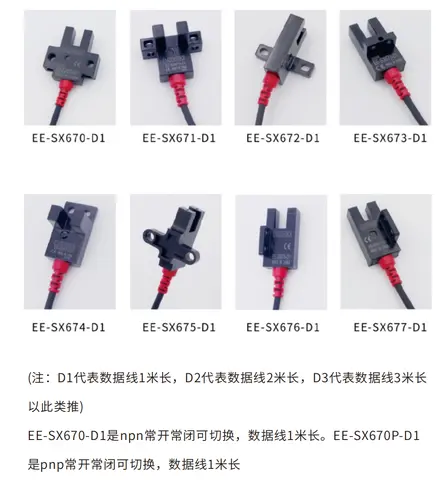
EE-SX67 Series Slot-type Photoelectric Sensor (Photomicrosensor)
Pre-aligned U-shaped photoelectric sensor in 8 shapes with full NPN/PNP output and wiring-selectable NO/NC logic.
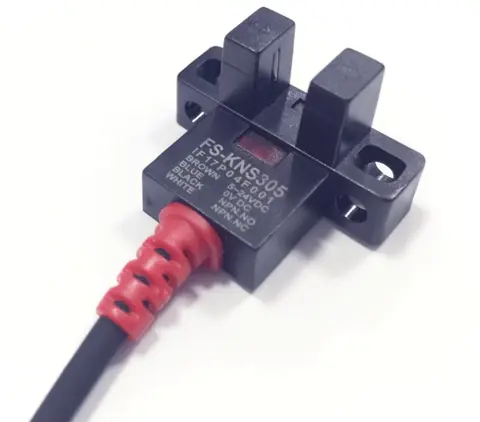
FS-KNS Slot Photoelectric Sensor (Plug-in Type)
5 mm-slot sensor with simultaneous NO+NC outputs, 0.3 ms response, and 1 mm minimum detectable object.