
Fiber Amplifier (Digital Fiber Optic Sensor Amplifier)
Digital fiber optic amplifiers with NPN/PNP output, from potentiometer economy models to 25µs dual-display smart units.
 🔍 Click to enlarge · 1/25
Technical Specifications
| Output Type (all models) | NPN (sinking) / PNP (sourcing) open-collector, offered as a pair on every model |
|---|---|
| Output Logic (all models) | Light-ON / Dark-ON (N.O./N.C.), one-touch button switching in the field |
| Mounting (all models) | 35 mm DIN rail |
| DDSK-WDN/WDP – Display | Single digital display |
| DDSK-WDN/WDP – Operating Voltage | DC12-24V |
| DDSK-WDN/WDP – Power Modes | FINE (200 µs) / TURBO (400 µs) / SUPER (0.8 ms) |
| DDSK-WDN/WDP – Maximum System Detection Distance | 0-4000 mm (fiber-probe dependent) |
| DDSK-WDN/WDP – Teaching Methods | One-point (3-second long press), two-point, manual fine-tuning |
| DDSK-WDN/WDP – Light Intensity Display | 0-4095 (raw) or percentage relative to threshold (100% = setpoint) |
| DDSK-WDN/WDP – Stability Indicator | Bar-graph LED, ±5% / ±10% / ±15% steps relative to setting |
| DDSK-WDN/WDP – Open-Collector Output Rating | 24 V DC / 100 mA max. |
| DDSK-WDN/WDP – OFF-Delay Output Timer | 10 ms / 40 ms (fixed) |
| DDSK-WDN/WDP – External Control Input | Remote calibration, display-ratio switching, zero-shift, reset, emitter-off (input ON: 2 ms / OFF: 20 ms) |
| DDSK-WDN/WDP – Protection Circuits | Reverse-polarity protection (power and output), overcurrent and short-circuit protection (output) |
| DDSK-WDN/WDP – Ambient Light Immunity | Up to 20,000 lux (incandescent) / 30,000 lux (sunlight) |
| DDSK-WDN/WDP – Operating Temperature | -25 to +55°C |
| DDSK-WDN/WDP – Operating Humidity | 35-85% RH |
| DDSK-WDN/WDP – Vibration Resistance | 10-55 Hz, combined amplitude 1.5 mm |
| DDSK-WDN/WDP – Shock Resistance | 500 m/s² |
| DDSK-WDN/WDP – Power Consumption | 710 mW (standard mode) / 540 mW (eco mode) |
| DDSK-WAN/WAP – Display | Multi-function dual digital display (threshold in green, current light intensity 0-9999 in red) |
| DDSK-WAN/WAP – Output | NPN / PNP, NO+NC |
| DDSK-WAN/WAP – Operating Voltage | DC12-24V |
| DDSK-WAN/WAP – Response Frequency | 1000Hz |
| DDSK-WAN/WAP – Response Time | 4-step adjustable, 25/50/200/400 µs |
| DDSK-WAN/WAP – Output Capacity | Open collector, 100mA/24V |
| DA4-DAIDI-N/P – Display | Chinese-menu |
| DA4-DAIDI-N/P – Output | NPN / PNP |
| DA4-DAIDI-N/P – Response Time | 16-25 µs |
| DDSK-WZN/WZP – Type | Economy (potentiometer-adjusted) |
| DDSK-WZN/WZP – Output | NPN / PNP, NO+NC |
| DDSK-WZN/WZP – Operating Voltage | DC10-30V |
| DDSK-WZN/WZP – Response Frequency | 200Hz |
| DDSK-NA11/NA11P – Output | NPN / PNP |
| DDSK-NA11/NA11P – Response Time | 250 µs |
Overview
A fiber amplifier is the electronic control unit of a fiber optic sensor: the amplifier itself mounts on a DIN rail in the control cabinet, while a passive, all-fiber probe (through-beam, diffuse, coaxial or fiber-optic matrix type) extends to the actual detection point. Because the probe end has no electronics, it can be routed into narrow fixtures, high-temperature zones, or locations with strong electromagnetic interference where a conventional housed photoelectric sensor cannot be installed.
It is built for machine builders and panel integrators who need object present/absent or pass/count detection on automation lines and who select NPN or PNP output to match their PLC I/O standard. The lineup spans potentiometer-adjusted economy models through a single-display model with three power modes and two-point teaching, to a dual-display smart model with 4-step selectable response time (25/50/200/400 µs), so each station on a line can be matched to its budget and speed requirement.
Features & Benefits
Dual 8-digit display shows threshold and live signal side by side
On the WAN/WAP dual-display models, the green row shows the preset threshold and the red row shows the current received light intensity (0–9999) in real time, so the operator can read the excess-gain margin at a glance instead of blind tuning. A dirty lens, loose fiber, or misaligned workpiece shows up immediately as a shrinking gap between the two numbers.
4-step selectable response time on the WAN/WAP
Response time can be switched among 25 µs / 50 µs / 200 µs / 400 µs, letting one unit cover both ultra-high-speed detection of fast-moving small parts and high-stability filtering in dusty or vibrating environments, without stocking separate models for different stations.
Three power modes on the WDN single-display model — FINE / TURBO / SUPER
FINE mode (200 µs) is for detecting minute differences at short range; TURBO (400 µs) extends the usable range when FINE falls short; SUPER (0.8 ms) pushes through dusty or otherwise harsh environments. Maximum system detection distance is 0–4000 mm, fiber-probe dependent.
One-point and two-point teaching plus manual fine-tuning (WDN)
A 3-second long-press sets a one-point threshold automatically; two-point teaching (press once on background, once on target) has the amplifier calculate the optimum threshold between the two readings automatically — reliable setup even for low-contrast targets, without relying on operator experience.
Switchable light-intensity display plus a stability bar indicator (WDN)
The display can show either raw received light intensity (0–4095) or a percentage relative to the threshold (100% = setpoint); a bar-graph LED further indicates the current stability level in ±5% / ±10% / ±15% steps against the setting, so detection margin is quantified rather than left to guess.
Full NPN and PNP pairing across the line
Every model is offered in both NPN (sinking, open-collector) and PNP (sourcing, open-collector) versions. Open-collector output is rated 24 V DC / 100 mA max. on the WDN and WAN series. Exporters can match Japanese-style or European-style PLC input/output without changing the mechanical or optical part of the solution.
One-touch Light-ON / Dark-ON (N.O./N.C.) switching
The output action mode is switched by a single button press in the field, so a reversed logic requirement does not mean reordering a different model — it also halves the number of SKUs an integrator needs to stock.
Built-in OFF-delay output timer on the WDN (fixed 10 ms / 40 ms)
Stretches an ultra-short detection pulse so that a PLC's scan cycle can reliably capture it, eliminating the need for an external time relay or extra ladder logic for fast-moving targets.
Applications
Models & Ordering Information
Single-Display (WDN)
Multi-Function Dual Display (WAN)
Chinese-Menu Model (DA4-DAIDI)
Economy (WZN)
High-Speed Response (NA11)
How to Select
- For debugging convenience and budget, choose by display/operation type: economy potentiometer-adjusted models (DDSK-WZN/WZP, DDSK-NA11/NA11P) for standard presence detection without a numeric display; the single-display WDN/WDP for on-site quantified setup and remote calibration; the dual-display WAN/WAP for fast signal-margin readout and high-speed detection; the Chinese-menu DA4-DAIDI-N/P as the fastest-response model.
- Match the output suffix to your PLC type: N = NPN (sinking), common on Japanese-brand and domestic PLCs such as Mitsubishi, Omron, Xinje, and Inovance; P = PNP (sourcing), common on European/American PLCs such as Siemens, Beckhoff, and Rockwell. Every model is offered in both versions.
- N.O./N.C. output logic does not need to be specified at order time — every model's Light-ON/Dark-ON output mode is switched on site with a single button press.
- For detection-speed requirements: DA4-DAIDI (16-25 µs) and WAN/WAP (4-step, fastest 25 µs) suit high-speed pick-and-place and fast-moving small parts; the WDN/WDP (three power modes) and DDSK-NA11 (250 µs) or WZN/WZP (200 Hz) suit general packaging and assembly stations.
- Check operating voltage range: DDSK-WDN/WDP and DDSK-WAN/WAP run on DC12-24V; DDSK-WZN/WZP run on a wider DC10-30V range, useful where supply voltage fluctuates more.
- Pair the amplifier with the correct fiber-optic probe type — through-beam, diffuse, coaxial multi-fiber, or fiber-optic matrix — since actual detection distance is determined by the probe selected, not by the amplifier alone.
📘 Need the full method? NPN vs PNP Sensor Outputs Explained
When NOT to specify the Fiber — and what to use instead
You need a complete, ready-to-mount sensor rather than an electronic control unit
Why not: The amplifier is only the DIN-rail control electronics; every model in this lineup must be paired with a separate passive fiber-optic probe (through-beam, diffuse, coaxial, or matrix type) before it can detect anything at all.
Use instead: A self-contained photoelectric or laser diffuse-reflective sensor with the emitter/receiver already built into one housing.
The application needs detection well beyond the fiber-optic system's practical range
Why not: The WDN model's documented maximum system detection distance is 0-4000 mm, and that ceiling is fiber-probe dependent -- actual usable range with a given head is typically well under that figure.
Use instead: A longer-range laser distance-measurement or standard photoelectric sensor not limited by fiber-optic light transmission.
You need a continuous numeric distance or analog reading rather than a threshold switch
Why not: Every model in this lineup (WDN, WAN, DA4-DAIDI, WZN, NA11) outputs only an NPN or PNP on/off switching signal -- none provide analog, continuous distance, or serial data output.
Use instead: A laser displacement or distance-measurement sensor with 4-20mA or serial output.
You need built-in numeric setup feedback (threshold display, two-point teach, stability indicator) but are pricing the economy models
Why not: The WZN/WZP and NA11/NA11P series are documented as potentiometer-adjusted models without a digital display, two-point teaching, or the stability bar-graph indicator -- those features are documented only for the WDN and WAN series.
Use instead: The WDN/WDP single-display or WAN/WAP dual-display model for teach-assisted setup and live signal-margin readout.
The panel's supply voltage runs outside DC12-24V, down toward DC10V or fluctuating
Why not: WDN/WAN operating voltage is documented as DC12-24V; only the WZN/WZP economy series is documented at the wider DC10-30V range.
Use instead: The DDSK-WZN/WZP economy model for the wider DC10-30V supply tolerance.
There is no confined space, high heat, or EMI reason to keep electronics away from the detection point
Why not: The whole rationale for a remote amplifier plus passive probe, per the product overview, is routing into narrow fixtures, high-temperature zones, or high-EMI locations a housed sensor cannot reach -- without that constraint, the extra probe cable and connector add cost and an installation step versus a self-contained sensor.
Use instead: A self-contained photoelectric sensor mounted directly at the detection point.
Specifications we do not publish yet
We only publish a figure once we are confident it is true. The items below are still being validated through further testing and real-world customer feedback, so for now we would rather leave them open than guess. If one of them matters to your design, ask us for the latest validated status.
- IP/ingress protection rating for the fiber amplifier housing is not stated in the source documentation
- Overall unit dimensions and housing material are not documented
- DA4-DAIDI model's operating voltage, response frequency, and output current rating are not documented -- only the 16-25µs response time is confirmed
- DDSK-WZN/WZP economy model's response time and output current capacity are not documented -- only 200Hz response frequency and DC10-30V voltage are confirmed
- DDSK-NA11/NA11P model's display type, operating voltage, and output capacity are not documented -- only 250µs response time and NPN/PNP output are confirmed
- Certification documents beyond "available on request" are not specified -- no standard/certificate numbers are cited in source material
- Cable length and connector type between the amplifier and the fiber-optic probe are not documented
Frequently Asked Questions
What is the difference between a fiber amplifier and a regular photoelectric sensor?
Should I choose the NPN or PNP version?
Can I switch between normally open and normally closed output without ordering a different model?
What response time does the fastest model in this lineup offer?
How do I set the detection threshold for a low-contrast target?
What is the maximum detection distance?
Does the amplifier protect against wiring mistakes?
How does the amplifier resist false triggering from ambient light?
What mounting format does this product use?
Can the amplifier's control functions be triggered remotely by the PLC?
Can DAIDISIKE provide certification documents such as CE for the fiber amplifier?
Related Categories and Example Products
Explore other functions that may be needed in a machine or line. The products below are category examples, not pre-validated electrical or safety combinations. Confirm each interface and application separately: Laser Switch Sensors · Slot Sensors · Photoelectric Sensors
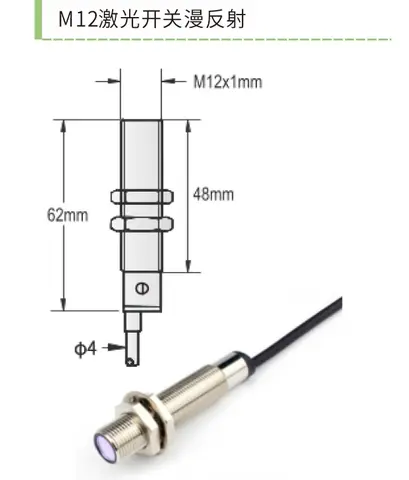
DDSK Laser Diffuse Reflective Sensor M12 / DK Laser Diffuse Reflective Sensor M18
M12/M18 threaded laser diffuse reflective sensor with a visible 650nm red laser for fast alignment.
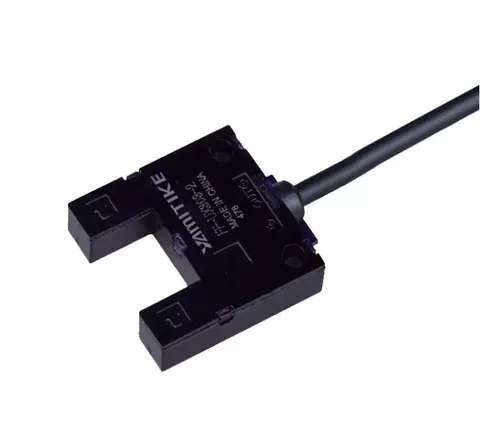
DD-303N / DD-403N Wide-slot Photoelectric Sensor
13 mm through-beam slot sensor giving real tolerance for thick or fluttering parts, still detecting down to 2.2×0.5 mm.
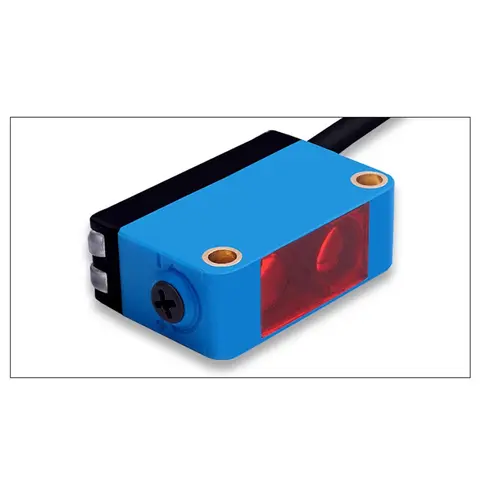
BGS-CX441 / BGS-CX442 Background Suppression Photoelectric Sensor
Wire-adjustable BGS sensor with 2 mm or 15 mm spot, 10-300 mm range, published black/white differential distance.
Related Products in Fiber Optic Sensors
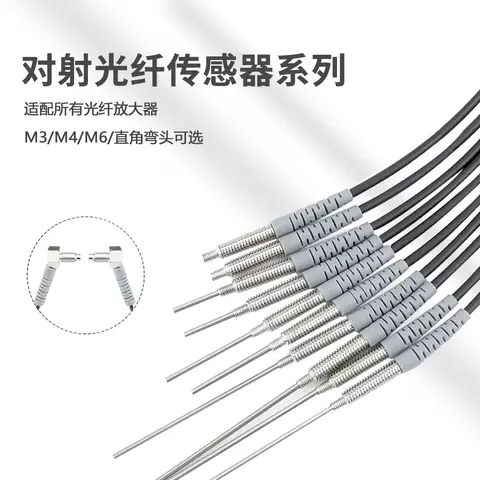
Fiber Optic Sensor Heads (Fiber Units)
Passive M3-M6 fiber optic heads: through-beam, diffuse, coaxial and array types for spots standard sensors can't reach.
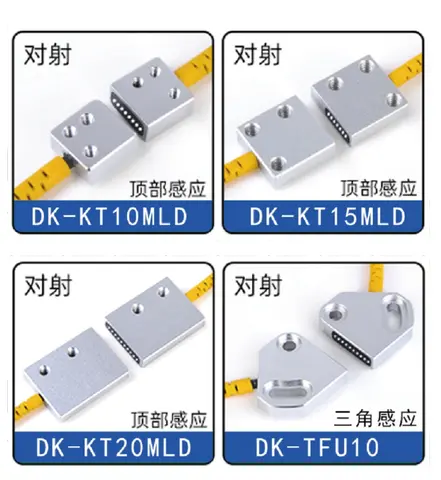
Matrix (Array) Fiber Optic Heads
Array fiber optic heads covering a detection zone instead of a single spot - through-beam and diffuse reflective types.