
Fiber Optic Sensor Heads (Fiber Units)
Passive M3-M6 fiber optic heads: through-beam, diffuse, coaxial and array types for spots standard sensors can't reach.
 🔍 Click to enlarge · 1/24
Technical Specifications
| Sensing head type | Passive optical component -- no electronics at the sensing point; requires a separate fiber amplifier |
|---|---|
| Detection method by series | T series = through-beam; KS series = diffuse reflective; RC series = coaxial multi-core diffuse reflective |
| Body/thread size groups | 310 / 410 / 610 (M3/M4/M6 sizing groups) |
| Sleeve length options | No suffix = no sleeve; -I = 10 mm; -S = 20 mm; -M = 40 mm; -L = 90 mm |
| Standard cable length | 1 m (RC series additionally offers an optional 2 m cable) |
| Right-angle (90 degree) head option | Available across the through-beam, diffuse reflective and coaxial series |
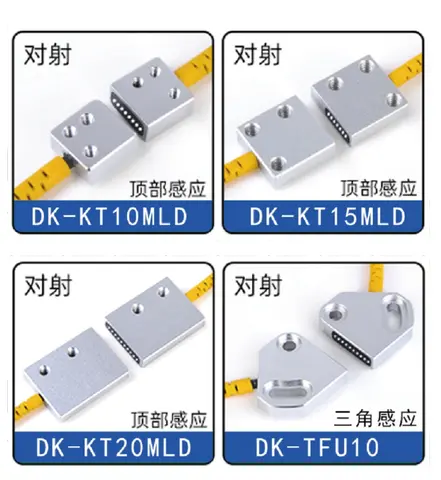
| Array (matrix) fiber unit configurations | DK-KT series = through-beam; DK-KF series = diffuse reflective |
| Compatible amplifier platform max detection range | 0-4,000 mm (system maximum; actual range depends on fiber head and amplifier power setting) |
Overview
Fiber optic sensor heads (fiber units) are passive optical components -- no electronics, no power connection at the sensing point itself. Each head is paired with a separate fiber amplifier, which supplies the light source, receiver electronics and switch output. This product line covers standard through-beam (T series) and diffuse reflective (KS series) heads in M3/M4/M6 thread sizes, coaxial multi-core diffuse reflective heads (RC series) for small-target/close-range work, and array (matrix) fiber units (DK-KT through-beam / DK-KF diffuse reflective) that project a wide detection band instead of a single point. It is built for machine builders, panel integrators and equipment OEMs who need a detection point inside a fixture, near a welding cell, or on a moving part -- locations a self-contained photoelectric sensor cannot reach or survive.
Standard T, KS and RC series share a common 310/410/610 body-size system with four optional sleeve lengths (10, 20, 40 and 90 mm, suffix -I/-S/-M/-L), and all three series are also available in a right-angle (90 degree) head for low-profile mounting. Array fiber units are offered as 9 through-beam models (DK-KT series) and 9 diffuse reflective models (DK-KF series). The standard fiber cable is 1 m, with a 2 m option on the RC series, and every head pairs with the same fiber amplifier platform (e.g. WDN/WAN/DA4), which is rated for a maximum system detection range of 0-4,000 mm.
Features & Benefits
Fully Passive Sensing Head
All detection electronics live in the remote amplifier; the head itself has zero electronic components, so it is unaffected by electromagnetic interference or heat that would disrupt a conventional photoelectric sensor's internal circuitry.
M3/M4/M6 Miniature Threaded Heads with Four Sleeve-Length Options
Through-beam, diffuse and coaxial heads share the same 310/410/610 sizing and -I/-S/-M/-L sleeve-length suffixes (10/20/40/90 mm), letting the sensing point reach deep into fixtures, molds or narrow gaps where a self-contained sensor body cannot fit.
Right-Angle (90 Degree) Versions Across the Range
Through-beam, diffuse reflective and coaxial types are all available with a right-angle head, for low-profile, flush-to-wall or flush-to-floor mounting, without bending or stressing the fiber cable itself to change its aim.
Through-Beam and Diffuse Reflective for Two-Sided or One-Sided Installation
Through-beam (emitter/receiver on opposite sides) gives the largest excess gain and best contamination tolerance; diffuse reflective (emitter/receiver on the same side) needs mounting access on one side only, saving a bracket, wiring run and alignment step.
Array (Matrix) Fiber Units Cover a Detection Zone, Not Just One Point
DK-KT (through-beam) and DK-KF (diffuse reflective) array fiber units arrange multiple light points across a detection band, so a target passing anywhere across that band produces an output, greatly reducing missed detections of small, irregular or position-shifting targets versus a single-point fiber.
Array Fiber Units Target Proven Hard-to-Detect Objects
Detection scope covers thin sheets, battery electrode sheets, coated films, and small parts in trays -- difficult targets that reflect poorly or present very little surface area to a single-point sensor.
Coaxial Multi-Core Heads (RC Series) for Small-Target, Close-Range Detection
Coaxial optical layout is the industry-standard arrangement for keeping the light spot concentric with the mounting axis, which is preferable for small-hole or mark detection at close range.
Flexible, Bend-Resistant Fiber Cable
The fiber cable routes through narrow channels like ordinary wiring, suited to installation along moving mechanisms, inside machine bodies, or in oily/vibrating environments.
Applications
Models & Ordering Information
Through-Beam Fiber Heads (T Series)
Diffuse Reflective Fiber Heads (KS Series)
Coaxial Multi-Core Diffuse Reflective Fiber Heads (RC Series)
Array (Matrix) Fiber Units -- Through-Beam (DK-KT Series)
Array (Matrix) Fiber Units -- Diffuse Reflective (DK-KF Series)
How to Select
- Need maximum excess gain and best tolerance to dirt/contamination, and can mount on both sides of the target -- choose through-beam: T series (standard) or DK-KT array series.
- Can only mount on one side of the target, or want to save wiring and a second bracket -- choose diffuse reflective: KS series (standard) or DK-KF array series.
- Need small-target, close-range, or fixed-point detection with the light spot kept on the mounting axis -- choose coaxial multi-core diffuse reflective: RC series.
- Target is small, irregular, thin, or its position along the detection line varies (electrode sheets, films, small parts in trays) -- choose an array (matrix) fiber unit: DK-KT (through-beam) or DK-KF (diffuse reflective).
- Among standard T/KS/RC series, the 310/410/610 suffix denotes three body/thread size groups, with 310 the smallest and 610 the largest and most robust.
- Choose sleeve length by how deep the sensing tip must reach: no suffix (flush head), -I (10 mm), -S (20 mm), -M (40 mm), or -L (90 mm, for the deepest recesses).
- Choose a right-angle (90 degree) head -- available on T, KS and RC series -- for low-profile, flush mounting where a straight head cannot be aimed without bending the cable.
- Standard cable length is 1 m across the range; the RC series additionally offers an optional 2 m cable.
- Every fiber head requires a separate fiber amplifier (e.g. WDN/WAN/DA4 series) to produce a usable switch output; select the fiber head first by installation geometry and target type, then select the amplifier by required detection distance and output type.
📘 Need the full method? NPN vs PNP Sensor Outputs Explained
When NOT to specify the Fiber — and what to use instead
You need a functioning sensor on its own, without sourcing any other part
Why not: The fiber head is documented as a passive optical component with no electronics; it must be paired with a separate fiber amplifier to produce any switch output.
Use instead: A self-contained photoelectric sensor with electronics built into the same housing.
Only one side of the target is accessible for mounting, but a through-beam (T series) head is being specified
Why not: T-series through-beam heads require the emitter and receiver mounted on opposite sides of the target -- documented explicitly in the sellingPoints and FAQ.
Use instead: A KS diffuse reflective or RC coaxial diffuse reflective head, both of which need mounting access on one side only.
The target is small, thin, irregularly shaped, or its position shifts across the detection line
Why not: Standard T/KS/RC heads project a single fixed light point; the product overview states array units exist specifically because a single-point fiber risks missing exactly this class of target (electrode sheets, films, small parts in trays).
Use instead: A DK-KT (through-beam) or DK-KF (diffuse reflective) array/matrix fiber unit, sold as the separate matrix-fiber-optic-heads product line.
The installation needs a fiber cable run longer than the documented standard length
Why not: Standard cable length is 1 m across the range; only the RC (coaxial) series additionally offers an optional 2 m cable -- no longer length is documented for the T or KS series.
Use instead: Confirm with the factory whether a custom longer cable is available, or relocate the amplifier closer to the head.
Specifications we do not publish yet
We only publish a figure once we are confident it is true. The items below are still being validated through further testing and real-world customer feedback, so for now we would rather leave them open than guess. If one of them matters to your design, ask us for the latest validated status.
- Minimum bend radius of the fiber cable is not documented
- Fiber core diameter and core count (especially the RC coaxial multi-core arrangement) are not documented
- Operating temperature range of the head itself is not documented
- IP/protection rating of the head is not documented, relevant since some heads are positioned near welding, EMI or heat sources
- Housing/tip material is not documented
- Certification documents beyond "available on request" are not specified
- Individual order codes for the right-angle head versions are not listed -- only that a right-angle version "is available" for T310/T410/T610, KS310/KS410/KS610 and RC310/RC410/RC610
Frequently Asked Questions
Does the fiber head itself contain any electronics or need its own power supply?
What is the difference between through-beam and diffuse reflective fiber units?
What is an array (matrix) fiber unit and when should I use one instead of a standard fiber unit?
What thread sizes are available for the standard fiber heads?
What sleeve lengths are available, and what do the suffixes mean?
What is a coaxial multi-core fiber unit used for?
Is a right-angle (90 degree) head version available?
Can the fiber unit be used near welding equipment or in other high-EMI environments?
What amplifier do I need with this fiber unit, and what detection distance can I expect?
What is the standard cable length?
Can DAIDISIKE provide certification documents for this fiber optic sensor head series?
Related Categories and Example Products
Explore other functions that may be needed in a machine or line. The products below are category examples, not pre-validated electrical or safety combinations. Confirm each interface and application separately: Laser Switch Sensors · Slot Sensors · Photoelectric Sensors
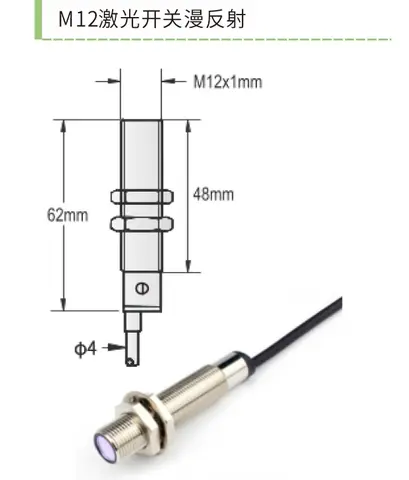
DDSK Laser Diffuse Reflective Sensor M12 / DK Laser Diffuse Reflective Sensor M18
M12/M18 threaded laser diffuse reflective sensor with a visible 650nm red laser for fast alignment.
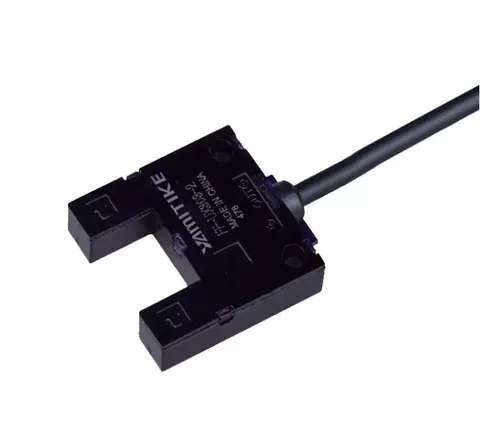
DD-303N / DD-403N Wide-slot Photoelectric Sensor
13 mm through-beam slot sensor giving real tolerance for thick or fluttering parts, still detecting down to 2.2×0.5 mm.
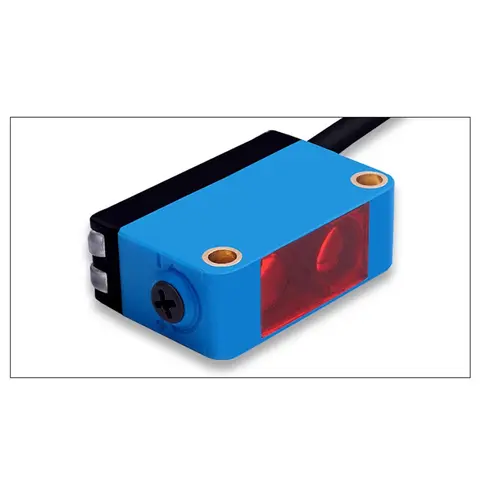
BGS-CX441 / BGS-CX442 Background Suppression Photoelectric Sensor
Wire-adjustable BGS sensor with 2 mm or 15 mm spot, 10-300 mm range, published black/white differential distance.
Related Products in Fiber Optic Sensors
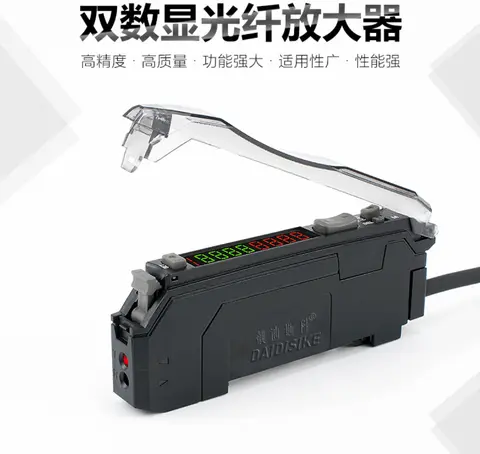
Fiber Amplifier (Digital Fiber Optic Sensor Amplifier)
Digital fiber optic amplifiers with NPN/PNP output, from potentiometer economy models to 25µs dual-display smart units.
Matrix (Array) Fiber Optic Heads
Array fiber optic heads covering a detection zone instead of a single spot - through-beam and diffuse reflective types.