
Matrix (Array) Fiber Optic Heads
Array fiber optic heads covering a detection zone instead of a single spot - through-beam and diffuse reflective types.
 🔍 Click to enlarge · 1/15
Technical Specifications
| Product Type | Passive matrix (array) fiber optic sensing head for area/wide-field detection |
|---|---|
| Configurations | Through-beam (DK-KT series); diffuse reflective (DK-KF series) |
| Output | None at the head (passive optical component); switching signal provided by a separate fiber amplifier |
| Compatible Amplifiers | WDN / WAN / DA4-series fiber amplifier platform (NPN/PNP output, digital display, teach function, selectable power modes) |
| System Detection Range | Up to 4,000 mm with the fiber amplifier platform, depending on the fiber unit and power mode selected |
| Model Range | 9 through-beam models (DK-KT) and 9 diffuse reflective models (DK-KF), 18 in total |
| Certifications | Available on request |
Overview
Matrix (array) fiber optic heads project multiple light points across a detection zone instead of a single spot, so small, irregular, or position-shifting parts are detected wherever they pass through the zone. The DK-KT series is through-beam, with emitter and receiver heads mounted on opposite sides of the target; the DK-KF series is diffuse reflective, with emitter and receiver on the same side so only one side of the target needs mounting access.
Each head is a fully passive optical probe: it contains no electronics and produces no output on its own. A separate fiber amplifier (WDN/WAN/DA4-series) supplies the light source, receives the return signal, and delivers the actual NPN/PNP switching output, digital display, and teach functions. This architecture suits engineers detecting small, thin, or position-uncertain parts in confined or electrically noisy locations - typically in battery and electronics manufacturing, packaging, and conveyor automation.
Features & Benefits
Area coverage instead of a single point
A matrix fiber head arranges multiple light points into an array so the probe covers a detection zone; a part passing anywhere across that zone produces a signal, instead of requiring it to cross one exact spot. This substantially reduces missed detections of small, irregular, or position-shifting targets on vibratory feeders and conveyors compared with a single-point fiber sensor.
Proven target set includes thin sheets, battery electrode sheets and coated films
The published application scope for this product line covers thin sheets, battery electrode sheets, coated/laminated films, and presence verification of small components inside trays - target types that are traditionally difficult for point-style sensors because they are thin, reflective, or easy to miss.
Through-beam and diffuse reflective configurations cover both mounting scenarios
DK-KT (through-beam) places emitter and receiver on opposite sides for maximum excess gain and better tolerance of contamination; DK-KF (diffuse reflective) places both on the same side, so only one side of the target needs mounting access, brackets, and wiring.
Fully passive sensing head - no electronics at the detection point
The head itself is a purely passive optical component; all switching electronics reside in the remote fiber amplifier. This makes the probe end inherently immune to electromagnetic interference and suited to locations near welding equipment, VFDs/inverters, or other electrically noisy machinery where conventional self-contained photoelectric sensors can misfire.
Flexible fiber cable routes through narrow channels like ordinary wiring
The fiber cable is bend-resistant and can be routed along machine arms, through drag chains, or inside tight enclosures the same way electrical cable is routed, and is resistant to oil and vibration in service.
One amplifier platform serves the whole probe range
All matrix fiber heads work with the same fiber amplifier platform (WDN/WAN/DA4-series), which provides the NPN/PNP switching output, digital display, teach function, and selectable power modes. Probe geometry can be chosen per application while one amplifier standard is kept across the plant, with a system detection range of up to 4,000 mm depending on the fiber unit and power mode selected.
Applications
Models & Ordering Information
DK-KT Series - Through-Beam Matrix Fiber Heads
DK-KF Series - Diffuse Reflective Matrix Fiber Heads
How to Select
- Choose the configuration first: pick the DK-KT through-beam series when both sides of the target offer mounting space and you want maximum excess gain and contamination tolerance; pick the DK-KF diffuse reflective series when only one side is accessible and you want to save the opposite-side bracket and wiring.
- Select the size grade: each series offers eight numeric-suffix models (10/15/20/25/30/35/50/120) plus one U10 model (DK-KTU10 / DK-KFU10). Confirm the actual detection-face dimensions against factory drawings or datasheets rather than inferring them from the model number.
- Confirm output and power via the amplifier, not the head: the head itself has no output. NPN/PNP, NO/NC, supply voltage, detection distance, and response time are all determined by the paired fiber amplifier (WDN/WAN/DA4-series) and its power-mode setting, so specify head, amplifier, and power mode together.
- Check the operating environment: if the mounting point is near welding machines, VFDs, or other strong EMI sources, or space is tight and flexible routing is needed, the passive-head-plus-remote-amplifier architecture outperforms self-contained photoelectric switches; where space is ample, distance is long, and interference is low, compare the economics of a self-contained photoelectric sensor.
📘 Need the full method? NPN vs PNP Sensor Outputs Explained
When NOT to specify the Matrix — and what to use instead
You need a single, precise detection point rather than coverage across a zone
Why not: The product overview states matrix heads project multiple light points across a detection zone instead of a single spot -- the opposite of what a precise single-point application needs.
Use instead: A standard single-point through-beam (T), diffuse reflective (KS), or coaxial (RC) fiber head from the fiber-optic-sensor-heads line.
You need a functioning sensor on its own, without a separate control unit
Why not: The spec table states the head has no output at all -- it is a passive optical component; the switching signal is produced only by a separate fiber amplifier.
Use instead: The matrix head paired with a WDN/WAN/DA4-series fiber amplifier, or a self-contained photoelectric sensor if area coverage is not required.
Final fixture or enclosure design requires exact detection-face dimensions
Why not: The selectionGuide explicitly instructs confirming the actual detection-face dimensions against factory drawings or datasheets rather than inferring them from the model number.
Use instead: Request the factory drawing or datasheet for the specific DK-KT/DK-KF model before finalizing enclosure design.
The plant standard amplifier is a third-party brand, not DAIDISIKE's own platform
Why not: The FAQ states compatibility with third-party amplifiers has not been verified and is not claimed.
Use instead: Use the WDN/WAN/DA4-series amplifier platform this product line is designed for, or request compatibility testing before specifying a third-party amplifier.
Specifications we do not publish yet
We only publish a figure once we are confident it is true. The items below are still being validated through further testing and real-world customer feedback, so for now we would rather leave them open than guess. If one of them matters to your design, ask us for the latest validated status.
- Exact detection-face/zone dimensions for each size grade (10/15/20/25/30/35/50/120, U10) are not listed numerically
- Response time and detection distance specific to each individual matrix model are not documented -- only the amplifier platform's system maximum of up to 4,000 mm is confirmed
- Fiber cable length for the DK-KT/DK-KF series is not documented
- Operating temperature range and IP/protection rating are not documented
- Certification documents beyond "available on request" are not specified
- Number of light points within the array and their spacing/pitch are not documented
Frequently Asked Questions
What is the difference between a matrix (array) fiber optic head and a standard single-point fiber optic head?
Do matrix fiber heads produce a switching output by themselves?
What is the difference between the DK-KT and DK-KF series?
What detection distance can I expect from a matrix fiber head?
What applications are matrix fiber heads suited for?
Can matrix fiber heads be used near welding equipment or variable-frequency drives?
Are matrix fiber heads compatible with any fiber amplifier?
Related Categories and Example Products
Explore other functions that may be needed in a machine or line. The products below are category examples, not pre-validated electrical or safety combinations. Confirm each interface and application separately: Laser Switch Sensors · Slot Sensors · Photoelectric Sensors
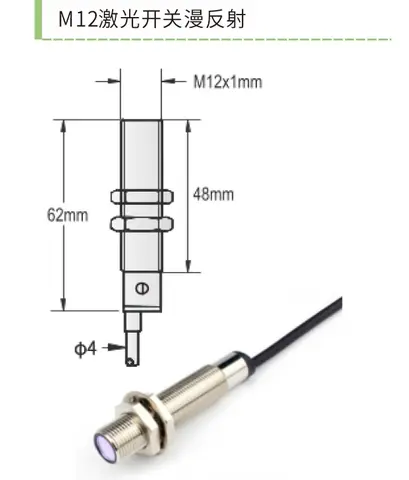
DDSK Laser Diffuse Reflective Sensor M12 / DK Laser Diffuse Reflective Sensor M18
M12/M18 threaded laser diffuse reflective sensor with a visible 650nm red laser for fast alignment.
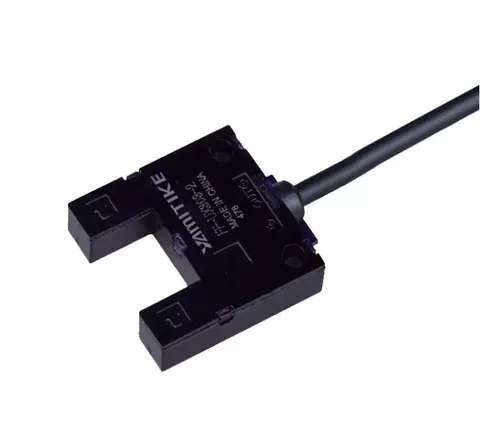
DD-303N / DD-403N Wide-slot Photoelectric Sensor
13 mm through-beam slot sensor giving real tolerance for thick or fluttering parts, still detecting down to 2.2×0.5 mm.
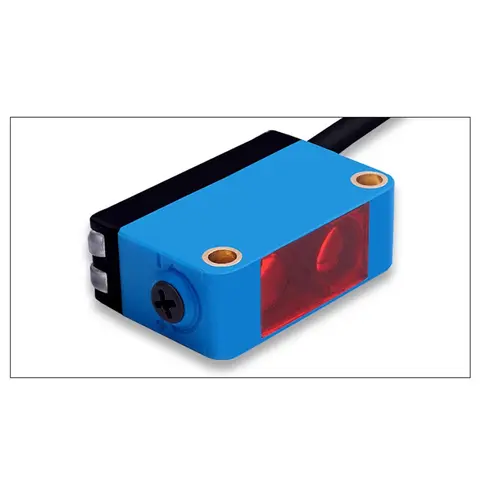
BGS-CX441 / BGS-CX442 Background Suppression Photoelectric Sensor
Wire-adjustable BGS sensor with 2 mm or 15 mm spot, 10-300 mm range, published black/white differential distance.
Related Products in Fiber Optic Sensors
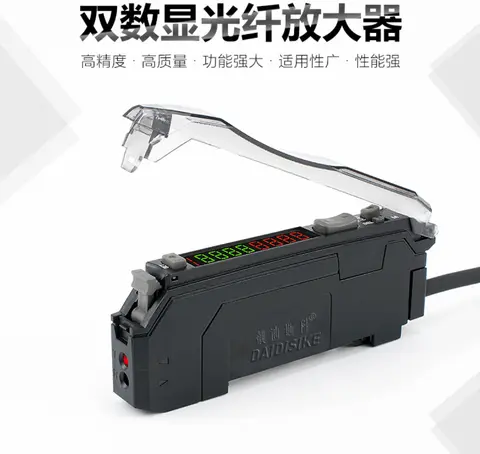
Fiber Amplifier (Digital Fiber Optic Sensor Amplifier)
Digital fiber optic amplifiers with NPN/PNP output, from potentiometer economy models to 25µs dual-display smart units.
Fiber Optic Sensor Heads (Fiber Units)
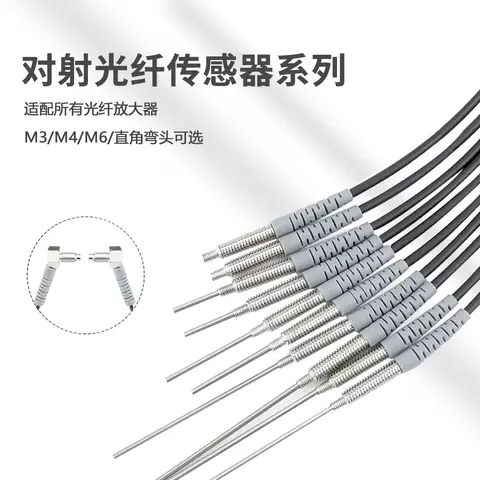
Passive M3-M6 fiber optic heads: through-beam, diffuse, coaxial and array types for spots standard sensors can't reach.