
DX-D2 & DX-D3 Safety Door Switch
Mechanical NC/NO safety interlock switch, IP67, 1,000,000-cycle mechanical life, no locking function.
▶ Watch it in action: Safety Light Curtain + Guard-Locking Door Switch Interlock — Wiring Demo
 🔍 Click to enlarge · 1/21
Technical Specifications
| Output Type | Mechanical contact (NC/NO combination, no locking function) |
|---|---|
| Head Material | Resin |
| Protection Rating | IP67 |
| Mechanical Life | 1,000,000 operations |
| Electrical Life | 300,000 operations |
| Rated Insulation Voltage Ui | 400V |
| Conventional Thermal Current Ith | 8A |
| Rated Operational Voltage/Current Ue / Ie | AC400V / 2A |
| Forced Separation | ≥60N / ≥10mm |
| Standards | IEC/EN60947-5-1; GB14048.5-2017 |
| Cable Connection | Factory-fitted PG13.5 cable gland |
| Key Insertion Orientations | 8 directions |
Overview
DX-D2 and DX-D3 are mechanical, contact-based safety door switches - tongue/key-operated interlock switches for machine guard doors. A matching actuator key from the DX-K series (8 insertion orientations) is inserted into the switch head; when the guard door is opened, the key withdraws and mechanically drives the internal NC/NO contact block. These two models have no electronic OSSD output and no mechanical locking segment - they are a straightforward, monitoring-only interlock rather than a locking safeguard.
They suit OEM machine builders and panel/equipment integrators who need to wire door-open detection into a safety relay or safety PLC for guard doors, inspection hatches, and access covers where a locking/holding function is not required. The range covers four ordering codes with different NC/NO contact combinations, an IP67-rated resin head, forced contact separation of at least 60N over at least 10mm of travel, and a rated mechanical life of 1,000,000 operations with a rated electrical life of 300,000 operations.
Features & Benefits
Mechanical Contact Interlock, No Wiring Ambiguity
Pure NC/NO contact output integrates directly with conventional safety relays without needing OSSD-capable inputs.
Four Contact Configurations for Circuit Redundancy
DX-D2-CO (1NC+1NO), DX-D2-2C (2NC), DX-D3-2CO (2NC+1NO), and DX-D3-3C (3NC) let designers choose single-channel or redundant dual-channel wiring.
IP67-Rated Resin Head
Sealed construction suited to washdown, dust, or coolant-mist areas around the guard door.
Long Mechanical/Electrical Life for High-Cycle Doors
Rated 1,000,000 mechanical operations and 300,000 electrical operations reduces the maintenance burden on frequently opened access doors.
Forced Contact Separation for Direct-Opening Reliability
Forced separation force of at least 60N with at least 10mm of travel is a design feature intended to help the NC contacts open even if a contact welds shut, supporting fail-safe wiring practice.
Designed to Relevant IEC/GB Safety Switch Standards
Complies with the design requirements of IEC/EN60947-5-1 and GB14048.5-2017 for low-voltage switchgear control-circuit devices and interlock switching elements.
8 Key-Insertion Orientations for Flexible Door Layouts
The switch accepts its actuator key from 8 different directions, easing mounting on doors that hinge or slide from either side.
Ready Cable Connection Out of the Box
Supplied with a factory-fitted PG13.5 cable gland, cutting installation steps on the panel line.
Applications
Models & Ordering Information
DX-D2 / DX-D3 Ordering Codes
PDF & 3D CAD Downloads
Browse all downloadsDX-D2 / DX-D3 Safety Door Switch Technical Data Sheet
Find the file for your exact model
Open the download center with this series selected. Search the full model, check the file details, and download the matching CAD file.
Confirm the document and CAD file match the exact ordered version before installation or mechanical design. Contact us if your model is not listed.
How to Select
- DX-D2-CO (1NC+1NO): a single-channel safety signal plus one auxiliary signal (e.g. status indication), suited to the most basic interlock-plus-feedback needs.
- DX-D2-2C (2NC): two normally-closed contacts, usable as a dual-channel redundant safety circuit.
- DX-D3-2CO (2NC+1NO): two normally-closed contacts form the safety channel, with one normally-open contact available as an auxiliary/indication signal for circuits needing an extra output.
- DX-D3-3C (3NC): three normally-closed contacts, suited to more complex multi-circuit interlocking or applications needing three independent signals.
- DX-D2 and DX-D3 both have no locking function (no C/D segment); if the equipment needs the door to be locked or held closed, choose another door lock series from the factory range that offers locking, or combine with the DXL mechanical door bolt.
- Both series use an IP67 resin head suited to general industrial environments and washdown, dust, or oil-mist locations; confirm with the factory if the application involves harsher chemical exposure or high-pressure washdown.
- 8 key-insertion orientations are available; select the orientation that matches the door's hinge or sliding direction.
- Check the switch's electrical ratings - Ui 400V, Ith 8A, Ue AC400V / Ie 2A - against the safety relay or control circuit it will be wired into.
- Select DX-D2/DX-D3 when the project requires design compliance with IEC/EN60947-5-1 or GB14048.5-2017.
📘 Need the full method? How to Choose a Safety Door Switch / Interlock
When NOT to specify the DX-D2 — and what to use instead
Machine risk assessment requires the guard door to stay locked closed during coast-down or other lingering hazard.
Why not: Per the current model list, DX-D2 and DX-D3 have no locking segment -- they detect door position only and do not hold or lock the door.
Use instead: DX-D6 guard-locking switch, DX-W2/DX-W3 solenoid door locks, or a DX-D2/DX-D3 switch combined with the DXL mechanical door bolt
The application needs RFID-coded or non-contact sensing to resist substitute-actuator defeat or to tolerate door misalignment without mechanical wear.
Why not: DX-D2/DX-D3 use a mechanical key/tongue and plain NC/NO contacts, with no coding level and no non-contact tolerance for misalignment.
Use instead: DX-R1 non-contact RFID-coded safety switch
The switched load exceeds the device's electrical ratings (Ui 400V, Ith 8A, Ue AC400V / Ie 2A).
Why not: These are the published limits for DX-D2/DX-D3 contacts; driving heavier loads directly risks contact damage or welding.
Use instead: Route the load through a DA31 or DQSRN safety relay sized for the actual load, using DX-D2/DX-D3 only as the pilot signal
The environment requires ingress protection above IP67 (e.g. high-pressure washdown).
Why not: DX-D2/DX-D3's resin head is rated IP67, with no higher ingress-protection option published for this series.
Use instead: Confirm washdown requirements with the factory before specifying, or evaluate the DX-C1/DX-R1 series (IP65 standard, custom up to IP68)
The project needs a single, formally certified safety-function block with a published PFHd for a SISTEMA calculation.
Why not: DX-D2/DX-D3 are only stated as designed to IEC/EN60947-5-1 and GB14048.5-2017; no PFHd/B10d/MTTFd or certificate number is published for the device.
Use instead: Request certification documents from the factory and perform the PL/SIL calculation at the safety-relay level (DA31/DQSRN)
Specifications we do not publish yet
We only publish a figure once we are confident it is true. The items below are still being validated through further testing and real-world customer feedback, so for now we would rather leave them open than guess. If one of them matters to your design, ask us for the latest validated status.
- Operating temperature range
- PFHd / B10d / MTTFd reliability figures
- Certificate number and scope for the IEC/EN60947-5-1 / GB14048.5-2017 design basis
- Overall dimensions and weight
- Mechanical/dimensional distinction between the DX-D2 and DX-D3 bodies beyond contact count
- Housing/actuator material specification is not published yet
Frequently Asked Questions
Is the DX-D2/DX-D3 an electronic (OSSD) safety switch or a mechanical contact switch?
Do DX-D2 and DX-D3 have a door-locking function?
What contact configurations are available?
What is the difference between DX-D2 and DX-D3?
What IP rating do these switches carry?
What standards are these switches designed to?
What is the rated electrical life?
What does forced separation mean on this switch and why does it matter?
Can DX-D2/DX-D3 be combined with a mechanical door bolt for locking?
What cable connection does the switch use?
Are DX-D2 and DX-D3 certified to any safety standard?
Related Categories and Example Products
Explore other functions that may be needed in a machine or line. The products below are category examples, not pre-validated electrical or safety combinations. Confirm each interface and application separately: Safety Relays · Safety Light Curtains · Safety Mats
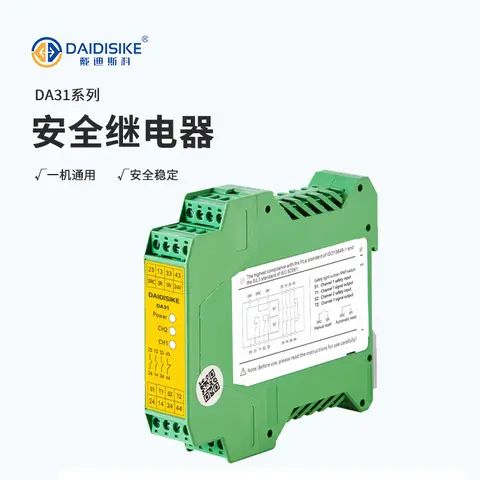
DA31 Emergency-Stop Safety Relay Module
Ultra-slim 22.6 mm Category 4/PL e/SIL 3 safety relay with dual-channel PNP/NPN input and a solid-state status output.
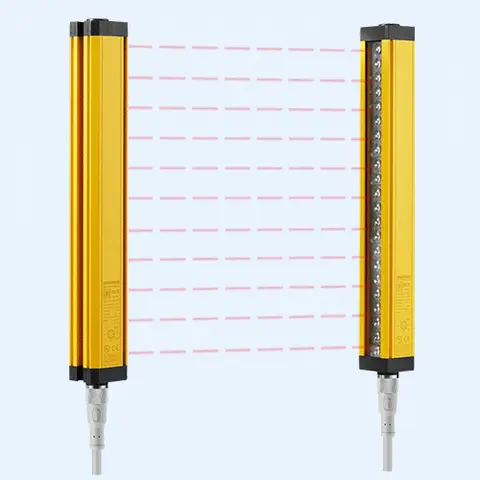
DCE Automation Safety Light Curtain
Compact through-beam safety light curtain in a 30 x 30 mm housing: 10/20/30/40 mm beam pitch, up to 72 beams, 0.3-3 m or 0.3-6 m sensing distance, NPN/PNP output. Catalogue-stated Type 4 design basis; confirm exact safety-document scope.
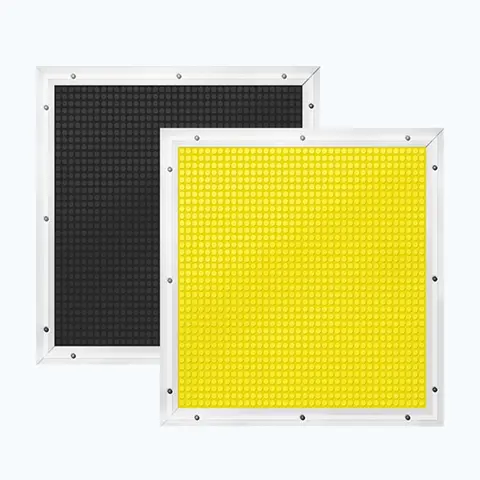
JT14 Safety Mat (Economical)
Economical pressure-sensitive safety mat with volt-free N.O. output for large-area or custom-shape floor guarding.
Related Products in Safety Door Locks & Switches
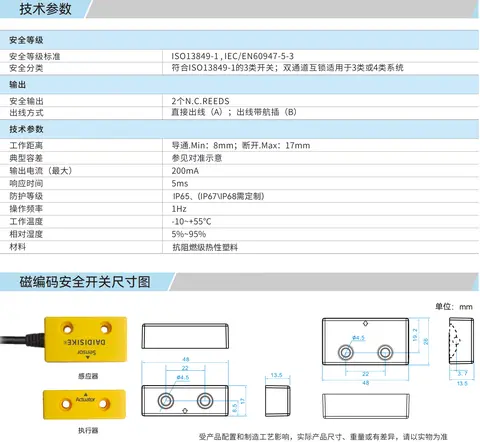
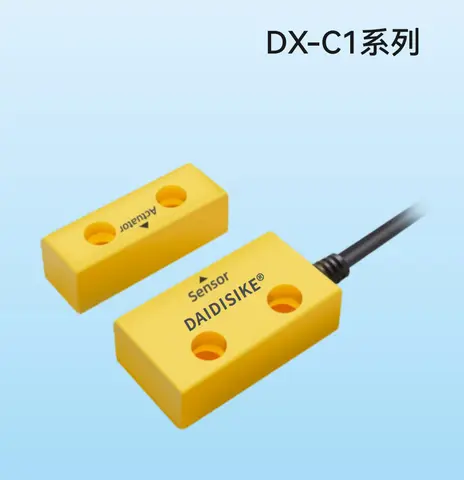
DX-C1 Magnetic Coded Safety Switch
Non-contact coded-magnet safety switch with 17 mm sensing range and high misalignment tolerance for guard doors.
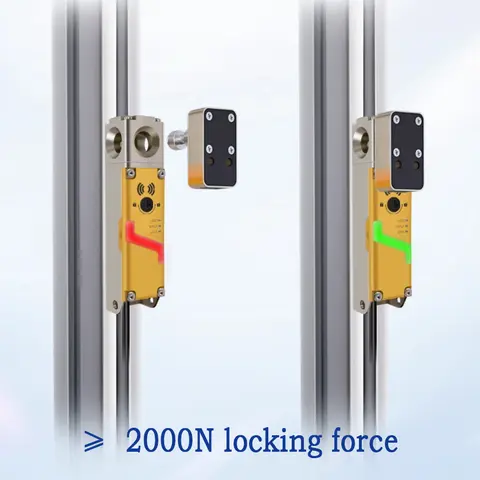
DX-D6 Guard Locking Safety-Door Switch
Guard locking safety-door switch: 2000 N holding force, redundant dual outputs, RFID-coded actuators.
DX-K Series Safety Door Lock Operation Keys
11-model range of fixed and adjustable operation keys for DX-W2/W3/W5 and DX-D2/D3 safety door interlock switches.
DX-R1 Non-contact Safety Switch (RFID Coded)
Non-contact RFID-coded safety switch, dual-channel PLe/Type 4 output, 0-10mm switch-on, cascadable, 8 NPN/PNP models.