
DX-K Series Safety Door Lock Operation Keys
11-model range of fixed and adjustable operation keys for DX-W2/W3/W5 and DX-D2/D3 safety door interlock switches.
▶ Watch it in action: Safety Light Curtain + Guard-Locking Door Switch Interlock — Wiring Demo
 🔍 Click to enlarge · 1/21
Technical Specifications
| Model Count | 11 models (DX-K1, DX-K1D, DX-K2, DX-K2D, DX-K3, DX-K3D, DX-K4, DX-K4D, DX-K5, DX-K6, DX-K8; no DX-K7) |
|---|---|
| Compatible Switches | DX-W2 / DX-W3 / DX-W5 / DX-D2 / DX-D3 |
| Installation (Swing Door) | R>300mm |
| Preparation Position (DX-W2/W3/W5) | 1~3.5mm |
| Preparation Position (DX-D2/D3) | 1~2.5mm |
| Key Insertion Slot Center Tolerance | ±1mm |
| Adjustable Types | DX-K5: horizontal adjustment (angle-adjustment screw); DX-K6: horizontal/vertical adjustment; DX-K8: horizontal/vertical adjustment, operating head press 3mm to rotate 90 degrees |
Overview
An operation key (also called an actuator or tongue) is the mechanical part mounted on the moving guard door that inserts into a DX-W/DX-D safety interlock switch body mounted on the fixed frame. When the door closes, the key enters the switch's key slot and allows the switch to confirm the door is closed and, on locking versions, allows the switch to mechanically or electromagnetically lock the door shut. The DX-K series is intended for machine builders, panel/guard fabricators, and maintenance engineers who need to fit or replace the actuator side of a DX-W2/W3/W5/D2/D3 safety switch on a hinged (swing) guard door.
The DX-K series is an 11-model range of mechanical operation keys (actuators) for DX-W2/W3/W5 and DX-D2/D3 safety door interlock switches, offering fixed and adjustable geometries so the key can be precisely aligned to the switch head across a wide range of hinged-door mounting conditions. Ten body variants (DX-K1/K1D/K2/K2D/K3/K3D/K4/K4D plus K5/K6/K8) span T-type, L-type, extended T-type, extended L-type geometries, and three levels of on-site adjustability.
Features & Benefits
11-Model Range Covers Fixed and Adjustable Mounting Needs
Ten body variants (DX-K1/K1D/K2/K2D/K3/K3D/K4/K4D plus K5/K6/K8) span T-type, L-type, extended T-type, extended L-type geometries, and three adjustable designs, letting the same door-lock body be paired with a key that matches the actual door/frame geometry.
Buffer-Pad Variants (D-Suffix) Absorb Door Closing Impact
DX-K1D/K2D/K3D/K4D add a rubber buffer pad to their respective base geometry (T/L/long-T/long-L), cushioning the mechanical shock each time the door closes onto the key.
Progressive Adjustability Across K5/K6/K8 for Installation Tolerance Correction
DX-K5 offers horizontal adjustment via an angle-adjustment screw; DX-K6 adds both horizontal and vertical adjustment; DX-K8 combines horizontal/vertical adjustment with a press-and-rotate head (press 3mm, rotate 90 degrees), giving installers three levels of on-site alignment correction without re-drilling the door.
Defined Insertion Tolerance Simplifies Design-In
A published key-to-slot centering tolerance of ±1mm gives design engineers a concrete number to work to when specifying door/frame machining and bracket positions.
Documented Pre-Installation Clearance by Switch Family
Preparation position is specified as 1~3.5mm for the DX-W2/W3/W5 family and 1~2.5mm for the DX-D2/D3 family, letting fabricators machine the correct standoff before the switch and key are fitted.
Minimum Door-Swing Radius Stated for Hinged-Door Applications
A published R>300mm requirement for swing (hinged) doors helps engineers confirm the DX-K key geometry is mechanically compatible with their door's arc of travel before ordering.
Cross-Compatible with the Full DX-W/DX-D Locking and Non-Locking Switch Family
The same DX-K1~K8 key range fits both the locking DX-W2/W3/W5 switches and the non-locking DX-D2/D3 switches, simplifying spare-parts stocking for sites running a mixed fleet of these switches.
Clearly Separated from the RFID-Coded Key System Used on DX-D6
DX-D6 door switches use a distinct RFID-coded key system (DX-K9S/DX-K9D) with dedicated brackets (DX-K9-L/L1/T1/T2); this is a different, non-interchangeable product family from the mechanical DX-K1~K8 keys, preventing incorrect part selection.
Applications
Models & Ordering Information
Fixed Keys
Adjustable Keys
RFID-Coded Keys and Brackets (DX-D6 Only, Not Interchangeable with DX-K1~K8)
PDF & 3D CAD Downloads
Browse all downloadsFind the file for your exact model
Open the download center with this series selected. Search the full model, check the file details, and download the matching CAD file.
Confirm the document and CAD file match the exact ordered version before installation or mechanical design. Contact us if your model is not listed.
How to Select
- Step 1: Confirm the compatible switch model, which determines the preparation position - DX-W2/DX-W3/DX-W5 (locking switches) require 1~3.5mm; DX-D2/DX-D3 (non-locking switches) require 1~2.5mm.
- For hinged (swing) doors, confirm the door meets the R>300mm swing-radius requirement.
- Step 2: Select the key geometry by door/frame mounting condition - use fixed keys DX-K1 (T-type), DX-K2 (L-type), DX-K3 (extended T-type, for thicker or more offset door frames), or DX-K4 (extended L-type) when the door mounting position is fixed and machining precision is controlled.
- Where door closing produces noticeable impact or vibration and cushioning is wanted, choose the buffer-pad version of the matching base geometry - DX-K1D/K2D/K3D/K4D.
- Where field installation has a slight horizontal deviation needing angle fine-tuning, choose DX-K5 (horizontal adjustment, angle-adjustment screw).
- Where field installation has both horizontal and vertical deviation, choose DX-K6 (horizontal/vertical adjustment).
- Where horizontal/vertical adjustment plus a rotatable operating head is needed for a special insertion angle, choose DX-K8 (horizontal/vertical adjustment, operating head press 3mm to rotate 90 degrees).
- Step 3: Verify the installation tolerance - the key insertion slot center tolerance is ±1mm and should be held during installation/machining to ensure reliable insertion.
- Do not cross-select with DX-D6 accessories: the DX-D6 door switch uses the RFID-coded key system DX-K9S/DX-K9D with dedicated brackets DX-K9-L/L1/T1/T2, a separate system that is not interchangeable with the mechanical DX-K1~K8 keys.
📘 Need the full method? How to Choose a Safety Door Switch / Interlock
When NOT to specify the DX-K — and what to use instead
The switch to be actuated is a DX-D6 guard-locking switch.
Why not: DX-D6 uses a separate RFID-coded key system (DX-K9S/DX-K9D with DX-K9-L/L1/T1/T2 brackets), which is not interchangeable with the mechanical DX-K1~K8 keys.
Use instead: DX-K9S (universal coded) or DX-K9D (uniquely coded) actuator with the matching DX-K9 bracket
The hinged door's swing radius is smaller than the published R>300mm minimum.
Why not: DX-K1~K8 installation data specifies a minimum swing radius of R>300mm for hinged-door applications.
Use instead: Consult the factory for a tight-radius mounting solution before ordering; no DX-K variant below this radius is currently cataloged
Field alignment is expected to vary by more than the fixed keys can absorb, but a fixed-geometry key (DX-K1-K4 or its D-suffix variant) is selected.
Why not: The published key-to-slot insertion tolerance is +/-1mm, and DX-K1-K4 (plus their D-suffix buffer variants) have no adjustment mechanism.
Use instead: DX-K5 (horizontal adjustment), DX-K6 (horizontal/vertical adjustment), or DX-K8 (horizontal/vertical adjustment plus rotating head)
Door closing produces noticeable mechanical shock, but a non-buffered fixed key is specified.
Why not: Only the D-suffix variants (DX-K1D/K2D/K3D/K4D) add a rubber buffer pad; the base T/L/extended-T/extended-L keys do not.
Use instead: The matching buffer-pad variant: DX-K1D, DX-K2D, DX-K3D, or DX-K4D
Specifications we do not publish yet
We only publish a figure once we are confident it is true. The items below are still being validated through further testing and real-world customer feedback, so for now we would rather leave them open than guess. If one of them matters to your design, ask us for the latest validated status.
- Key body material
- Overall key dimensions
- Numeric adjustment range (mm) for the DX-K5/K6/K8 horizontal/vertical adjustment mechanisms
- Mechanical load / breaking-force rating of the key body
- Certificate or material-compliance documentation (e.g. RoHS)
Frequently Asked Questions
What is a DX-K key used for?
How many DX-K models are there, and is there a DX-K7?
What is the difference between DX-K1 and DX-K1D?
Which DX-K models are adjustable?
What insertion tolerance do I need to design to?
What preparation clearance should I leave before the switch and key are fitted?
Is there a minimum door swing radius for hinged doors?
Do DX-K1~K8 keys work with the DX-D6 door switch?
Can the same key range be used across both locking and non-locking switch families?
Are DX-K keys sold as a standalone product?
What certifications does the DX-K series hold?
Related Categories and Example Products
Explore other functions that may be needed in a machine or line. The products below are category examples, not pre-validated electrical or safety combinations. Confirm each interface and application separately: Safety Relays · Safety Light Curtains · Safety Mats
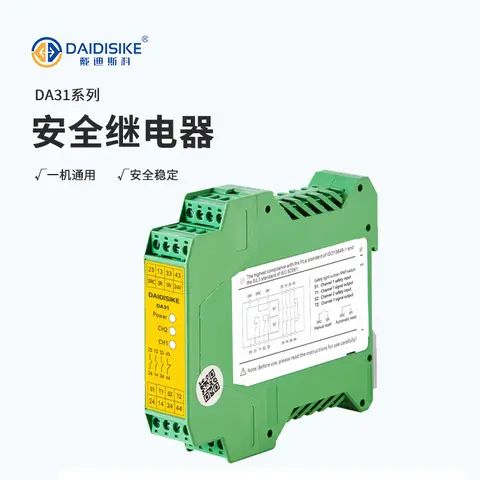
DA31 Emergency-Stop Safety Relay Module
Ultra-slim 22.6 mm Category 4/PL e/SIL 3 safety relay with dual-channel PNP/NPN input and a solid-state status output.
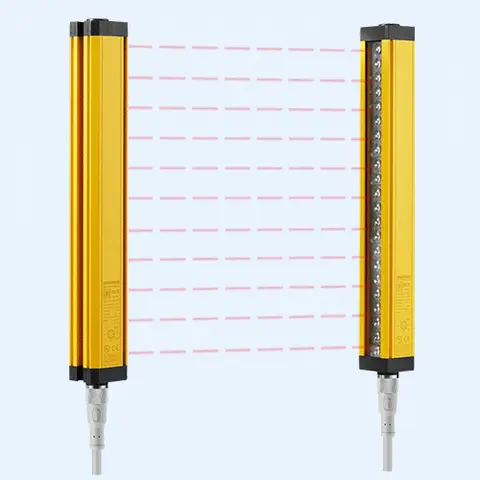
DCE Automation Safety Light Curtain
Compact through-beam safety light curtain in a 30 x 30 mm housing: 10/20/30/40 mm beam pitch, up to 72 beams, 0.3-3 m or 0.3-6 m sensing distance, NPN/PNP output. Catalogue-stated Type 4 design basis; confirm exact safety-document scope.
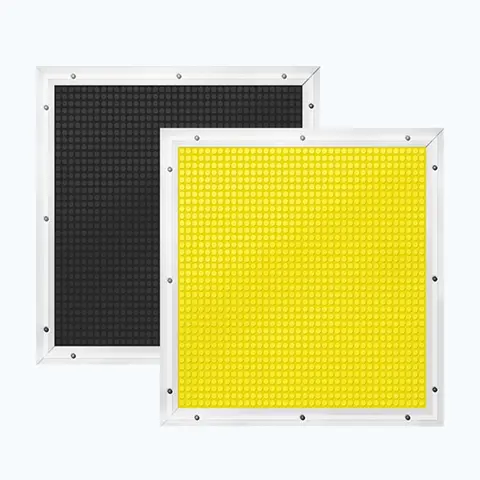
JT14 Safety Mat (Economical)
Economical pressure-sensitive safety mat with volt-free N.O. output for large-area or custom-shape floor guarding.
Related Products in Safety Door Locks & Switches
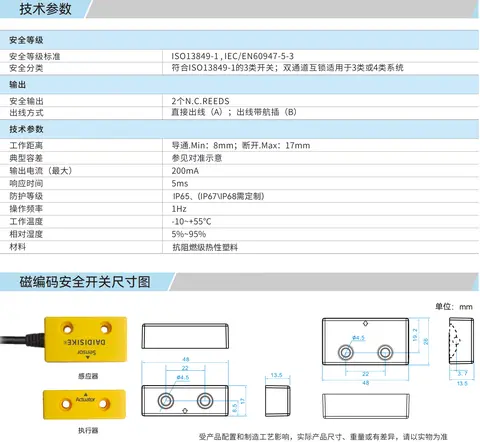
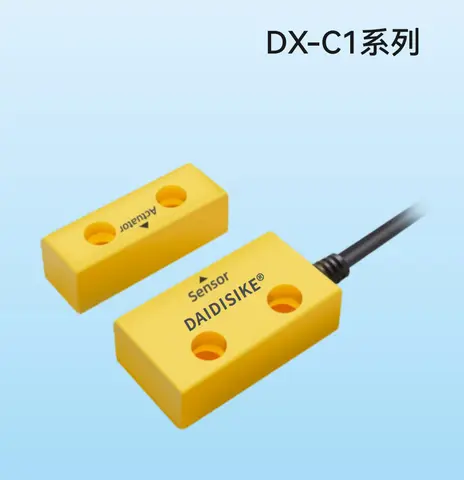
DX-C1 Magnetic Coded Safety Switch
Non-contact coded-magnet safety switch with 17 mm sensing range and high misalignment tolerance for guard doors.
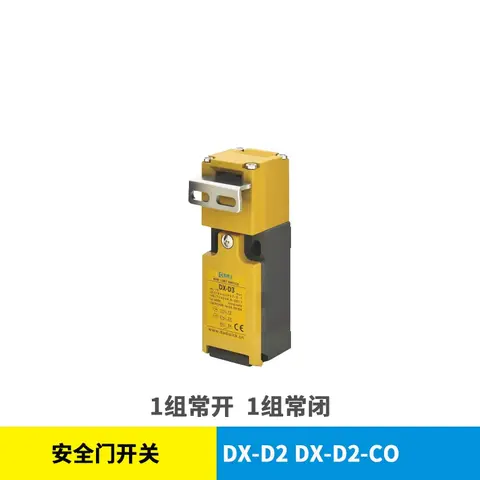
DX-D2 & DX-D3 Safety Door Switch
Mechanical NC/NO safety interlock switch, IP67, 1,000,000-cycle mechanical life, no locking function.
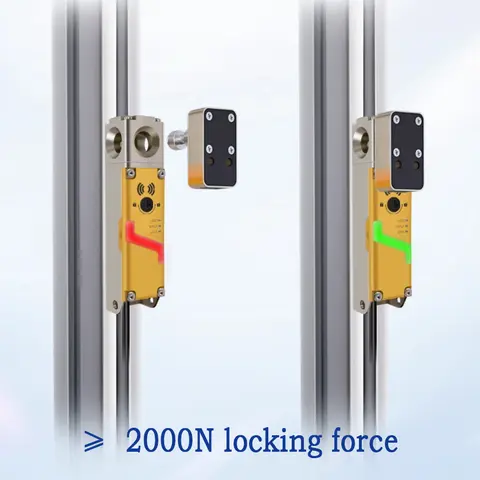
DX-D6 Guard Locking Safety-Door Switch
Guard locking safety-door switch: 2000 N holding force, redundant dual outputs, RFID-coded actuators.
DX-R1 Non-contact Safety Switch (RFID Coded)
Non-contact RFID-coded safety switch, dual-channel PLe/Type 4 output, 0-10mm switch-on, cascadable, 8 NPN/PNP models.