
MQ Essence Edition Safety Light Curtain
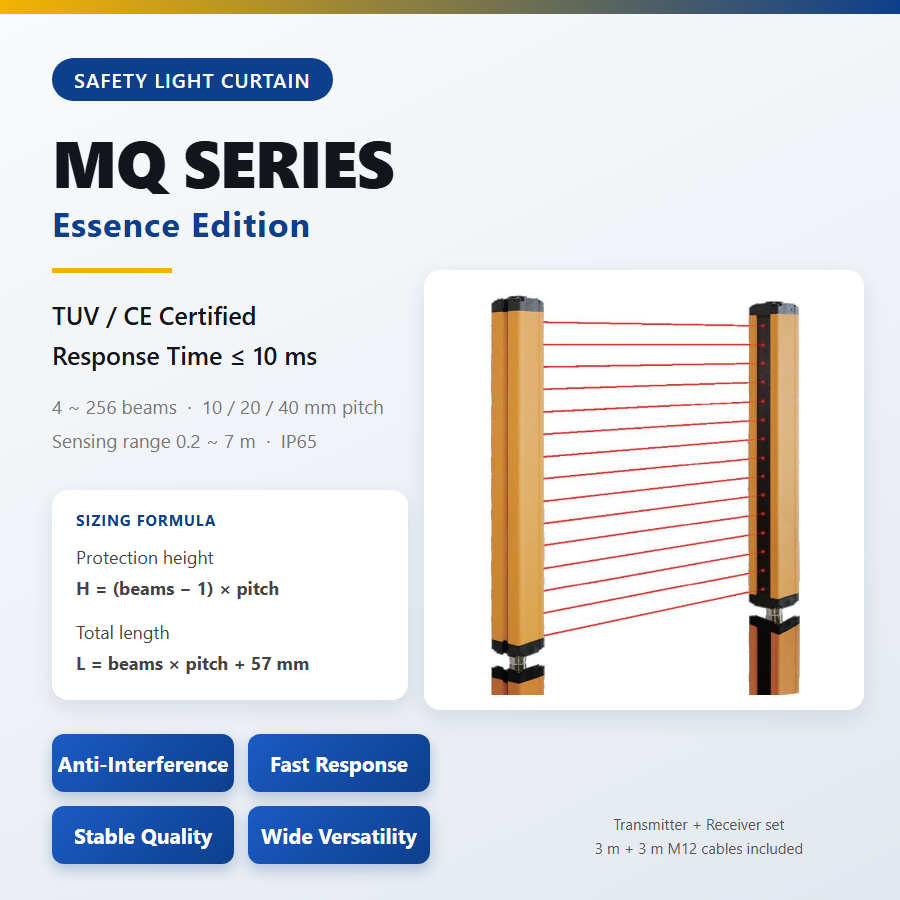
TUV/CE-certified through-beam pair in a 29 × 30 mm profile — optical synchronisation with no wire between TX and RX, ≤ 10 ms response, 4–256 beams.
 🔍 Click to enlarge · 1/8
Technical Specifications
| Curtain type | Through-beam (opposed) — matched transmitter and receiver pair |
|---|---|
| Certification | TUV / CE (stated in the series manual; certification covers design and manufacturing process) |
| Cross-section | 29 × 30 mm extruded aluminium |
| Beam pitch | 10 / 20 / 40 mm |
| Minimum detectable object | Φ15 mm (10 mm pitch) / Φ25 mm (20 mm pitch) / Φ45 mm (40 mm pitch) |
| Beam count | 4, 6, 8 … 256 (even numbers); 4–60 tabulated as standard |
| Protection height | H = (beam count − 1) × beam pitch |
| Total housing length | L = beam count × beam pitch + 57 mm (top cap 12 mm + bottom cap/cable outlet 45 mm; blind zone ½ pitch at each end) |
| Sensing distance | 0.2–7 m, ordered by band: 01 = 0–1 m · 03 = 1–3 m · 05 = 1–5 m · 07 = 1–7 m |
| Response time | ≤ 10 ms |
| Supply voltage | 24 V DC ± 10 % |
| Power consumption | 3–8 W (depends on beam count and length) |
| Signal output | NPN or PNP, NO or NC — selected by ordering code (NC is the conventional choice for safety circuits) |
| Synchronisation | Optical (standard, no wire between TX and RX; separate supplies permitted) or wire sync via CP conductor (code W; common supply and 0 V required) |
| Ambient light immunity | 10,000 Lux |
| Insulation resistance | ≥ 100 MΩ |
| Circuit protection | Reverse-polarity protection on supply; short-circuit protection on output |
| Enclosure rating | IP65 (housing, end caps and front window) |
| Operating temperature | −10 °C to +55 °C |
| Storage temperature | −40 °C to +70 °C |
| Operating humidity | 35–85 %RH |
| Standard wiring | Factory-terminated 3 m cable on TX + 3 m cable on RX, direct M12 aviation connectors — no field termination |
| Wire colours | Brown +24 V · Blue 0 V · Black NPN output (CP sync line on W version) · White PNP output |
| Mounting | Top-and-bottom fixing brackets (code E, default) or L-type side brackets (code L), fixing kit included |
| Ordering code | MQ + beams(2 digits) + pitch, then N/P (NPN/PNP), C/O (NC/NO), range band, bracket — example MQ-2010NC03E |
Overview
The MQ Series "Essence Edition" is a through-beam photoelectric barrier: a matched transmitter and receiver pair in slim 29 × 30 mm extruded-aluminium profiles, projecting synchronised infrared beams across an opening. Select against the specified minimum detectable object, not beam pitch alone. The catalogue lists a response time of ≤10 ms; any protective-stop application also requires exact-model safety evidence and a validated compatible control chain. Optical detection by itself does not guarantee that the machine stops safely.
The series is the product of more than ten years of continuous development and field application across metal forming, automation, packaging and plastics machinery. Every unit is built around a self-monitoring CPU architecture that watches the curtain itself, not just the beams: loss of synchronisation, insufficient received light, emitter or receiver drive errors, cable faults and CPU errors are all detected and annunciated rather than silently ignored.
Its signature convenience is the proprietary cyclic optical synchronisation algorithm: transmitter and receiver lock timing purely through the light path, so no synchronisation wire of any kind runs between them — the two units may even be fed from completely separate 24 V DC supplies on opposite sides of a large machine. A wire-synchronised version (order code W) exists for specifications that demand it, with identical detection behaviour.
With beam pitches of 10, 20 and 40 mm, beam counts from 4 up to 256, sensing ranges of 0.2–7 m in four ordered bands, selectable NPN or PNP output in NO or NC logic, and IP65 sealing across a −10 to +55 °C operating window, MQ offers several opening-size configurations. The listed minimum detectable objects are Φ15, Φ25 and Φ45 mm respectively. Confirm the selected configuration, including the matched pair, standard 3 m cables and connector arrangement, before ordering; larger beam counts and custom options need an exact quotation.
Features & Benefits
No Synchronisation Wire Between Transmitter and Receiver
The cyclic optical synchronisation algorithm carries timing inside the light beam itself, so no conductor of any kind runs between the two units. That removes an entire cable, its connector and a mechanical failure point from every installation — and allows transmitter and receiver to be powered from completely separate 24 V DC supplies when the two sides of a machine are fed from different panels.
M12 Plug-and-Play — No Field Termination
Both units ship with a factory-terminated 3 m cable ending in a direct M12 aviation connector. There are no field-assembled terminals to strip and screw, no polarity guesswork, and nothing to get wrong at the curtain end during commissioning.
CPU Self-Check Architecture
An onboard microcontroller monitors the health of the curtain itself, not just the beam status: loss of light-source synchronisation, insufficient received light intensity, emitter drive circuit errors, main control circuit errors, cable faults, receiver drive circuit errors and CPU errors. A detected fault is annunciated — never silently ignored.
Strong Anti-Interference Performance
Narrow emission angle, coded cyclic scanning and optical filtering reject both optical and electromagnetic disturbance. Ambient light immunity is rated at 10,000 Lux, which covers high-bay lighting, proximity to welding stations and areas with significant indirect daylight.
Compact 29 × 30 mm Profile
One of the slimmest formats in its class. The extruded aluminium body fits inside tight press uprights, machine columns, robot cell frames and existing guard structures where a bulkier barrier will not — while still providing rigidity, heat dissipation and shielding in a single part.
Protection Against the Two Most Common Commissioning Errors
Built-in reverse polarity protection on the supply input and short-circuit protection on the signal output. If +24 V and 0 V are transposed during commissioning the unit is not damaged; if the output is inadvertently shorted, the output stage is protected.
Output Ordered to Match the Machine, Not the Other Way Round
NPN (sinking) or PNP (sourcing), in normally open or normally closed logic, selected by ordering code. NC logic is the conventional safety choice because a broken wire, lost supply or disconnected connector then produces the same state as an intrusion — the machine stops.
Complete Matched Set in the Box
Transmitter and receiver as a factory-matched pair, one set of mounting brackets (top-and-bottom type E as default, or L-type side brackets), the complete fixing kit of screws, washers and nuts, and the instruction manual.
Applications
Models & Ordering Information
87 listed table entries across 3 beam-pitch options. Compare beam count and span, then confirm the complete ordering code. Beam pitch alone does not establish detection capability or suitability for personnel protection.
Minimum detectable object Φ15 mm, distinct from the 10 mm pitch. Total housing length L = beam count × 10 + 57 mm (117–657 mm). Selection for a press, tooling or manual insertion opening requires exact-model safety evidence and validation of the complete protective function.
| Listed model entry | Beam pitch K (mm) | Number of beams N | Beam span H (mm) |
|---|---|---|---|
| MQ04/10-30 | 10 | 4 | 30 |
| MQ06/10-50 | 10 | 6 | 50 |
| MQ08/10-70 | 10 | 8 | 70 |
| MQ10/10-90 | 10 | 10 | 90 |
| MQ12/10-110 | 10 | 12 | 110 |
| MQ14/10-130 | 10 | 14 | 130 |
| MQ16/10-150 | 10 | 16 | 150 |
| MQ18/10-170 | 10 | 18 | 170 |
| MQ20/10-190 | 10 | 20 | 190 |
| MQ22/10-210 | 10 | 22 | 210 |
| MQ24/10-230 | 10 | 24 | 230 |
| MQ26/10-250 | 10 | 26 | 250 |
| MQ28/10-270 | 10 | 28 | 270 |
| MQ30/10-290 | 10 | 30 | 290 |
| MQ32/10-310 | 10 | 32 | 310 |
| MQ34/10-330 | 10 | 34 | 330 |
| MQ36/10-350 | 10 | 36 | 350 |
| MQ38/10-370 | 10 | 38 | 370 |
| MQ40/10-390 | 10 | 40 | 390 |
| MQ42/10-410 | 10 | 42 | 410 |
| MQ44/10-430 | 10 | 44 | 430 |
| MQ46/10-450 | 10 | 46 | 450 |
| MQ48/10-470 | 10 | 48 | 470 |
| MQ50/10-490 | 10 | 50 | 490 |
| MQ52/10-510 | 10 | 52 | 510 |
| MQ54/10-530 | 10 | 54 | 530 |
| MQ56/10-550 | 10 | 56 | 550 |
| MQ58/10-570 | 10 | 58 | 570 |
| MQ60/10-590 | 10 | 60 | 590 |
| Listed model entry | Beam pitch K (mm) | Number of beams N | Beam span H (mm) |
|---|---|---|---|
| MQ04/20-60 | 20 | 4 | 60 |
| MQ06/20-100 | 20 | 6 | 100 |
| MQ08/20-140 | 20 | 8 | 140 |
| MQ10/20-180 | 20 | 10 | 180 |
| MQ12/20-220 | 20 | 12 | 220 |
| MQ14/20-260 | 20 | 14 | 260 |
| MQ16/20-300 | 20 | 16 | 300 |
| MQ18/20-340 | 20 | 18 | 340 |
| MQ20/20-380 | 20 | 20 | 380 |
| MQ22/20-420 | 20 | 22 | 420 |
| MQ24/20-460 | 20 | 24 | 460 |
| MQ26/20-500 | 20 | 26 | 500 |
| MQ28/20-540 | 20 | 28 | 540 |
| MQ30/20-580 | 20 | 30 | 580 |
| MQ32/20-620 | 20 | 32 | 620 |
| MQ34/20-660 | 20 | 34 | 660 |
| MQ36/20-700 | 20 | 36 | 700 |
| MQ38/20-740 | 20 | 38 | 740 |
| MQ40/20-780 | 20 | 40 | 780 |
| MQ42/20-820 | 20 | 42 | 820 |
| MQ44/20-860 | 20 | 44 | 860 |
| MQ46/20-900 | 20 | 46 | 900 |
| MQ48/20-940 | 20 | 48 | 940 |
| MQ50/20-980 | 20 | 50 | 980 |
| MQ52/20-1020 | 20 | 52 | 1020 |
| MQ54/20-1060 | 20 | 54 | 1060 |
| MQ56/20-1100 | 20 | 56 | 1100 |
| MQ58/20-1140 | 20 | 58 | 1140 |
| MQ60/20-1180 | 20 | 60 | 1180 |
| Listed model entry | Beam pitch K (mm) | Number of beams N | Beam span H (mm) |
|---|---|---|---|
| MQ04/40-120 | 40 | 4 | 120 |
| MQ06/40-200 | 40 | 6 | 200 |
| MQ08/40-280 | 40 | 8 | 280 |
| MQ10/40-360 | 40 | 10 | 360 |
| MQ12/40-440 | 40 | 12 | 440 |
| MQ14/40-520 | 40 | 14 | 520 |
| MQ16/40-600 | 40 | 16 | 600 |
| MQ18/40-680 | 40 | 18 | 680 |
| MQ20/40-760 | 40 | 20 | 760 |
| MQ22/40-840 | 40 | 22 | 840 |
| MQ24/40-920 | 40 | 24 | 920 |
| MQ26/40-1000 | 40 | 26 | 1000 |
| MQ28/40-1080 | 40 | 28 | 1080 |
| MQ30/40-1160 | 40 | 30 | 1160 |
| MQ32/40-1240 | 40 | 32 | 1240 |
| MQ34/40-1320 | 40 | 34 | 1320 |
| MQ36/40-1400 | 40 | 36 | 1400 |
| MQ38/40-1480 | 40 | 38 | 1480 |
| MQ40/40-1560 | 40 | 40 | 1560 |
| MQ42/40-1640 | 40 | 42 | 1640 |
| MQ44/40-1720 | 40 | 44 | 1720 |
| MQ46/40-1800 | 40 | 46 | 1800 |
| MQ48/40-1880 | 40 | 48 | 1880 |
| MQ50/40-1960 | 40 | 50 | 1960 |
| MQ52/40-2040 | 40 | 52 | 2040 |
| MQ54/40-2120 | 40 | 54 | 2120 |
| MQ56/40-2200 | 40 | 56 | 2200 |
| MQ58/40-2280 | 40 | 58 | 2280 |
| MQ60/40-2360 | 40 | 60 | 2360 |
29 listed entries at 10 mm pitch · 87 across this table. Beam span is calculated as H = (N − 1) × K; it is not overall housing length or proof of detection capability. Some entries expand catalogue ranges. Confirm the complete ordering code and availability before ordering; inclusion is not a stock claim.
PDF & 3D CAD Downloads
Browse all downloadsMQ Series Technical Manual & Installation Guide (English)
22 pages: full model selection tables for all three pitches, dimension formulas, wiring for both synchronisation modes, 12-point installation guide, commissioning test procedure, troubleshooting matrix, maintenance schedule and safety notes.
Confirm the document and CAD file match the exact ordered version before installation or mechanical design. Contact us if your model is not listed.
How to Select
- Step 1 — establish the required minimum detectable object, then compare the catalogue pairs: 10 mm pitch / Φ15 mm detection; 20 mm / Φ25 mm; 40 mm / Φ45 mm. Neither pitch nor a body-part label replaces the application risk assessment and exact-model safety evidence.
- Step 2 — protection height from the opening: H must cover the whole reachable opening; remember a blind zone of ½ pitch exists beyond the first and last beam, so position the housing so those margins overlap solid guarding.
- Step 3 — range band from the installed separation: order the band containing your actual TX–RX distance (01/03/05/07). Do not over-specify — the correct band improves signal margin and reduces crosstalk between neighbouring curtains.
- Step 4 — output from the machine input: NPN (sinking) for common-positive input circuits, PNP (sourcing) for common-negative — the usual European convention. Check the machine schematic, not habit.
- Step 5 — logic: NC (code C) is the safety convention, because a broken wire or lost supply then produces a machine stop, not a false clear. Choose NO only when the existing input logic demands it.
- Step 6 — check total length L = beams × pitch + 57 mm against the mounting space, allowing clearance below for the cable to exit and bend without strain.
📘 Need the full method? How to Choose a Safety Light Curtain · Type 2 vs Type 4 Safety Light Curtains
When NOT to specify the MQ — and what to use instead
Your risk assessment requires a documented IEC 61496 Type class or ISO 13849 Performance Level printed on the device
Why not: The Essence Edition manual states TUV/CE certification covering design and manufacturing process, but does not print a Type 2 / Type 4 class or a PL figure.
Use instead: Request the certificate and its scope before ordering, or specify from the DQT4 family, whose pages state the Type 4 architecture of IEC 61496 explicitly.
The hazard is ejected or falling objects rather than intrusion
Why not: A light curtain detects something entering its plane. It offers no protection against workpieces, tooling fragments, chips, sparks or swarf thrown out of the machine, nor against objects falling from above.
Use instead: Fixed physical guarding, in addition to the curtain — the two solve different problems.
A person can reach the hazard from above, below, behind or around the guarded plane
Why not: The curtain guards only the plane it spans, and each housing end carries a blind zone equal to half the beam pitch.
Use instead: Mechanical guarding on the unguarded approaches, additional curtains, or a layout where the blind zones overlap solid structure.
The transmitter-to-receiver separation exceeds 7 m, or differs from the ordered range band
Why not: Beyond 7 m the signal margin is insufficient; and a unit configured for the 0–1 m band will not reliably span 5 m even though the series as a whole covers that distance.
Use instead: Order the range band that contains your actual installed separation (01 / 03 / 05 / 07), or reduce the span.
The receiver would look directly into the sun, a skylight, a welding arc or a high-intensity lamp
Why not: Ambient light immunity is rated at 10,000 Lux, which is strong but not unconditional against a direct high-intensity source aimed into the lens.
Use instead: Rotate the installation, fit a shade or hood, or swap transmitter and receiver positions so the receiver faces away from the source.
You need something to lean on, stand on, hang tooling from, or stop a moving workpiece
Why not: The aluminium profile is not a structural member. Impact damage voids both the IP65 sealing and the certification, and may cause the safety function to fail without warning.
Use instead: A separate mechanical protection bar in front of the curtain wherever impact is possible.
Specifications we do not publish yet
We only publish a figure once we are confident it is true. The items below are still being validated through further testing and real-world customer feedback, so for now we would rather leave them open than guess. If one of them matters to your design, ask us for the latest validated status.
- IEC 61496 Type class (2 or 4), ISO 13849 PL/Category, PFHd and mission time are not printed in the Essence Edition manual — the TUV/CE statement covers design and manufacturing process; request the certificate and its scope for machine-file documentation.
- EMC test standards and levels are not itemised in the manual.
- Unit weight per model is not published.
- M12 connector pin assignment table is not printed (wiring is by wire colour on the factory-fitted cables).
- Indicator LED states are described functionally (steady operating / stable clear / fault annunciation) but a full LED table is not included.
- Wire-sync (W) version: only the CP conductor and shared-supply requirement are specified; any further pin differences ship with the order documentation.
Frequently Asked Questions
Does the MQ series really need no cable between transmitter and receiver?
What does the ordering code MQ-2010NC03E mean?
How do I compute protection height and housing length?
Which pitch should I choose?
Why is NC logic recommended for safety circuits?
Can two MQ curtains work close to each other without interference?
What test rod do I use at commissioning?
Is the MQ curtain enough on its own to make a machine safe?
What arrives in the box?
What options exist beyond the standard tables?
Related Categories and Example Products
Explore other functions that may be needed in a machine or line. The products below are category examples, not pre-validated electrical or safety combinations. Confirm each interface and application separately: Safety Relays · Safety Door Locks & Switches · Press & Press Brake Protection
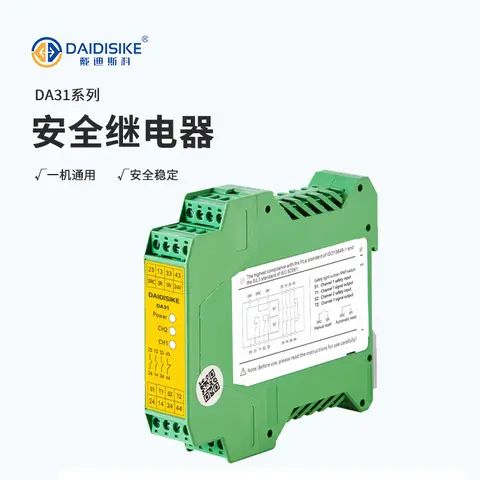
DA31 Emergency-Stop Safety Relay Module
Ultra-slim 22.6 mm Category 4/PL e/SIL 3 safety relay with dual-channel PNP/NPN input and a solid-state status output.
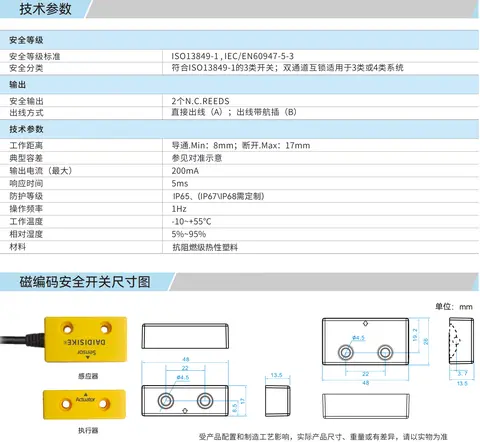
DX-C1 Magnetic Coded Safety Switch
Non-contact coded-magnet safety switch with 17 mm sensing range and high misalignment tolerance for guard doors.
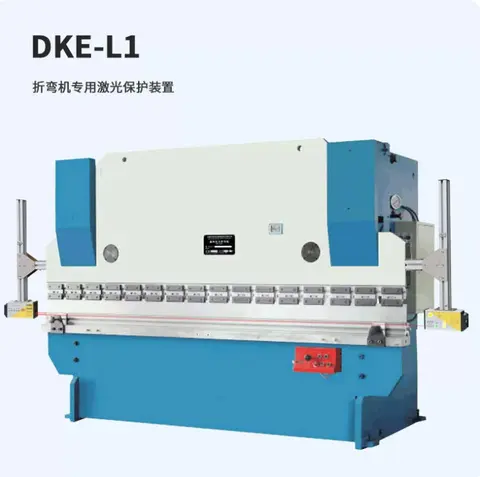
DKE-L3 Press Brake Laser Protection
Ram-mounted laser guarding that tracks the punch tip on press brakes and shears without blocking hand-fed work.
Related Products in Safety Light Curtains
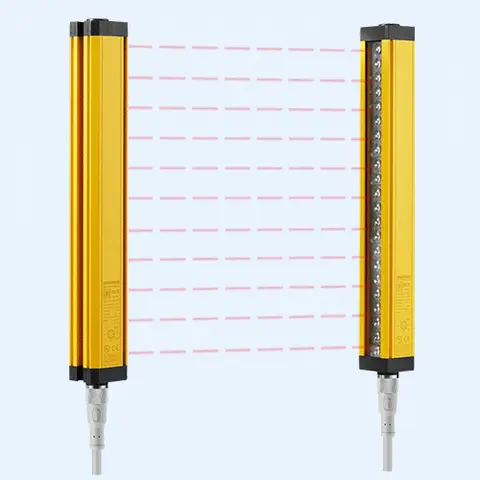
DCE Automation Safety Light Curtain
Compact through-beam safety light curtain in a 30 x 30 mm housing: 10/20/30/40 mm beam pitch, up to 72 beams, 0.3-3 m or 0.3-6 m sensing distance, NPN/PNP output. Catalogue-stated Type 4 design basis; confirm exact safety-document scope.
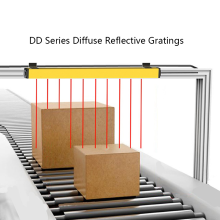
DD / DDOF Single-Sided Area Light Curtain
One housing, no far-side receiver: order DD for diffuse sensing to 2000 mm, or DDOF for per-beam TOF ranging to 4000 mm with zero dead zone and one-key distance teaching. 48 standard models, 4-50 beams.
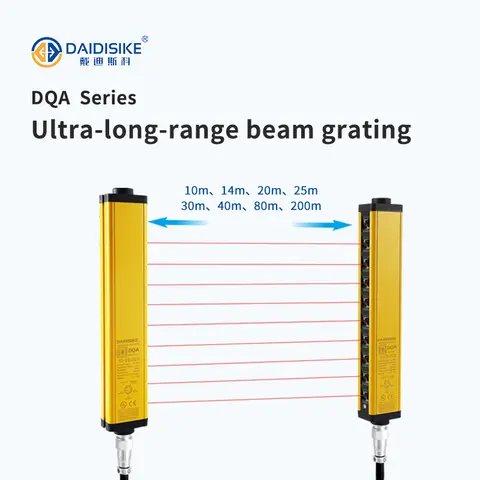
DQA Long-distance Safety Light Curtain
Long-range through-beam safety light curtain for large presses, hydraulic and shearing machines: a transmitter/receiver pair spanning up to 40 m, in 8 beam pitches from 10 to 200 mm, with NPN, PNP or relay output and a selectable single- or dual-output signal. Designed to the Type 4 architecture of IEC 61496 and Category 4 of ISO 13849-1.
DQB Ultra-thin (Side-emitting) Safety Light Curtain
Ultra-thin side-emitting safety light curtain with a 15 x 30 mm cross-section for gaps too narrow for standard units.