
E3JK Square Photoelectric Sensor (Relay & Transistor Output)
Square photoelectric sensor with relay (3 A) or NPN/PNP transistor output — relay versions drive a load with no PLC or amplifier; transistor versions feed a PLC input directly.
 🔍 Click to enlarge · 1/7
Technical Specifications
| Sensing modes | Diffuse-reflective, retro-reflective (with reflector), through-beam |
|---|---|
| Sensing distance — diffuse-reflective (DS30) | 0.5 m or 1.5 m (±10%) |
| Sensing distance — retro-reflective (R4) | 4 m (±10%) |
| Sensing distance — through-beam (5DM) | 5 m (relay) / 15 m (transistor) |
| Output type | Internal relay (J/Z/A/DJ) or NPN/PNP transistor (M1-M4) |
| Relay operating voltage — J | 90-250 VAC |
| Relay operating voltage — Z | 10-30 VDC |
| Relay operating voltage — A/DJ | 10-250 V AC/DC (universal) |
| Transistor operating voltage | 10-30 VDC |
| Relay contact rating | 3 A max. |
| Transistor output logic | NPN-NO (M1), NPN-NC (M2), PNP-NO (M3), PNP-NC (M4) |
| Wiring | Relay versions: 5-wire; transistor versions: 3-wire |
| Sensitivity adjustment | Trimmer potentiometer |
| Degree of protection | IP55 |
| Operating temperature | -25°C to 65°C |
| Cable length | 2 m |
Overview
E3JK is a series of square-body photoelectric sensors offered in three sensing modes — diffuse-reflective, retro-reflective (with reflector), and through-beam (opposed) — and two output technologies: an internal relay (AC, DC, or universal AC/DC power) and NPN/PNP transistor (10-30 VDC, 3-wire) output. It suits panel builders, machine retrofitters, and OEMs who need a photoelectric switch that can either drive a load directly (relay) or feed a PLC/controller input (transistor) using the same housing footprint.
The series covers diffuse-reflective detection at 0.5 m or 1.5 m (±10%), retro-reflective detection at 4 m (±10%) using a reflector board, and through-beam detection at 5 m (relay) or up to 15 m (transistor). Relay-output versions switch loads up to 3 A directly and accept 90-250 VAC, 10-30 VDC, or a universal 10-250 V AC/DC supply, while transistor versions operate on 10-30 VDC in NPN or PNP, normally-open or normally-closed logic.
Features & Benefits
Relay Output Drives Loads Directly
J/Z/A(DJ) versions have a built-in relay (3 A max. contact rating) that switches small contactors, solenoid valves, or alarm lamps directly. No PLC or amplifier is required, which is useful where there is no PLC or DC power supply on site.
One Series, Any Power Supply
The J suffix runs on 90-250 VAC, the Z suffix on 10-30 VDC, and the A/DJ suffix accepts a universal 10-250 V AC/DC supply, so the same sensing mode can match almost any panel power available on site.
Relay and Transistor Share One Housing
Diffuse-reflective and retro-reflective models are offered in all four transistor logic combinations (NPN-NO, NPN-NC, PNP-NO, PNP-NC) in the same housing as the relay versions, so upgrading from relay to transistor control does not require re-drilling the mounting bracket.
Three Sensing Modes in One Family
Diffuse-reflective (0.5 m / 1.5 m ±10%) suits close-range detection without a reflector, retro-reflective (4 m ±10%) uses a reflector board for longer range, and through-beam (5 m relay / 15 m transistor) gives the longest, most reliable detection distance.
Adjustable Sensitivity
An onboard trimmer potentiometer lets you fine-tune the detection threshold on site to match different target sizes, colors, or reflectivity.
IP55 Protection, Wide Temperature Range
IP55 degree of protection suits general industrial environments with dust and occasional water splash, and a -25°C to 65°C operating range tolerates unheated workshops and moderately hot equipment enclosures.
Applications
Models & Ordering Information
Diffuse-Reflective (DS30, 0.5 m / 1.5 m ±10%)
Retro-Reflective (R4, 4 m ±10%, with reflector)
Through-Beam (5DM, 5 m relay / 15 m transistor)
How to Select
- For close-range detection without a reflector, choose diffuse-reflective DS30 (0.5 m or 1.5 m ±10%).
- For mid-range detection where a reflector board can be mounted, choose retro-reflective R4 (4 m ±10%).
- For the longest range and highest reliability with separate emitter/receiver mounting, choose through-beam 5DM (5 m relay / 15 m transistor).
- To drive a contactor, solenoid valve, or alarm lamp directly from AC mains, choose relay output J (90-250 VAC).
- If only DC power is available on site, choose relay output Z (10-30 VDC).
- If the site power type is uncertain or both AC and DC must be supported, choose relay output A/DJ (10-250 V AC/DC universal).
- To feed a PLC or controller digital input, choose transistor output M1 (NPN-NO), M2 (NPN-NC), M3 (PNP-NO), or M4 (PNP-NC), 10-30 VDC.
- Note: the through-beam (5DM) transistor line only offers M1 (NPN-NO) and M3 (PNP-NO) — normally-closed 5DM2/5DM4 do not exist, so check before ordering.
- Diffuse-reflective (DS30) and retro-reflective (R4) transistor versions offer all four M1-M4 combinations (NO/NC, NPN/PNP).
- Relay versions are 5-wire; transistor versions are 3-wire. All models use a 2 m integral cable that connects directly into the control cabinet.
📘 Need the full method? NPN vs PNP Sensor Outputs Explained
When NOT to specify the E3JK — and what to use instead
A Normally-Closed (NC) output is required on the through-beam (5DM) transistor version
Why not: The through-beam transistor line only offers NO logic (M1/M3) - E3JK-5DM2 and E3JK-5DM4 (NC) do not exist in this series.
Use instead: the diffuse-reflective (DS30) or retro-reflective (R4) E3JK models, which offer all four M1-M4 NO/NC combinations
The retro-reflective (R4) model must detect a shiny, mirror-like, or highly reflective target
Why not: Retro-reflective sensing compares reflected light against the reflector board's signature - a mirror-like target can read the same as the reflector itself; no polarizing-filter option is documented for this series.
Use instead: a background-suppression model that senses the object directly, such as BGS-CX441/CX442
Outdoor washdown, high-pressure spray, or heavy wet exposure
Why not: This series is rated IP55 - dust and splash protected, not rated for high-pressure washdown or submersion.
Use instead: the BGS-CX61, which is IP67-rated
Detecting very small parts or narrow features
Why not: No minimum detectable object size is published for the E3JK series; its sensing distances (0.5-15 m) are sized for object/box/bottle-scale detection.
Use instead: the DX-15/30 ultra-thin series (1 mm minimum detectable object) or the strip-beam DK-D461/D561 for narrow targets
Specifications we do not publish yet
We only publish a figure once we are confident it is true. The items below are still being validated through further testing and real-world customer feedback, so for now we would rather leave them open than guess. If one of them matters to your design, ask us for the latest validated status.
- Minimum detectable object size
- Hysteresis
- MTBF
- Light source type/wavelength (not specified as infrared, visible, or laser)
- Reflector part number for the retro-reflective (R4) variant
- Cable connector type (2 m cable length is stated, connector type is not)
- Certification status (documents said to be available on request but not specified)
Frequently Asked Questions
What is the maximum load current of the E3JK relay output?
Can the E3JK run directly on AC mains power?
What is the difference between the J, Z, and A/DJ output suffixes?
What sensing distances does the E3JK series cover?
Are NPN and PNP transistor outputs both available?
Is there a through-beam NC (normally closed) transistor version?
What is the degree of protection of the E3JK sensor?
What is the operating temperature range?
How is sensitivity adjusted?
What cable length does the E3JK come with?
Can you provide certification documents for the E3JK sensor?
Related Categories and Example Products
Explore other functions that may be needed in a machine or line. The products below are category examples, not pre-validated electrical or safety combinations. Confirm each interface and application separately: Proximity Sensors · Laser Switch Sensors · Relay & Timer Modules
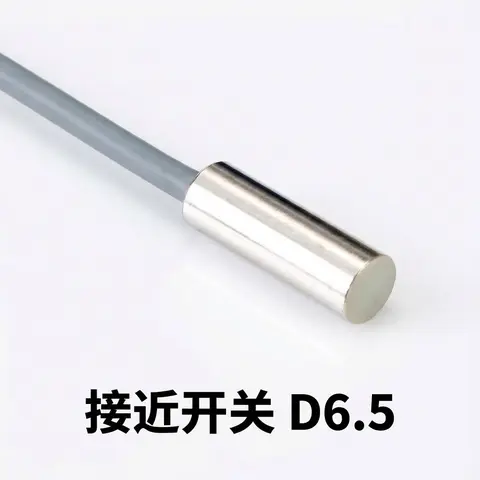
D6.5 Series Inductive Proximity Sensors (Ultra-Short 18mm / Y-Type / 35mm / 45mm)
6.5mm-diameter inductive proximity sensors for tight-clearance mounting where M8 sensors won't fit.
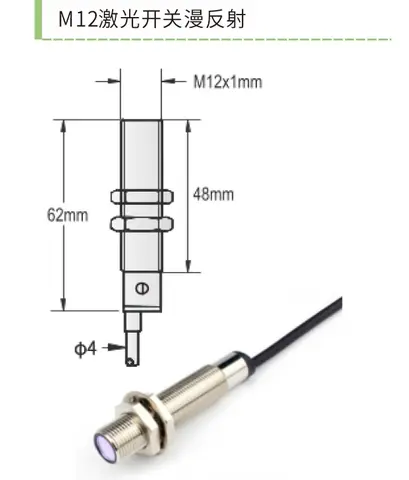
DDSK Laser Diffuse Reflective Sensor M12 / DK Laser Diffuse Reflective Sensor M18
M12/M18 threaded laser diffuse reflective sensor with a visible 650nm red laser for fast alignment.
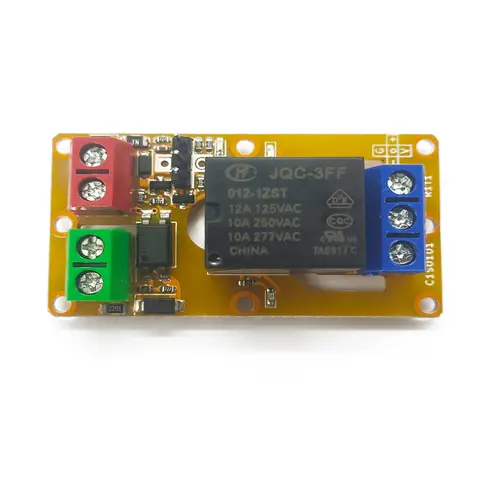
A1J0101 Economical Input Amplifier Module
Optocoupler-isolated input amplifier that turns a low-voltage signal into a 250V AC / 10A relay output.
Related Products in Photoelectric Sensors
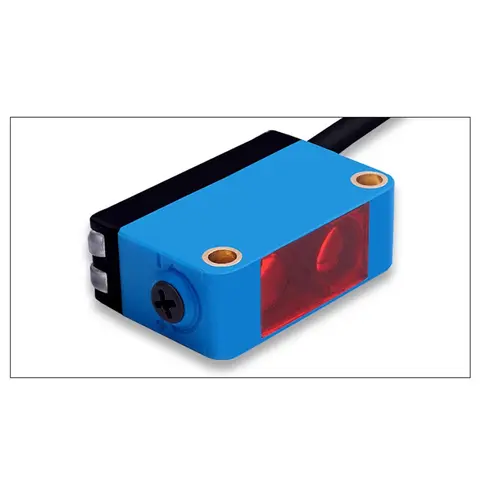
BGS-CX441 / BGS-CX442 Background Suppression Photoelectric Sensor
Wire-adjustable BGS sensor with 2 mm or 15 mm spot, 10-300 mm range, published black/white differential distance.
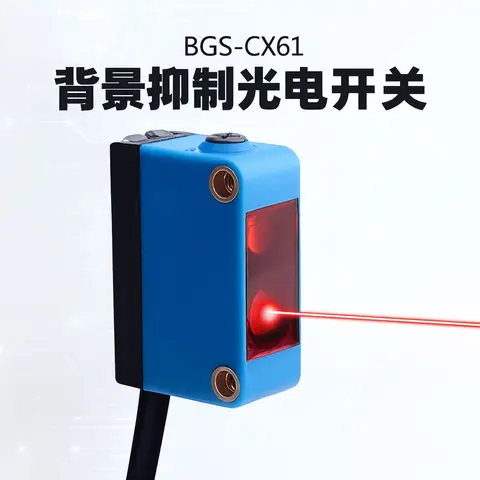
BGS-CX61 Focused-Beam Background Suppression Photoelectric Sensor
2 mm focused-spot BGS sensor that switches strictly by distance, ignoring shiny or close backgrounds.
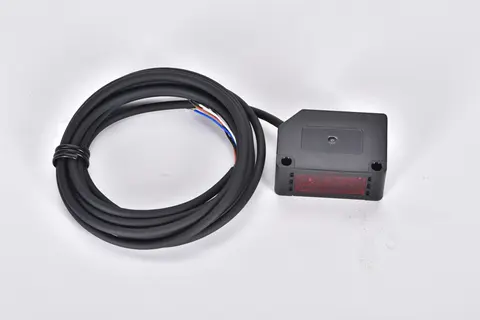
BX Series Long-range Background Suppression (BGS) Photoelectric Sensor
Background suppression photoelectric sensor detecting up to 4 m from one side, no reflector needed.
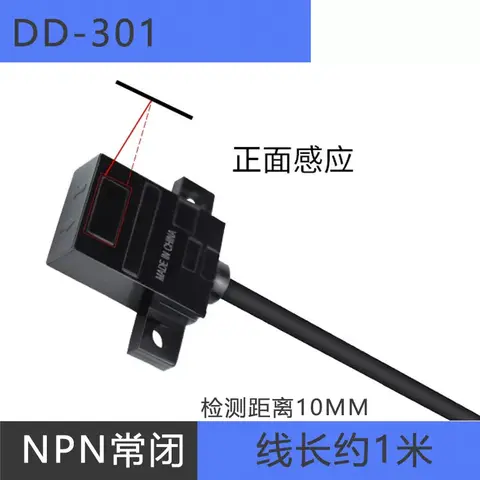
DD-301/401/302/402 Series Reflective Photoelectric Sensor (Wire-lead Type)
Wire-lead NPN reflective sensor, 5mm range, horizontal/vertical mount, Light-ON/Dark-ON logic options.