
LK-F Series CMOS Laser Displacement Sensor
CMOS laser triangulation sensor with switching + analog dual output, 30-400 mm reference distances, IP67 protection.
 🔍 Click to enlarge · 1/8
Technical Specifications
| Category | Laser displacement / distance measurement (CMOS) |
|---|---|
| Output Type | Switching output type (N = NPN / P = PNP, open-collector transistor, max. 50 mA, Light-ON/non-Light-ON switchable, i.e. N.O./N.C. switchable); M-type = switching + analog dual output (voltage 0-5 V, output impedance 100 Ω / current 4-20 mA, switchable in PRO mode) |
| Supply Voltage | 12-24 VDC ±10% |
| Response Time | 1.5 / 5 / 10 ms, switchable |
| Protection Rating | IP67 |
| Laser | 655 nm Class 2 red laser, 1 mW |
| 30 mm Reference Distance | Measuring range ±5 mm, repeatability 10 μm |
| 50 mm Reference Distance | Measuring range ±15 mm, repeatability 50 μm |
| 100 mm Reference Distance | Measuring range ±35 mm, repeatability 100 μm |
| 200 mm Reference Distance | Measuring range ±80 mm, repeatability 200 μm |
| 400 mm Reference Distance | Measuring range ±200 mm, repeatability 400 μm (200-400 mm) / 800 μm (400-600 mm) |
Overview
The LK-F series is a non-contact CMOS laser displacement (distance) sensor using the laser triangulation measuring principle. It is built for machine builders, panel integrators and factory automation engineers who need to measure or monitor a target's position, height, thickness or runout in real time, and who need one sensor to both trigger a go/no-go alarm output and feed a continuous measurement value into a PLC or DAQ.
The 16-model lineup spans five reference-distance ranges (30, 50, 100, 200 and 400 mm) and both NPN and PNP output logic, so it fits both Japanese-standard (sinking) and European/American-standard (sourcing) PLC input modules directly. M-type models add a field-selectable 0-5 V or 4-20 mA analog output alongside the discrete switching output, and the full range carries IP67 protection for washdown and coolant-splash environments.
Features & Benefits
Dual output in one sensor: discrete switching + analog measurement
M-type models output a discrete (switching) signal for go/no-go alarm judgment and an analog signal for continuous measurement simultaneously, from a single sensor. No separate limit sensor is needed alongside the measurement sensor, saving one device, one mounting position and one wiring run.
Field-selectable 0-5 V voltage or 4-20 mA current-loop analog output
In PRO mode, the analog output can be switched on-site between 0-5 V (output impedance 100 Ω) and 4-20 mA current loop. A single part number can therefore serve both voltage-input and current-loop-input control systems, and the 4-20 mA loop provides better noise immunity than voltage signaling over long cable runs or near electrically noisy equipment.
Both NPN and PNP available across the full 16-model range
Every reference-distance option ships in both NPN (sinking, open-collector) and PNP (sourcing) versions, so the sensor connects directly to both Japanese-standard PLC input cards (commonly NPN/sinking) and European/American-standard PLC input cards (commonly PNP/sourcing) without adapter wiring.
Selectable Light-ON / Dark-ON switching logic (N.O./N.C.)
The discrete output can be set to activate either when the target is in the beam or when it is out of the beam, letting the same wiring serve either a "part present" alarm or a fail-safe "part missing" alarm by changing a setting rather than the wiring or PLC program.
Switchable response time: 1.5 / 5 / 10 ms
Response time is selectable among three settings, allowing the same sensor to be configured for fast-moving targets on high-speed lines (1.5 ms) or for more stable readings on dark, rough or low-reflectivity surfaces (10 ms), without changing hardware.
IP67-rated enclosure for washdown, coolant-splash and dusty environments
The full LK-F range carries IP67 protection, allowing use in machining areas exposed to coolant splash and in dusty or wash-down production environments without an additional protective enclosure.
Visible 655 nm red laser spot for fast, intuitive alignment
A visible red laser dot (655 nm, Class 2 per IEC 60825-1) lets installers see and align the beam on the target directly by eye, speeding up mounting and setup. As with any Class 2 laser, direct viewing of the beam should still be avoided.
Five reference distances (30-400 mm) covering close-range precision to longer-range measurement
The lineup spans 30/50/100/200/400 mm reference distances with measuring ranges from ±5 mm up to ±200 mm (extending to a 600 mm total span at the 400 mm setting), and repeatability as fine as 10 μm at the 30 mm reference distance, letting a project standardize on one product family across near- and mid-range measurement tasks.
Applications
Models & Ordering Information
30 mm Reference Distance
50 mm Reference Distance
100 mm Reference Distance
200 mm Reference Distance
400 mm Reference Distance
How to Select
- Choose the reference distance first based on required measuring range and precision: pick 30 mm for the tightest repeatability (10 μm) in a confined installation space, or 200/400 mm when the target's position varies over a wider range at a longer mounting distance, keeping in mind repeatability becomes coarser at the longer distances.
- Choose a pure switching-output model (no "M", e.g. LK-F100N, LK-F200P) when only a present/absent or in-position/out-of-position judgment is needed; this option is available only at the 100, 200 and 400 mm reference distances and costs less.
- Choose an M-type model (e.g. LK-F30MN, LK-F100MP) when a continuous measurement value must be fed into a PLC analog channel in addition to an alarm output; M-type is the only option available at the 30 mm and 50 mm reference distances.
- Choose NPN (N suffix) for Japanese-standard PLCs that commonly use sinking inputs (e.g. Mitsubishi, Omron), or PNP (P suffix) for European/American-standard PLCs that commonly use sourcing inputs (e.g. Siemens, Allen-Bradley).
- On M-type models, use the 0-5 V analog output for voltage-input control systems, or switch to the 4-20 mA current loop in PRO mode for long cable runs or electrically noisy environments, or where the control system expects a current-loop input.
- Set the switching output logic (Light-ON/Dark-ON, equivalent to N.O./N.C.) and response time (1.5/5/10 ms) according to the required alarm logic and the target's speed and surface reflectivity: choose 1.5 ms for high-speed lines and 5-10 ms for more stable readings on dark or low-reflectivity surfaces.
- All LK-F models share a 12-24 VDC ±10% supply, IP67 protection and a 655 nm Class 2 laser, so these do not need to be a selection factor.
When NOT to specify the LK-F — and what to use instead
The task needs metre-range distance or position measurement, such as crane positioning or silo level over several metres.
Why not: LK-F's longest reference distance is 400 mm with a ±200 mm measuring range (600 mm total span) — the series has no metre-range option.
Use instead: a laser distance sensor for metre-range ranging, such as DDA-Y/DDB-Y, DDK-F, or DSK-CG
The project wants a pure switching-output model, or a lower-cost analog-only model, at the 30 mm or 50 mm reference distance.
Why not: the 30 mm and 50 mm reference-distance options are available only as M-type (combined switching + analog) models; a pure switching-output variant exists only from the 100 mm reference distance upward.
Use instead: the 100/200/400 mm reference-distance pure switching-output models (LK-F100N/P, LK-F200N/P, LK-F400N/P) if analog output is not needed and a longer reference distance is acceptable
The project needs the tightest repeatability at a longer standoff distance (e.g., 200-400 mm).
Why not: repeatability coarsens with reference distance — from 10 μm at the 30 mm reference to 400 μm (200-400 mm range)/800 μm (400-600 mm range) at the 400 mm reference.
Use instead: the 30 mm or 50 mm reference-distance model, if mounting space allows
The target is both fast-moving and very dark/low-reflectivity, needing the fastest response and the best low-light stability at once.
Why not: response time is a fixed trade-off among 1.5/5/10 ms settings — the fastest setting suits high-speed targets while the slower settings improve stability on dark or low-reflectivity surfaces; one sensor cannot deliver both extremes simultaneously.
Use instead: testing the actual target speed/reflectivity combination and choosing reference distance and response time accordingly, consulting the factory for a suitability check if needed
The application requires a personnel-safety function.
Why not: LK-F is a measurement sensor with standard switching and analog outputs; no safety certification is documented for it.
Use instead: a certified safety device, such as a safety light curtain or safety laser scanner, rather than a displacement sensor
Specifications we do not publish yet
We only publish a figure once we are confident it is true. The items below are still being validated through further testing and real-world customer feedback, so for now we would rather leave them open than guess. If one of them matters to your design, ask us for the latest validated status.
- Outline dimensions and housing material are not published
- Formal certification documents (CE/RoHS) beyond "available on request" have not been attached to this record
- Whether a bus-communication variant (RS485/Modbus or other fieldbus) or an ultra-fast response option below 1.5 ms exists is unconfirmed against factory documentation
- Exact laser output power and laser class are not published yet
- The 200 mm reference-distance measuring range figure (±80 mm in one source, ±85 mm in another) is still being validated — ask us for the confirmed value
Frequently Asked Questions
What is the measuring principle of the LK-F series?
Can one LK-F sensor provide both an alarm signal and a measurement value at the same time?
Is the analog output voltage or current?
Does LK-F support both NPN and PNP wiring?
Can I switch the switching output between normally-open and normally-closed?
What is the IP rating and can it be used near coolant or washdown?
What response times are available?
What laser class is used and is it eye-safe?
What is the smallest reference-distance / highest-precision model?
Is there a pure switching-output (non-analog) option?
Are certification documents such as CE or RoHS available for the LK-F series?
Related Categories and Example Products
Explore other functions that may be needed in a machine or line. The products below are category examples, not pre-validated electrical or safety combinations. Confirm each interface and application separately: Laser Distance Sensors · Contact Displacement Sensors · Relay & Timer Modules
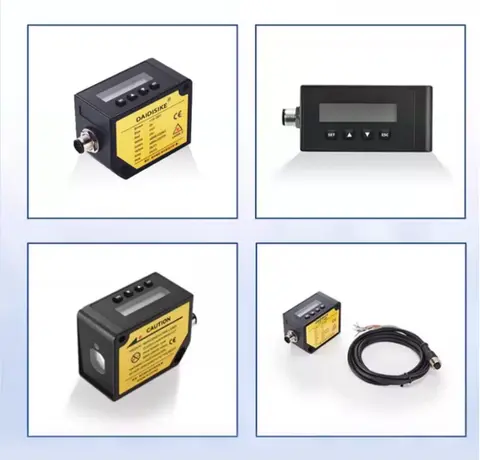
DDA-Y & DDB-Y Industrial Laser Distance Sensor (Phase-Shift)
Phase-shift laser distance sensors: 0.2-100 m range, millimeter accuracy, RS485 Modbus RTU, switching or analog output.
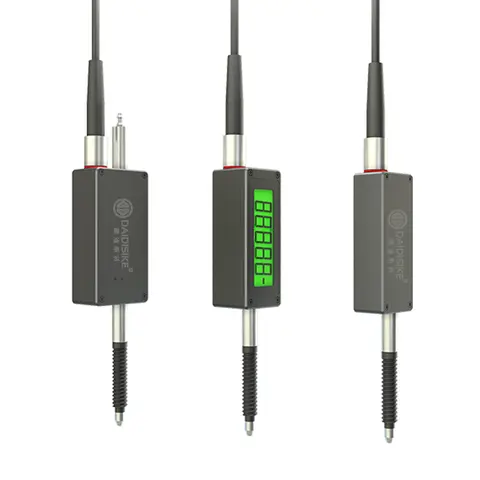
JNS-Q Contact Displacement Grating Sensor
Digital, RS-485-networkable contact displacement sensor with resolution down to 0.2 micron for inline dimensional inspection.
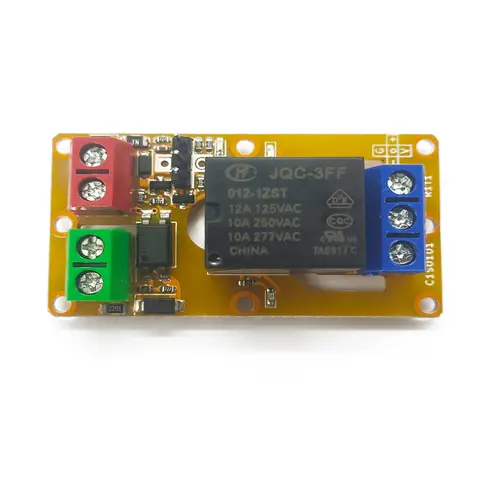
A1J0101 Economical Input Amplifier Module
Optocoupler-isolated input amplifier that turns a low-voltage signal into a 250V AC / 10A relay output.
Related Products in Laser Displacement Sensors
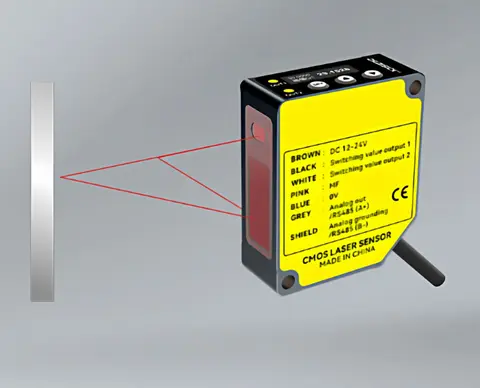
DDK-G Laser Displacement Sensor 30-250 mm
Five reference-distance grades, 20 model codes, and a choice of 4-20 mA, 0-10 V or RS485. Resolution starts at 2 um on G30 under the published test conditions; select by measuring window, target and required output.
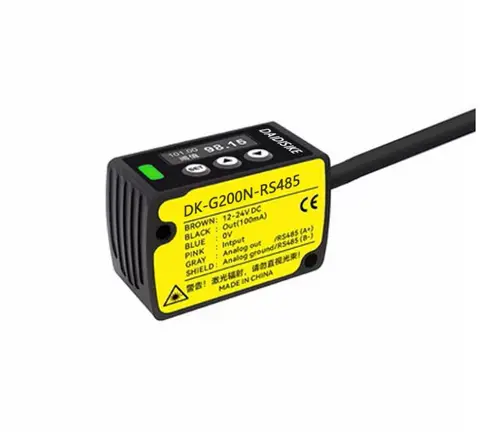
DK-G Series Laser Displacement Sensor
Laser triangulation sensor: 30-400 mm reference distances, switching, analog, or RS485 output.