
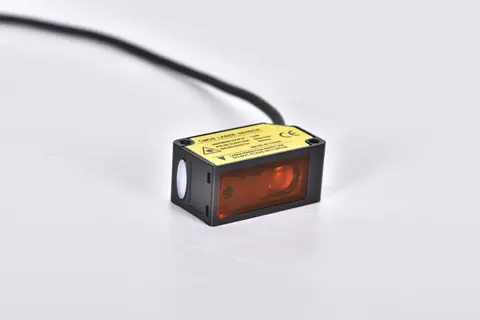
DK-G Series Laser Displacement Sensor
Laser triangulation sensor: 30-400 mm reference distances, switching, analog, or RS485 output.
 🔍 Click to enlarge · 1/7
Technical Specifications
| Category | Laser displacement / distance measurement |
|---|---|
| Measuring principle | Laser triangulation |
| Laser source | Class 2, 655 nm red semiconductor laser, max. output 1 mW |
| Output types | NPN discrete switching output / Analog output (0-5 V or 4-20 mA) / RS485 Modbus RTU output |
| Operating voltage | 12-24 VDC ±10% (pulsation P-P 10%) |
| Response time | 1.5 / 5 / 10 ms, switchable |
| Protection rating | IP60 |
| RS485 communication | Modbus RTU, 9600-115200 bps (RS485 variant only) |
| Switching output type | NPN open-collector, max. sink current 50 mA, applied voltage ≤30 VDC, residual voltage ≤1.5 V at 50 mA, leakage current ≤0.1 mA |
| Switching output logic | Selectable: ON while target detected / ON while target not detected, with automatic recovery after short-circuit |
| Measuring range — 30 mm reference | 30 ±5 mm |
| Repeatability — 30 mm reference | 10 μm |
| Beam diameter — 30 mm reference | about Φ50 μm |
| Measuring range — 50 mm reference | 50 ±15 mm |
| Repeatability — 50 mm reference | 30 μm |
| Beam diameter — 50 mm reference | about Φ70 μm |
| Measuring range — 100 mm reference | 100 ±35 mm |
| Repeatability — 100 mm reference | 70 μm |
| Beam diameter — 100 mm reference | about Φ200 μm |
| Measuring range — 200 mm reference | 200 ±80 mm |
| Repeatability — 200 mm reference | 200 μm |
| Beam diameter — 200 mm reference | about Φ300 μm |
| Measuring range — 400 mm reference | 400 ±200 mm |
| Repeatability — 400 mm reference | 400 μm (200-400 mm range) / 800 μm (400-600 mm range) |
| Beam diameter — 400 mm reference | about Φ500 μm |
| Housing material | Die-cast aluminum body with acrylic front cover plate |
| Operating temperature | -10°C to +40°C |
| Storage temperature | -20°C to +60°C |
| Operating humidity | 35%-85% RH |
| Altitude | Under 2000 m |
| Ambient illumination | Below 3000 lx (incandescent-type light) on the illuminated surface |
| Weight | Approx. 35 g without cable; approx. 85 g with the supplied 5-core, 2 m composite cable |
| Cable | Supplied 5-core, 2 m composite cable |
| Applicable specifications | Comply with EMC instructions |
Overview
DK-G is a laser triangulation displacement sensor: a red semiconductor laser (Class 2, 655 nm) projects a spot onto the target surface, and a CMOS receiving element detects how the reflected spot position shifts as the target moves closer or farther from the reference distance. The sensor converts that shift into a distance/displacement reading.
It suits machine builders and process engineers who need non-contact distance, thickness, position, or runout measurement in the 30-600 mm range, with a choice of simple on/off output, continuous analog output for PLC integration, or RS485 digital output for multi-sensor networks.
Features & Benefits
Three Output Tiers — Pay Only for the Interface You Need
Discrete NPN switching output (DK-G50N/100N/200N/400N; no discrete-switch variant at the 30 mm reference distance), analog output (DK-GxxNM, 0-5 V or 4-20 mA), and RS485 Modbus RTU output (DK-GxxN-RS485) are all offered across the same 30-400 mm distance lineup, so you only pay for the interface tier your application needs.
Five Reference Distances (30-400 mm) with Repeatability from 10 μm
Measuring range spans ±5 mm (30 mm reference) to ±200 mm (400 mm reference); repeatability runs from 10 μm at the 30 mm reference down to 400 μm (200-400 mm) or 800 μm (400-600 mm) at the 400 mm reference — near-range high precision through to longer-range coarse measurement in one series.
Switchable Response Time (1.5 / 5 / 10 ms)
A faster response setting suits high-speed moving targets; a slower setting improves reading stability on darker or low-reflectivity surfaces, giving you a speed/stability trade-off standard for laser triangulation sensors.
RS485 Modbus RTU for Digital, Drift-Free Readings and Multi-Drop Networking
The RS485 variant transmits the measured distance as digital data over Modbus RTU, avoiding the A/D conversion error and long-cable voltage drop inherent to analog transmission, and allows multiple sensors to be daisy-chained on one bus.
NPN Open-Collector Switching Output with Selectable Logic
The switching output is an NPN open-collector transistor (max. sink current 50 mA, applied voltage ≤30 VDC, residual voltage ≤1.5 V at 50 mA, leakage current ≤0.1 mA), and can be configured for "ON while target detected" or "ON while target not detected," with automatic recovery after a short-circuit condition.
Compact Aluminum Housing, IP60, -10°C to +40°C Operation
Body shell is die-cast aluminum with an acrylic front cover plate; the sensor is rated IP60 and specified for use at -10°C to +40°C (storage -20°C to +60°C), 35%-85% RH, under 2000 m altitude, weighing approx. 35 g without cable (approx. 85 g with the supplied 5-core, 2 m composite cable).
Applications
Models & Ordering Information
NPN Discrete Switching Output
Analog Output (0-5 V or 4-20 mA)
RS485 Modbus RTU Output
How to Select
- Need only a go/no-go or limit judgment? Choose NPN switching output (DK-G50N / 100N / 200N / 400N); no discrete-switch model is offered at the 30 mm reference distance.
- Need a continuous value into a PLC analog input? Choose analog output (DK-G30NM / 50NM / 100NM / 200NM / 400NM), 0-5 V or 4-20 mA.
- Need digital readings, multi-sensor networking, or Modbus-based software integration? Choose RS485 output (DK-G30N-RS485 / 50N-RS485 / 100N-RS485 / 200N-RS485 / 400N-RS485).
- Pick the reference distance that keeps your target's normal travel within its measuring range, centered as close as possible to the reference distance for best precision.
- Shorter reference distances (30 mm, 50 mm) give the tightest repeatability and smallest beam spot, best for small or fine targets; longer reference distances (200 mm, 400 mm) trade precision for working distance and range.
- Match response time to your target: use the fastest setting (1.5 ms) for high-speed moving targets, and a slower setting (5 / 10 ms) for improved reading stability on dark, matte, or low-reflectivity surfaces.
- Check mechanical/environmental fit: all variants share the same aluminum housing, IP60 rating, 12-24 VDC ±10% supply, and -10°C to +40°C operating range — verify against your installation environment, since IP60 is not a washdown/outdoor rating.
- The sensor cannot detect transparent objects or liquids, and cannot calculate range starting from zero distance; keep the detection angle perpendicular to the measured surface within 90°±15°.
When NOT to specify the DK-G — and what to use instead
The target sits more than 600 mm away, or the task is really a metre-scale distance/position measurement (e.g., crane travel, silo level over several metres).
Why not: DK-G's longest reference distance is 400 mm with a measuring range up to ±200 mm (600 mm maximum span) — the series has no metre-range option.
Use instead: a laser distance sensor built for metre-range ranging, such as DDA-Y/DDB-Y or DSK-CG
The target is transparent, a liquid, or cannot be mounted close to perpendicular to the beam.
Why not: per DK-G's own stated detection limitations, it cannot detect transparent objects or liquids, cannot calculate range starting from zero distance, and the detection angle must stay within 90°±15° of perpendicular.
Use instead: consulting the factory for an application-specific method for transparent/liquid targets rather than laser triangulation
The installation is outdoors, washdown, or otherwise exposed to significant water or heavy dust ingress.
Why not: DK-G carries an IP60 rating, which covers dust-tightness but no specified water-ingress protection — it is not a washdown or outdoor rating.
Use instead: confirming an IP-rated alternative with the factory, or housing the sensor in a protective enclosure
The project needs the tightest available repeatability at a longer standoff distance (e.g., 200-400 mm).
Why not: repeatability coarsens as reference distance grows — from 10 μm at the 30 mm reference to 400 μm (200-400 mm range) or 800 μm (400-600 mm range) at the 400 mm reference.
Use instead: the 30 mm or 50 mm reference-distance model, if the mounting space allows, for tighter repeatability
The application requires a personnel-safety function such as a guard interlock.
Why not: DK-G is a measurement sensor with standard NPN switching, analog, or RS485 outputs; no safety-rated certification is documented for it.
Use instead: a certified safety device such as a safety light curtain or safety laser scanner, not a displacement sensor
Specifications we do not publish yet
We only publish a figure once we are confident it is true. The items below are still being validated through further testing and real-world customer feedback, so for now we would rather leave them open than guess. If one of them matters to your design, ask us for the latest validated status.
- Whether a PNP output version, or a pure switching-output model at the 30 mm reference distance, is currently orderable
- RS485 communication protocol details (parity, register map, address range) beyond the general Modbus RTU description are not documented
- Outline dimensions read from the catalog drawing are approximate and not yet confirmed against a factory CAD file
- Certification documents (CE/RoHS, laser-safety standard reference) are not yet available
- Linearity and temperature-coefficient specifications are not yet included in the primary parameter sheet
Frequently Asked Questions
What measuring principle does the DK-G series use?
What output options are available?
What is the difference between "repeatability" and "resolution"?
Can the DK-G sensor measure transparent objects or liquids?
What is the IP rating and operating temperature range?
What power supply and output current does the switching output support?
Can multiple DK-G RS485 sensors share one communication bus?
How does response time affect the reading?
What is the sensor housing made of, and how much does it weigh?
Can DAIDISIKE provide certification documents for the DK-G series?
Related Categories and Example Products
Explore other functions that may be needed in a machine or line. The products below are category examples, not pre-validated electrical or safety combinations. Confirm each interface and application separately: Laser Distance Sensors · Contact Displacement Sensors · Relay & Timer Modules
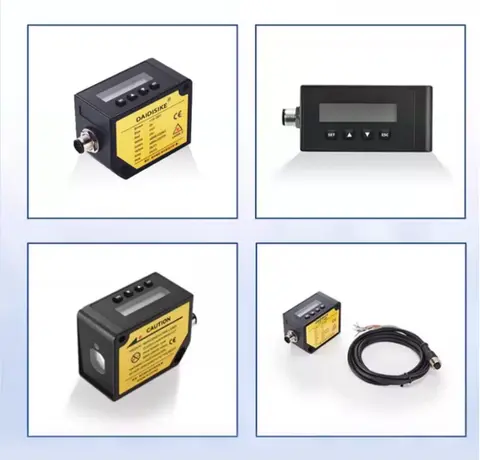
DDA-Y & DDB-Y Industrial Laser Distance Sensor (Phase-Shift)
Phase-shift laser distance sensors: 0.2-100 m range, millimeter accuracy, RS485 Modbus RTU, switching or analog output.
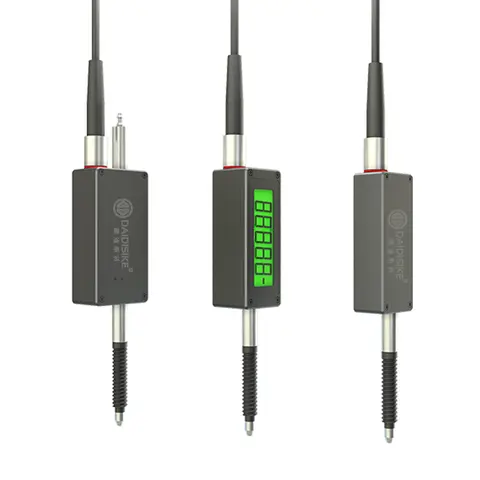
JNS-Q Contact Displacement Grating Sensor
Digital, RS-485-networkable contact displacement sensor with resolution down to 0.2 micron for inline dimensional inspection.
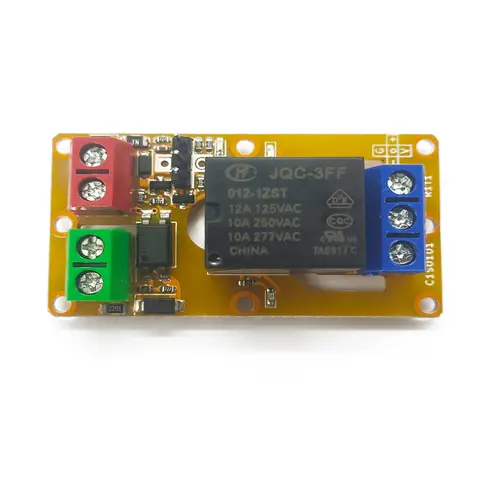
A1J0101 Economical Input Amplifier Module
Optocoupler-isolated input amplifier that turns a low-voltage signal into a 250V AC / 10A relay output.
Related Products in Laser Displacement Sensors
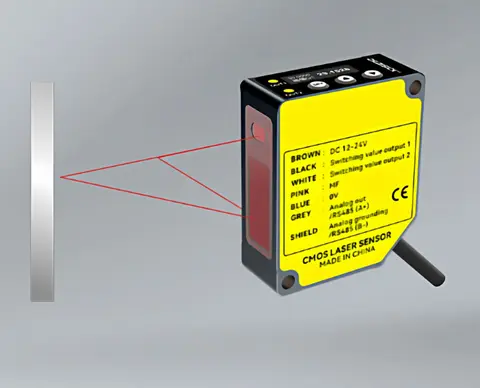
DDK-G Laser Displacement Sensor 30-250 mm
Five reference-distance grades, 20 model codes, and a choice of 4-20 mA, 0-10 V or RS485. Resolution starts at 2 um on G30 under the published test conditions; select by measuring window, target and required output.
LK-F Series CMOS Laser Displacement Sensor
CMOS laser triangulation sensor with switching + analog dual output, 30-400 mm reference distances, IP67 protection.