
DSK-CG Long-range Laser Distance Sensor
56 models, 1 m to 80 m range, 1.5 mm-class accuracy — analog, RS-485 or dual switching outputs to match your needs.
 🔍 Click to enlarge · 1/16
Technical Specifications
| Model Code Structure | DSK-CG-{Range Code}C-{Output Code}[D] |
|---|---|
| Measuring Range Codes | 1 m / 5 m / 10 m / 20 m / 30 m / 50 m / 80 m |
| Resolution (standard-speed) | 1 mm |
| Measurement Accuracy (standard-speed, 30 Hz) | 1.5 mm + 0.05% of distance (1.5 mm + d×5/10000) |
| Sampling Frequency (standard) | 30 Hz |
| Sampling Frequency (high-speed, "D"-suffix models) | 100 Hz |
| Absolute Accuracy (high-speed, 100 Hz) | 3 cm (5 cm on low-reflectance targets, 7 cm on very-low-reflectance targets) |
| Output Type A | One analog output (0-10 V) + one switching output |
| Output Type B | One analog output (4-20 mA) + one switching output |
| Output Type C | One analog output (4-20 mA) + RS-485 |
| Output Type D | Two switching outputs |
| Switching Output | NPN/PNP, independently adjustable setpoints |
| Communication | RS-485, Modbus RTU protocol (optional) |
| Power Supply | DC10-30V ±10% |
| Initialization Time | < 250 ms |
| Housing Material | Aluminum alloy + acrylic |
| Connector | M12 waterproof connector |
Overview
The DSK-CG is a long-range diffuse-reflection laser distance sensor that measures the actual distance to a target, not just whether an object is present. It reads targets directly, with no reflector required, regardless of the target's color, material or surface sheen, at ranges from 1 m up to 80 m, and reports the result as an analog signal (0-10 V or 4-20 mA), a Modbus RTU RS-485 signal, or two independently-adjustable switching outputs.
It is built for machine builders and system integrators who need millimeter-level position feedback over long distances, covering 7 measuring-range codes (1/5/10/20/30/50/80 m) and 4 output types across 56 model variants, including a 100 Hz high-speed line for moving-target tracking: crane and stacker positioning, AGV/RGV navigation, warehouse rack-level sensing, and large-workpiece or coil position detection.
Features & Benefits
One Platform, 56 Models, 1 m to 80 m
7 measuring-range codes (1/5/10/20/30/50/80 m) x 4 output types (0-10 V analog, 4-20 mA analog, 4-20 mA+RS-485, dual switching) x 2 sampling speeds (30 Hz standard / 100 Hz high-speed) let you match the exact range and interface to your application, from short-distance positioning to 80 m crane anti-collision, all within one part-numbering system.
Millimeter-level Accuracy at Long Distance
1 mm resolution with accuracy of 1.5 mm + 0.05% of distance (1.5 mm + d x 5/10000) delivers true position measurement rather than simple presence detection, suitable for crane positioning, stacker positioning and large-workpiece location feedback.
Reads Targets Directly, No Reflector Needed
Measures vertical or angled targets within 30 m regardless of color, material or sheen, eliminating the installation and maintenance work of mounting and aligning a reflector.
Two Independent Switching Outputs, NPN/PNP Compatible
Dual switching outputs with independently adjustable setpoints give two action thresholds, such as approach warning plus stop position, from a single sensor. NPN/PNP compatibility means the same model wires into both Japanese-style (NPN) and European-style (PNP) PLC inputs.
On-device Setup, No PC Required
A 5-digit LED display shows the live measured distance, 3 push-buttons handle programming and teach-in, and 5 status LEDs (RUN/OUT1/OUT2/MAX/PRO) give at-a-glance diagnostics, so installation, teach-in and troubleshooting can be done entirely at the sensor without a laptop in the field.
High-speed 100 Hz Version for Moving Targets
Models with the D suffix sample at 100 Hz with 3 cm absolute accuracy (5 cm on low-reflectance targets, 7 cm on very-low-reflectance targets), suited to tracking moving objects on conveyors and monitoring coil or roll diameter. All 4 output types and all 7 range options are available in the high-speed line as well, 28 models in total.
Optional RS-485 Modbus RTU Alongside 4-20 mA
The C output type combines a 4-20 mA analog output with an RS-485 interface supporting the Modbus RTU protocol (optional), so distance data can go straight into a PLC, HMI or SCADA over a digital bus while the analog output remains available for legacy analog input cards.
Industrial Build with Wide Supply Range
Aluminum-alloy and acrylic housing, M12 waterproof connector cable, DC10-30V ±10% wide-range power input, and initialization time under 250 ms mean the sensor is measuring within a quarter-second of power-on.
Applications
Models & Ordering Information
Standard-speed Models (30 Hz)
High-speed Models (100 Hz)
How to Select
- Model code structure: DSK-CG-{Range Code}C-{Output Code}[D].
- Choose the range code closest to, and safely covering, your maximum required distance: 01=1m, 05=5m, 10=10m, 20=20m, 30=30m, 50=50m, 80=80m.
- Output type A gives one analog output (0-10 V) plus one switching output, for controllers with standard voltage analog inputs.
- Output type B gives one analog output (4-20 mA) plus one switching output, for long cable runs where a current loop resists noise better than voltage.
- Output type C gives one analog output (4-20 mA) plus RS-485 (Modbus RTU optional), for direct digital integration with PLC/HMI/SCADA while retaining analog compatibility.
- Output type D gives two switching outputs (NPN/PNP, independently adjustable setpoints), for two discrete threshold points such as pre-warning plus stop, without analog wiring.
- Add "D" to the output code (AD/BD/CD/DD) to select the 100 Hz high-speed line for tracking moving targets on conveyors or monitoring changing dimensions such as coil diameter; the standard 30 Hz line suits static or slow-moving targets.
- Both switching outputs support NPN and PNP wiring with independently adjustable setpoints, so the same physical model fits either Japanese-style (NPN) or European-style (PNP) PLC input cards; confirm your PLC's input type when specifying.
- All models operate on DC10-30V ±10%, suitable for standard industrial 24 V DC supplies with normal line tolerance.
📘 Need the full method? NPN vs PNP Sensor Outputs Explained
When NOT to specify the DSK-CG — and what to use instead
The task needs micron-level displacement or thickness measurement rather than metre-range distance ranging.
Why not: even the standard-speed (30 Hz) accuracy is 1.5 mm + 0.05% of distance, and the 100 Hz high-speed models widen to 3-7 cm depending on target reflectance — both are millimeter/centimeter-class, not micron-class.
Use instead: a laser displacement sensor (triangulation) rated in micron repeatability for thickness or height work
The target has very low reflectance (e.g., matte black material) and the project needs the 100 Hz high-speed line's fastest, tightest accuracy.
Why not: high-speed (100 Hz) models specify 3 cm absolute accuracy on standard targets, widening to 5 cm on low-reflectance targets and 7 cm on very-low-reflectance targets.
Use instead: the standard-speed (30 Hz) line for its tighter 1.5 mm + 0.05% accuracy if the target can be measured at a slower sampling rate, confirming target reflectance with the factory first
The application needs reflectance-independent, angled-target diffuse measurement at distances beyond 30 m.
Why not: diffuse (no-reflector) measurement is stated to work regardless of target color, material, or surface sheen specifically within 30 m; behavior for angled or off-axis targets at the 50 m and 80 m range codes is not separately qualified.
Use instead: confirming target angle and surface condition with the factory for range codes above 30 m, or considering a reflector-based long-range alternative
The controller needs RS-485/Modbus connectivity without also wiring an unused 4-20 mA analog channel.
Why not: only output type C bundles a 4-20 mA analog output with RS-485 (Modbus RTU optional); there is no RS-485-only output type in the 4-type model matrix (A, B, D do not include RS-485).
Use instead: output type C, treating the analog channel as available but optional to connect
The application is a personnel-safety interlock such as machine guarding or area protection.
Why not: DSK-CG is specified purely as a position/distance measurement sensor (NPN/PNP switching, analog, or RS-485 outputs); no safety-rated approval is documented for it.
Use instead: a certified safety light curtain or safety laser scanner for personnel-protection interlocks
Specifications we do not publish yet
We only publish a figure once we are confident it is true. The items below are still being validated through further testing and real-world customer feedback, so for now we would rather leave them open than guess. If one of them matters to your design, ask us for the latest validated status.
- Protection (IP) rating and power-consumption figures are not published yet
- Rated operating temperature range is not published
- Outline dimensions and lens/housing sub-component materials beyond "aluminum alloy + acrylic" are not published
- Whether the 3 m and 15 m range steps mentioned in marketing text are actually orderable, since they fall outside the documented 56-model numbering system
- Certification documents, including the laser-safety standard reference, are not yet available
Frequently Asked Questions
What is the measuring range of the DSK-CG laser distance sensor?
Does the DSK-CG need a reflector to measure distance?
What accuracy can I expect from the DSK-CG?
What output options are available?
Can the switching outputs be wired to both NPN and PNP PLC inputs?
Is there a high-speed version for moving targets?
Does the DSK-CG support digital communication with a PLC or SCADA?
Can the sensor be configured without a computer?
What is the power supply requirement?
How fast does the sensor initialize after power-on?
What certifications does the DSK-CG carry?
Related Categories and Example Products
Explore other functions that may be needed in a machine or line. The products below are category examples, not pre-validated electrical or safety combinations. Confirm each interface and application separately: Relay & Timer Modules · Laser Displacement Sensors · LiDAR Scanners
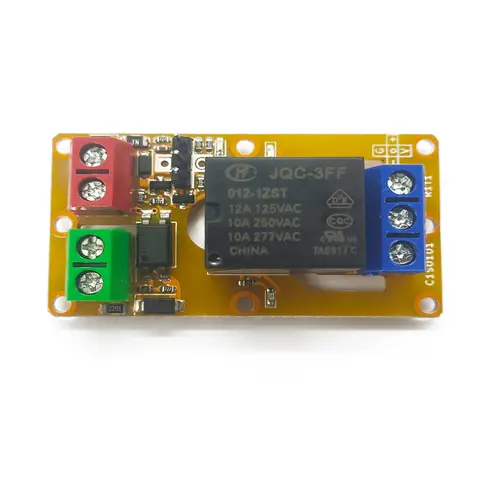
A1J0101 Economical Input Amplifier Module
Optocoupler-isolated input amplifier that turns a low-voltage signal into a 250V AC / 10A relay output.
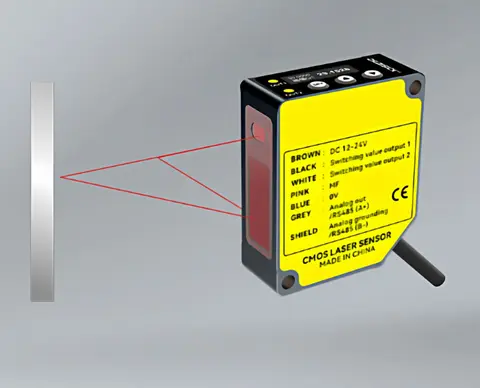
DDK-G Laser Displacement Sensor 30-250 mm
Five reference-distance grades, 20 model codes, and a choice of 4-20 mA, 0-10 V or RS485. Resolution starts at 2 um on G30 under the published test conditions; select by measuring window, target and required output.
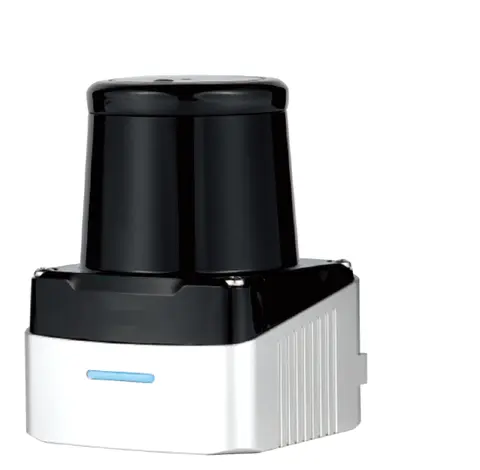
DLD-100D Single-Line TOF Scanning LiDAR
Single-line TOF scanning LiDAR with up to 100 m range, model-dependent 280°/360° coverage, and a 100 Hz / 0.32° DLD-100DP option.
Related Products in Laser Distance Sensors
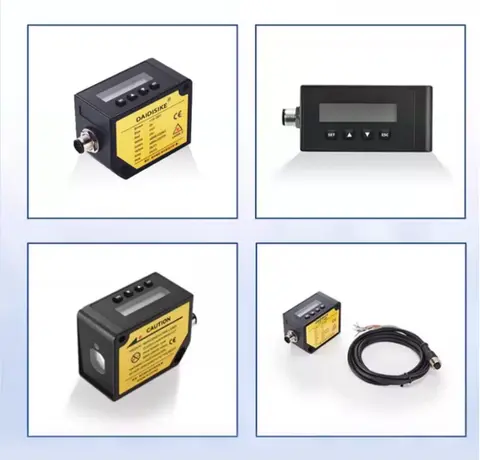
DDA-Y & DDB-Y Industrial Laser Distance Sensor (Phase-Shift)
Phase-shift laser distance sensors: 0.2-100 m range, millimeter accuracy, RS485 Modbus RTU, switching or analog output.
DDK-F Long-range Laser Distance Sensor
Pulsed TOF laser distance sensor with up to 200 m range, stated fog/snow accuracy, IP67 and -30 to +60°C.