
JNS-Q Contact Displacement Grating Sensor
Digital, RS-485-networkable contact displacement sensor with resolution down to 0.2 micron for inline dimensional inspection.
 🔍 Click to enlarge · 1/6
Technical Specifications
| Output | Catalogue-listed options: 5V RS485; relevant 24V RS232/RS485 / Modbus RTU and O1/O2 limit signals. Confirm exact probe/controller configuration; options are not all present on every model. |
|---|---|
| Measuring range | 12.7mm (JNS-Q120 series); 25.4mm (JNS-Q250 series) |
| Resolution (variant dependent) | Catalogue family options: 0.2μm (high-precision) to 5μm (basic); confirm selected variant. Not absolute accuracy or Q120 repeatability. |
| Repeatability | JNS-Q120: ±2μm (confirmed). Other family variants require their own specification. |
| Operating voltage | 5V type: DC5V (<50mA); 24V type: DC24V |
| Protection rating | Current JNS-Q120 IP54/IP65 references unresolved; confirm the exact probe, connector and controller configuration. |
| Pneumatic air source | Historical catalogue: Φ4 tubing, 0.16-0.2MPa on pneumatic variants; verify current actuation/pressure for the exact order, including Q120Q24. |
| Communication baud rate | Catalogue lists 38400bps Modbus RTU on relevant configurations; confirm the selected interface/controller. |
| Multi-drop capacity | Configuration-specific. Historical material lists different software/network counts; confirm supported connected devices, address capacity and topology. |
| Display controller | Optional for JNS-Q120; specify controller model, output interface and included accessories when ordering. |
Overview
JNS-Q is a contact-type digital displacement sensor whose measuring core is an optical grating (photoelectric linear encoder) with moire-fringe interpolation, rather than a conventional potentiometer or LVDT coil. A spindle with a contact stylus touches the workpiece and the grating reads the linear displacement digitally. JNS-Q120 is confirmed with 12.7 mm measuring range and ±2 μm repeatability. Repeatability is not display resolution or absolute measuring accuracy; the family's catalogue resolution options of 0.2–5 μm must be checked for the selected variant.
It is intended for manufacturing and quality-control engineers performing contact gauging, multi-point flatness/thickness checks and inline sorting where the workpiece can be physically contacted. The catalogue includes spring-return, air-push and on-body digital-display variants, and 5V/24V communication configurations. A separate display controller is optional, not included by default. Confirm the exact probe, display/controller, output interface and software/network capacity as one order configuration.
Features & Benefits
Sub-micron resolution via optical grating principle
Optical-grating variants list resolution from 0.2 μm (high-precision) to 5 μm (basic). JNS-Q120 repeatability is confirmed as ±2 μm, a separate quantity from resolution and absolute accuracy. Assess the complete fixture and measurement uncertainty against the required tolerance.
Three spindle actuation types on one platform
The catalogue shows spring-return, pneumatic and on-body digital-display variants. JNS-Q120's separate display controller is optional. Match the complete order code to the actuation method, current pressure/force specification and chosen display arrangement; do not infer included accessories from a family photograph.
RS-485 networking matched to the selected configuration
Catalogue configurations include 5V RS485 and 24V RS232/RS485 with Modbus RTU. Confirm the protocol, interface hardware, address capacity and supported software-device count before designing a multi-point fixture; historical images quote different capacities and do not establish one guaranteed total for every model.
Configuration-specific O1/O2 limit-alarm options
Where the ordered probe/controller supports O1/O2, limit signals can report a tolerance result to suitable control equipment. Check output type, current rating and load interface; an alarm signal does not by itself establish that a reject actuator can be driven directly.
Built-in peak-hold and peak-to-peak measurement modes
Catalogue configurations list real-time value, peak hold (MAX), bottom hold (MIN) and peak-to-peak (MAX-MIN) functions. Verify which functions are provided by the selected probe, optional controller or software before relying on them for runout or stroke measurement.
Check the current environmental specification
IP54 and IP65 references remain unresolved for the current JNS-Q120 configuration. Confirm the ordered probe, connector and optional controller ratings and the actual coolant or cleaning conditions; do not assume additional protection is unnecessary.
Two standard ranges matching common indicator strokes
12.7 mm (JNS-Q120 series) and 25.4 mm (JNS-Q250 series) correspond to the 0.5-inch/1.0-inch strokes commonly used on dial indicators, easing replacement of analog indicators and imported digital gauge probes in existing fixtures.
Applications
Models & Ordering Information
5V type
24V type
How to Select
- Need 12.7mm (0.5-inch) stroke: select the JNS-Q120 configuration with confirmed ±2μm repeatability; this is not its display resolution or absolute accuracy.
- Need 25.4mm (1.0-inch) stroke: choose the JNS-Q250 series.
- Fixed fixture, continuous contact measurement: choose the spring-return type (A suffix), which relies on an internal spring for return.
- For intermittent pneumatic contact, verify the Q-suffix actuator arrangement, current air-pressure specification and measuring force; the Q120Q24 description remains a version-reconciliation item.
- For local readout, compare the catalogue's on-body display variant with an optional external display controller. JNS-Q120's controller is not supplied by default unless included in the quotation.
- Single-point application, cost-sensitive, single-channel RS485 only: choose the 5V type (JNS-Q120A / JNS-Q250A / JNS-Q120S / JNS-Q120Q).
- For multi-point RS232/RS485 networking, compare the relevant 24V configurations and confirm controller/software capacity, protocol and permitted topology for the complete order.
- For GO/NG evaluation, confirm whether O1/O2 signals exist on the selected probe/controller and whether an external interface is needed for the actual load.
- For a pneumatic variant, confirm tubing, operating pressure and measuring force from the current model-specific sheet; do not close the Q120Q24 actuation conflict from its suffix alone.
📘 Need the full method? NPN vs PNP Sensor Outputs Explained
When NOT to specify the JNS-Q — and what to use instead
The target must not be physically touched -- delicate, soft, coated, or fast-moving surfaces
Why not: The FAQ confirms JNS-Q is a contact-type sensor: a spindle with a contact stylus physically touches the workpiece, distinguishing it explicitly from non-contact sensors.
Use instead: A non-contact laser displacement sensor from this manufacturer's separate laser displacement sensor product line, as the FAQ itself references.
The required measuring stroke exceeds 25.4 mm
Why not: The two standard ranges documented are 12.7 mm (JNS-Q120 series) and 25.4 mm (JNS-Q250 series) -- no longer-stroke model is listed.
Use instead: Confirm with DAIDISIKE whether a longer-stroke variant exists, or consider a non-contact laser/optical displacement sensor with a longer range.
An automated line where repeated stylus contact would cause unacceptable wear, and the spring-return type is being specified by default
Why not: Repeated stylus contact can cause wear or affect the workpiece. The selected actuation method and measuring force must suit the actual contact cycle; no universal wear-life improvement is established here.
Use instead: Evaluate the exact pneumatic variant or a non-contact method after confirming current actuation, pressure, force and fixture requirements.
A multi-point system needs RS232/RS485-selectable networking beyond a single channel, but the 5V-type model is being priced
Why not: The catalogue distinguishes 5V single-channel and 24V interface options, but historical software/network counts differ. A family headline does not establish the supported station count for the order.
Use instead: Specify the complete probe/controller/software network and obtain written channel-count, protocol and topology confirmation.
Specifications we do not publish yet
We only publish a figure once we are confident it is true. The items below are still being validated through further testing and real-world customer feedback, so for now we would rather leave them open than guess. If one of them matters to your design, ask us for the latest validated status.
- Response time is not documented
- Operating temperature range is not documented
- Overall dimensions are not documented
- Housing/stylus material is not documented
- Certification documents beyond "available on request" are not specified
- Contact/measuring force of the stylus is not documented
- Stylus tip wear life or recommended service interval is not documented
- The meaning of the JNS-Q120Q24 model suffix is unresolved -- source pages show a conflict between a "spring-return" description and the pneumatic "Q" suffix for this specific model
- Current JNS-Q120 protection rating: IP54/IP65 references need exact-version reconciliation; measuring range12.7mm, repeatability±2μm and optional display controller are already confirmed.
- Exact output/controller configuration, analog range, communication protocol and simultaneous capabilities need order-specific confirmation; historical software/network counts differ.
Frequently Asked Questions
What measuring principle does the JNS-Q sensor use?
What is the resolution and repeatability of the JNS-Q?
What measuring ranges are available?
Can multiple JNS-Q sensors be networked together?
Does the JNS-Q support GO/NG sorting without a PLC or host computer?
What measurement modes are built into the sensor?
What is the difference between the spring-return, air-push, and digital-display versions?
What environmental protection rating does the JNS-Q have?
Is the JNS-Q a contact or non-contact sensor?
What supply voltage does the JNS-Q require?
Is the JNS-Q certified to any specific standards?
Is a display controller included with JNS-Q120?
Related Categories and Example Products
Explore other functions that may be needed in a machine or line. The products below are category examples, not pre-validated electrical or safety combinations. Confirm each interface and application separately: Laser Displacement Sensors · Proximity Sensors
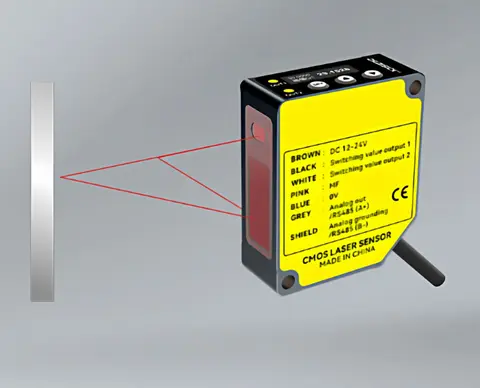
DDK-G Laser Displacement Sensor 30-250 mm
Five reference-distance grades, 20 model codes, and a choice of 4-20 mA, 0-10 V or RS485. Resolution starts at 2 um on G30 under the published test conditions; select by measuring window, target and required output.
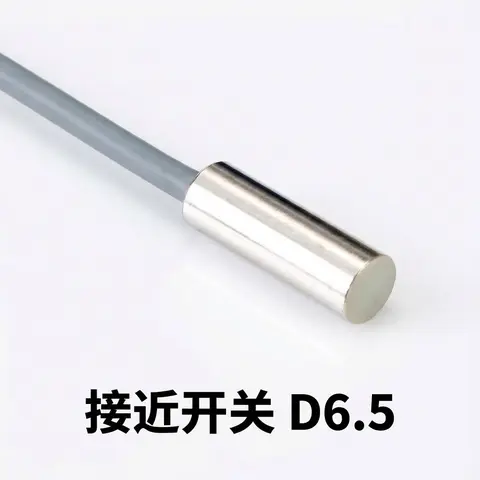
D6.5 Series Inductive Proximity Sensors (Ultra-Short 18mm / Y-Type / 35mm / 45mm)
6.5mm-diameter inductive proximity sensors for tight-clearance mounting where M8 sensors won't fit.