
JER Economical Safety Light Curtain (Optical Synchronization)
Economical through-beam safety light curtain using optical synchronization (no interconnecting sync cable between transmitter and receiver), in 4 beam pitches (10, 14, 20 and 40 mm) with up to 200 beams and a protected height up to 7960 mm. NPN/PNP transistor output, DC12/24V supply, IP65 housing.
 🔍 Click to enlarge · 1/20
Technical Specifications
| Curtain Type | Through-beam (opposed mode) — separate transmitter and receiver, optically synchronized (no interconnecting sync cable) |
|---|---|
| Safety Design Basis | Designed to the safety level of IEC 61496-1/-2, per the DAIDISIKE catalog, which also cites TUV CE certification. Certification documents are available on request. |
| Synchronization | Optical sync (光同步) between transmitter and receiver — no dedicated sync wire, which the catalog says simplifies wiring and cuts installation time |
| Beam Pitch | 10 / 14 / 20 / 40 mm (4 pitch steps) |
| Detection Accuracy (min. detectable object) | 18 / 22 / 28 / 48 mm respectively (= beam pitch + 8 mm) |
| Number of Beams | 8, 10 ... 200 (10 mm pitch); 8, 10 ... 200 (14 mm pitch); 6, 8 ... 200 (20 mm pitch); 4, 6 ... 200 (40 mm pitch). Catalog footnote: special orders up to 200 beams max on any pitch. |
| Protected Height | Beam pitch x (number of beams - 1). Catalog-listed range: 70-1990 mm (10 mm), 98-2786 mm (14 mm), 100-3980 mm (20 mm), 120-7960 mm (40 mm). |
| Curtain Overall Length | = P + H + J + 12 + 12 mm (H = protected height). P = 5 mm at 10/14 mm pitch, 10 mm at 20/40 mm pitch; J = 10 mm at all pitches. |
| Sensing / Detection Distance | Catalogue-listed models state 0.3-3 m by default (code A); code B = 0.3-6 m requires order confirmation. The legacy 30-3000 / 30-6000 mm text conflicts at the lower limit: 0.3 m equals 300 mm, not 30 mm. Confirm the minimum sensing distance for the exact ordered model. |
| Response Time | <= 15 ms |
| Ambient Light Immunity | 10,000 lux (incidence angle >= 5 degrees); catalog states the system effectively shields about 99% of interference signals (electromagnetic noise, strobe lighting, welding arc light and similar sources) |
| Dimensions | 29.3 x 29.3 mm x L (L = transmitter / receiver length) |
| Enclosure Rating | IP65 |
| Controller | DQCA / DQCA2 |
| Supply Voltage | DC 12/24 V; AC 110-220 V (relay-output version) is listed in the catalog's technical-parameter table, but no relay ('J') output code appears in the JER model-code diagram — see dataGaps |
| Current Consumption | <= 200 mA |
| Output | NPN / PNP transistor, sink current 500 mA, residual voltage < 1.5 V, with polarity, short-circuit and overload protection. Signal-output code selectable: N (NPN, NO/NC), 2NC (dual NPN, NC), 2NO (dual NPN, NO), P (PNP, NO/NC), 2PC (dual PNP, NC), 2PO (dual PNP, NO) |
| Output State | ON when beams clear (receiver indicator green) |
| Indicators | Transmitter: power (red). Receiver: output — clear (green) / blocked (red) |
| Light Source | Modulated infrared LED |
| Connection | Circular aviation connector with dedicated cable; transmitter 3-core, receiver 5-core. Optional M12 aviation-socket interface via the 29.3 x 29.3 mm housing. |
| Housing Material | Aluminium alloy; end caps ABS-reinforced nylon |
| Ambient Light Tolerance | Incandescent light: 3,000 lux at receiver face; sunlight: 10,000 lux at receiver face |
| Operating Temperature | -10 to +40 degrees C (non-condensing); storage -25 to +55 degrees C |
| Ambient Humidity | Operating 35-85% RH; storage 35-95% RH |
| Standard / Optional Accessories | JER-08 two-end mounting bracket and DQCA-02 T-screw ship standard; DQCA-01 stainless-steel pipe bracket and DQCA-03 raised-nut bracket are optional |
Overview
The JER is DAIDISIKE's economical through-beam (opposed-mode) safety light curtain: a separate transmitter and receiver bar that project a plane of modulated infrared beams across a machine opening. What sets JER apart from the rest of the range is optical synchronization (光同步技术) between the two bars — there is no interconnecting sync cable to route between transmitter and receiver, which the catalog says keeps wiring simple and cuts installation time. The catalog positions JER as a compact, low-cost, easy-to-install option ("体积小巧,安装调试方便,配线简单,外形美观,超高性价比") for presses, hydraulic and oil presses, shearing machines, automatic doors and other machinery, able to detect any opaque object passing through the curtain that is larger than its resolution.
JER is offered in four beam pitches — 10, 14, 20 and 40 mm — a narrower lineup than the full 8-step (10-200 mm) pitch range on DAIDISIKE's DQC/DQA series, consistent with its economical positioning. Beam count runs from as few as 4-8 (depending on pitch) up to 200 per unit, giving protected heights from 70 mm up to 7960 mm at the 40 mm pitch. The catalog states the design is built to the safety level of IEC 61496-1/-2 and also references a TÜV CE marking; certification documents are available on request.
Output is NPN or PNP transistor, single or dual signal, wired via the transmitter's 3-core and receiver's 5-core aviation connector, with an optional M12 aviation-socket interface on the 29.3 x 29.3 mm housing. The housing is rated IP65, self-checks continuously with polarity/short-circuit/overload protection, responds in <=15 ms, and the catalog says it shields about 99% of interference signals (electromagnetic noise, strobe lighting, welding arc light and similar ambient sources) and tolerates ambient light up to 10,000 lux at an incidence angle of 5 degrees or more.
Features & Benefits
Optical Synchronization — No Interconnecting Cable
The emitter and receiver synchronize via light, not wire, so each side only needs its own local power connection. This eliminates the cable trays, drag chains, or conduit runs that would otherwise have to cross the protected opening.
NPN/PNP Selectable Transistor Output
Transistor output is selectable as NPN or PNP, so the curtain wires directly into either input architecture on the customer's existing PLC or controller without an interposing relay.
Minimal 3-Wire or 5-Wire Hookup
Each side is wired with only 3 or 5 wires. Combined with the absence of a cross-cable, this keeps on-site wiring work low compared with curtains that need both power wiring and a separate sync line.
Up to 200 Beams, 7960mm Protective Height
Four beam pitches (10/14/20/40mm) and beam counts up to 200 give protective heights from 70mm up to 7960mm at the 40mm pitch — near-8-meter coverage from an entry-level series.
DC 12/24 V Supply
Tolerates typical factory-floor supply fluctuation without needing a dedicated regulated power supply.
IP65 Housing with Standard End-Mounting Brackets
The IP65-rated housing resists dust and low-pressure water jets from any direction. JER-08 end-mounting brackets and the DQCA-02 T-screw ship as standard; DQCA-01 and DQCA-03 are optional accessories.
Applications
Models & Ordering Information
10 mm Pitch
14 mm Pitch
20 mm Pitch
40 mm Pitch
How to read the JER model code
Mounting Accessories
PDF & 3D CAD Downloads
Browse all downloadsJER Safety Light Curtain User Manual
Find the file for your exact model
Open the download center with this series selected. Search the full model, check the file details, and download the matching CAD file.
Confirm the document and CAD file match the exact ordered version before installation or mechanical design. Contact us if your model is not listed.
How to Select
- The 10 mm-pitch group has an 18 mm minimum detectable object, not a 10 mm or 14 mm finger-detection rating. Beam counts run 08-200 (step 2), giving protective heights of 70-1990 mm. Verify the exact model and safety documentation before specifying.
- Choose 14mm pitch for beam counts 08-200 (step 2), giving protective heights of 98-2786mm.
- Choose 20mm pitch for beam counts 06-200 (step 2), giving protective heights of 100-3980mm.
- Choose 40mm pitch when you need to detect arm/body-sized objects across a large opening; beam counts run 04-200 (step 2), giving protective heights up to 7960mm.
- Match the output type (NPN or PNP) to your PLC's input card to avoid adding a conversion relay.
- Optical synchronization matters most where running a sync cable between the two housings is difficult or costly; where cable routing is already available, compare pricing against other series.
- Choose 3-wire wiring for basic switching output needs, or 5-wire where additional terminals/signals are required.
- Body cross-section is 29.3 x 29.3mm with JER-08 end-mounting brackets included as standard; confirm whether DQCA-01/02/03 accessories suit your mounting angle/position.
- Model numbers follow JER{pitch}-{beam count} {protected height}{signal output}{sensing distance}, e.g. JER20-10 180NA = 20 mm pitch, 10 beams, 180 mm protected height, N-type output, 0.3-3 m sensing distance; protected height = (beam count - 1) x pitch. Use this formula to work out the beam count you need, or pick directly from the model list by protected height.
📘 Need the full method? How to Choose a Safety Light Curtain · Type 2 vs Type 4 Safety Light Curtains
When NOT to specify the JER — and what to use instead
You need a beam pitch other than 10, 14, 20 or 40 mm (e.g. 25, 30, 80 or 200 mm)
Why not: JER's economical lineup is limited to four pitch steps, a narrower set than the full 8-step (10-200 mm) pitch range offered on the standard-range DQC and long-range DQA series.
Use instead: DQC (standard-range) or DQA (long-range) for the additional 25/30/80/200 mm pitch options.
You need a sensing/detection distance beyond 0.3-3 m as a routinely available option
Why not: Every catalog-listed JER model defaults to a 0.3-3 m sensing distance; a 0.3-6 m code (B) is defined in the model code, but the catalog explicitly says any distance beyond the 0.3-3 m default has to be confirmed with customer service rather than ordered off the standard list.
Use instead: Confirm 0.3-6 m (or longer) availability and lead time with us before specifying, or consider DQA, whose model code lists up to eight distance steps (0.3-3 m through 0.3-40 m) as catalog-listed options.
The machine control needs a volt-free relay output
Why not: Every signal-output code in the JER model-code diagram (N, 2NC, 2NO, P, 2PC, 2PO) is transistor-based (NPN or PNP). The catalog's technical-parameter table separately lists an AC110-220V 'relay-output' supply option, but no relay output code appears in the JER model-code diagram itself, so relay-output availability for JER is unconfirmed.
Use instead: Specify DQA or DQC, whose model code includes a dedicated relay ('J') output option, or confirm relay-output availability for JER with us first.
Washdown, high-pressure hosing or wet outdoor environments
Why not: The JER housing is rated IP65 — dust-tight and protected against low-pressure water jets, but not against high-pressure jetting or immersion.
Use instead: The DQR waterproof safety light curtain series for wet or washdown areas.
You need true 14 mm finger-detection capability
Why not: JER's finest pitch is 10 mm, but its detection accuracy — the minimum object it reliably detects — is 18 mm (pitch + 8 mm), a hand-level rather than a strict 14 mm finger-detection figure, even though the catalog groups the 10 mm pitch under finger protection (手指保护).
Use instead: Confirm the required detection capability against your ISO 13855 risk assessment; ask us for a finer-resolution series if 14 mm finger detection is mandatory.
Ambient temperature outside -10 to +40 degrees C, or condensing conditions
Why not: JER's operating range is -10 to +40 degrees C, non-condensing. Outside that band, or where the optical faces can condense or ice, detection is not guaranteed.
Use instead: A heated or sheltered enclosure that holds the curtain within spec, or confirm a wide-temperature option with us.
Specifications we do not publish yet
We only publish a figure once we are confident it is true. The items below are still being validated through further testing and real-world customer feedback, so for now we would rather leave them open than guess. If one of them matters to your design, ask us for the latest validated status.
- PFHd, MTTFd and DCavg figures, and any Type/Category classification under IEC 61496 or ISO 13849-1 — the catalog states only 'IEC 61496-1/-2 standard safety level' for JER without a Type or Category number.
- TUV CE certificate number and the exact scope (which JER models/configurations it covers). Certification documents are available on request.
- Safety-distance calculation guidance (ISO 13855) and the exact response time per beam count — the catalog gives only the <= 15 ms maximum.
- Whether an AC110-220V relay-output JER variant is actually orderable: the technical-parameter table lists this supply option, but the model-code diagram's signal-output codes are all transistor-based (N/2NC/2NO/P/2PC/2PO) with no relay code shown.
- Whether the 0.3-6 m sensing-distance code (B) is a standard catalog option or requires special ordering — the spec-table footnote only says distances beyond the 0.3-3 m default require contacting customer service.
- Cable length options and the pinout for the standard aviation connector and the optional M12 aviation-socket interface.
- Muting and fixed/floating blanking function availability — not mentioned anywhere in the JER catalog pages.
- Whether beam counts below the catalog's listed minimum (e.g. below 8 at 10/14 mm pitch, below 6 at 20 mm, below 4 at 40 mm) or odd-numbered beam counts can be special-ordered.
Frequently Asked Questions
Does the JER series require a cable between the emitter and receiver for synchronization?
What output types does JER support?
How many wires does each JER unit need?
What beam pitches are available in the JER series?
What is the maximum protective height available in the JER series?
What is the maximum number of beams in a single JER unit?
What power supply does JER require?
What is the ingress protection (IP) rating of the JER housing?
What is the JER housing's cross-sectional dimension?
What mounting accessories come standard with JER?
How is a JER model number structured?
What certifications does JER carry?
Related Categories and Example Products
Explore other functions that may be needed in a machine or line. The products below are category examples, not pre-validated electrical or safety combinations. Confirm each interface and application separately: Safety Relays · Safety Door Locks & Switches · Press & Press Brake Protection
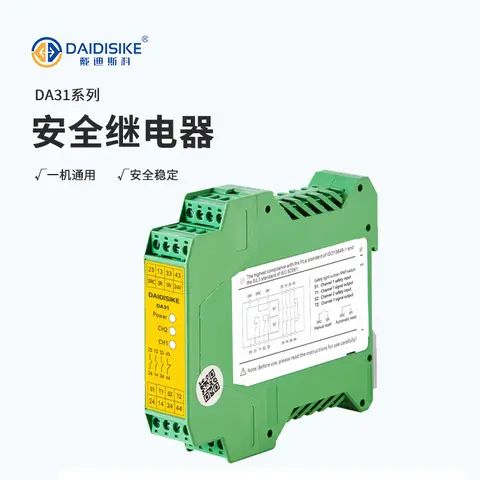
DA31 Emergency-Stop Safety Relay Module
Ultra-slim 22.6 mm Category 4/PL e/SIL 3 safety relay with dual-channel PNP/NPN input and a solid-state status output.
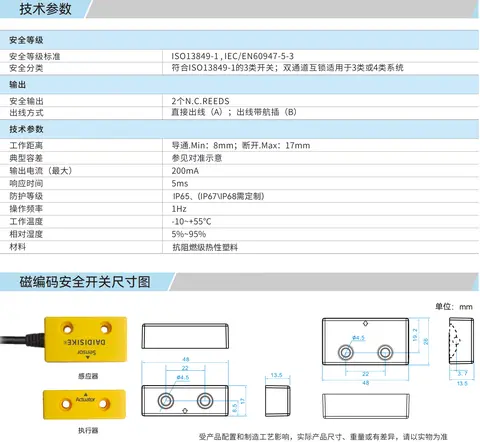
DX-C1 Magnetic Coded Safety Switch
Non-contact coded-magnet safety switch with 17 mm sensing range and high misalignment tolerance for guard doors.
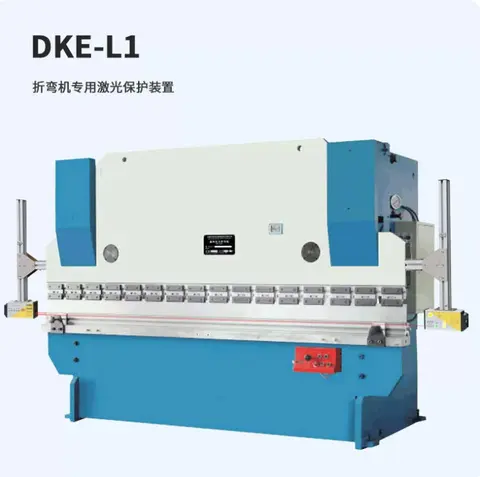
DKE-L3 Press Brake Laser Protection
Ram-mounted laser guarding that tracks the punch tip on press brakes and shears without blocking hand-fed work.
Related Products in Safety Light Curtains
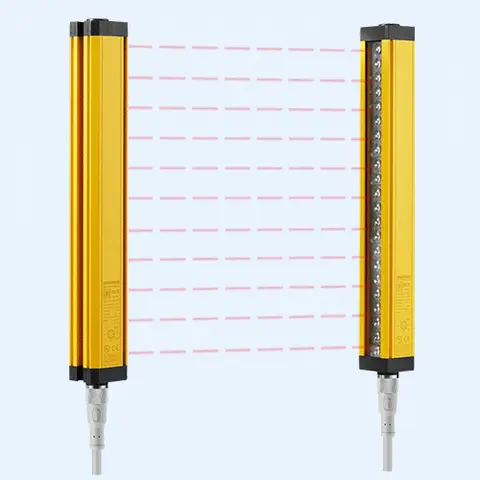
DCE Automation Safety Light Curtain
Compact through-beam safety light curtain in a 30 x 30 mm housing: 10/20/30/40 mm beam pitch, up to 72 beams, 0.3-3 m or 0.3-6 m sensing distance, NPN/PNP output. Catalogue-stated Type 4 design basis; confirm exact safety-document scope.
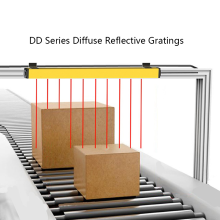
DD / DDOF Single-Sided Area Light Curtain
One housing, no far-side receiver: order DD for diffuse sensing to 2000 mm, or DDOF for per-beam TOF ranging to 4000 mm with zero dead zone and one-key distance teaching. 48 standard models, 4-50 beams.
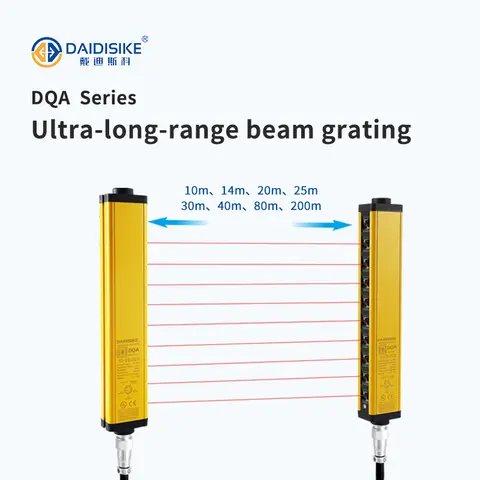
DQA Long-distance Safety Light Curtain
Long-range through-beam safety light curtain for large presses, hydraulic and shearing machines: a transmitter/receiver pair spanning up to 40 m, in 8 beam pitches from 10 to 200 mm, with NPN, PNP or relay output and a selectable single- or dual-output signal. Designed to the Type 4 architecture of IEC 61496 and Category 4 of ISO 13849-1.
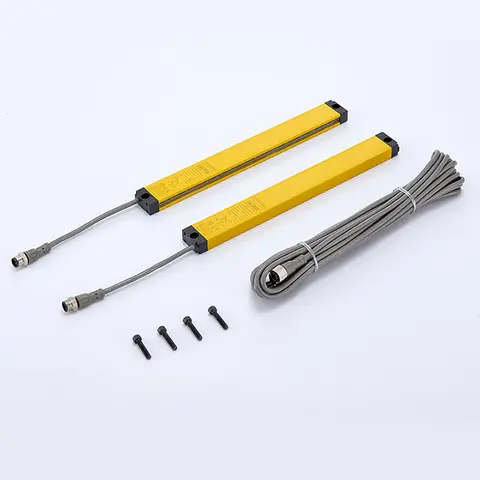
DQB Ultra-thin (Side-emitting) Safety Light Curtain
Ultra-thin side-emitting safety light curtain with a 15 x 30 mm cross-section for gaps too narrow for standard units.