
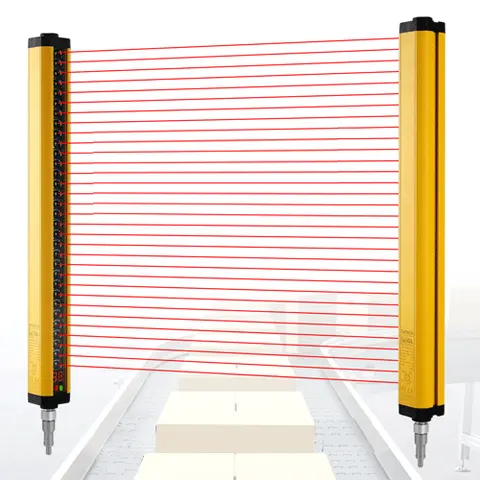
DQLV Vehicle Separation Light Curtain
Vehicle-separation through-beam curtain that deliberately ignores anything under 150 mm -- birds, insects, glare -- while resolving to 1 mm, with a controller-free NPN/PNP/relay/RS-485 output built for toll, parking and gate lanes.
 🔍 Click to enlarge · 1/15
Technical Specifications
| Curtain Type | Through-beam (opposed mode) vehicle-separation light curtain -- separate emitter and receiver bar, no mirrors |
|---|---|
| Product Positioning | Catalog groups DQLV under its 'Safety Light Curtain' chapter heading, but no IEC 61496 Type rating or ISO 13849 Category is stated for this series on these pages -- it is a vehicle detection/separation device, not a certified personnel-safety ESPE |
| Minimum Detectable Object | 150 mm by design (ignores sunlight glare, birds, insects, mud splatter), with 1 mm resolution above that threshold; can detect a vehicle tow hook |
| Beam Spacing | 20 / 40 / 80 mm |
| Number of Beams | 4-72 (20 mm pitch); 4-36 (40 mm pitch); 4-18 (80 mm pitch), even steps |
| Protected Height (H) | 60-1420 mm (20 mm pitch); 120-1400 mm (40 mm pitch); 240-1360 mm (80 mm pitch). H = spacing x (beam count - 1). Note: the catalog's general feature list separately states '60mm-2840mm', which conflicts with its own per-model table -- see data gaps. |
| Detection / Operating Range | Per-model table lists 0.3-15 m for every configuration; the order code offers 8 selectable bands (A: 0.3-3 m to H: 0.3-40 m), default code A unless a longer range is requested in advance. A separate general feature list states 0-5 m / 0-10 m / 0-30 m -- these figures do not fully align; confirm the actual achievable range with the factory. |
| Response Time | <= 15 ms |
| Interference Immunity | Catalog states 99% suppression of electromagnetic interference, strobe lighting, welding-arc light and surrounding light sources |
| Output | Order-code selectable: A = NPN normally closed, B = PNP normally closed, C = NPN normally open, D = PNP normally open, R = RS-485/232 communication, J = relay output, P = one switching group + one RS-485 channel combined. Dual-channel configuration: channel 1 = vehicle detection, channel 2 = fault alarm. Wiring diagram labels the switching lines (labelled OSSD1/OSSD2 on the catalog diagram, but DQLV is a vehicle-detection sensor, not a certified safety OSSD device) with CP/CE and 0V/VDC pins; no serial protocol (e.g. Modbus) is named for the RS-485 option. |
| Cabling | Seven-core cable, controller-free (no external controller needed). Cable length order code: E = 3.5 m, F = 5 m, G = 10 m, H = 15 m |
| Enclosure | Sensor bar: aluminium-profile housing, IP67-rated per catalog ('国际IP67级防水不锈钢外罩'). Optional heated hood is rated NEMA 3R / IEC IP54 -- lower than the base sensor rating because it carries a heated glass window |
| Optional Heated Hood | DQLV-1.6 (1600 mm overall / 1280 mm window, curtain heights <=1280 mm) or DQLVF-1.8 (1800 mm overall / 1600 mm window, curtain heights <=1440 mm). Stainless steel / cold-rolled steel / aluminium-alloy construction; anti-fog heated tempered glass 200 W per set, 24 VDC; heating engages below 0 degrees C or above 96% RH (both field-adjustable); overheat cutoff above 45 degrees C |
| Hood Electrical / Environmental | Heating supply 24 V / 10 A; primary thermostat closes 4 degrees C / opens 29 degrees C; backup thermostat closes 55 degrees C / opens 36 degrees C; humidity switch (mechanical nylon membrane) 20-80% RH; red LED indicates heater on; hood operating range -20 to +70 degrees C; protection rating NEMA 3R (IEC IP54) |
| Operating Temperature (sensor) | -10 to +55 degrees C |
| Ambient Humidity | RH <= 85% (at 20 degrees C) |
| Diagnostics | Continuous self-check; polarity, short-circuit and overload protected; auto-detects a faulty beam, blanks it while continuing normal operation, and issues a separate alarm signal |
| Functions | Automatic vehicle separation, counting, presence detection, classification detection, headway (vehicle time-gap) determination; eliminates tailgating, reliably separating semi-trailers, full trailers and single vehicles |
| Stated Applications | Toll plazas, ETC (electronic toll collection), AVC (automatic vehicle classification), WIM (weigh-in-motion) stations, fixed overload/over-limit detection stations, customs vehicle management, intelligent transportation systems |
| Order Code Structure | DQLV{beam count}/{spacing}-{protected height} {output: A/B/C/D/R/J/P} {detection range: A-H} {cable length: E/F/G/H} {hood: J/Y} |
Overview
The DQLV is a through-beam light curtain built specifically for vehicle separation and detection in lane-based applications. The DAIDISIKE catalog groups it under its 'Safety Light Curtain' chapter heading, but the DQLV-specific pages cite no IEC 61496 Type rating and no ISO 13849 Category for this series -- it is a vehicle detection/separation sensor, not a certified personnel-safety ESPE. Its stated applications are toll plazas and ETC (electronic toll collection) lanes, AVC (automatic vehicle classification) systems, WIM (weigh-in-motion) stations, fixed overload/over-limit detection stations, customs vehicle management, and intelligent transportation systems generally.
A deliberately coarse detection algorithm is the core design choice: the catalog states the curtain only detects objects 150 mm and larger, with 1 mm resolution above that threshold, so sunlight glare, birds, insects and mud do not register as a false vehicle. It supports automatic vehicle separation, counting, presence detection, classification detection, and headway (vehicle-to-vehicle time gap) measurement, and the catalog states it eliminates tailgading so semi-trailers, full trailers and single vehicles are reliably separated.
Output is selected by an order-code letter: A/B/C/D for NPN or PNP transistor output (normally closed or open), J for a relay output, R for RS-485/232 communication, or P for one switching group plus one RS-485 channel combined. In a dual-channel transistor configuration, channel 1 reports vehicle detection and channel 2 reports a light-curtain fault alarm, both carried over a seven-core cable directly into the lane controller -- no external controller is required. The sensor bar housing is rated IP67; an optional heated hood (DQLV-1.6 / DQLVF-1.8) with anti-fog glass and dual thermostats is available for cold or foggy outdoor lanes.
Features & Benefits
150 mm Minimum Detectable Object Ignores Birds and Insects
A deliberately coarse detection capability means small flying objects crossing the beam do not trigger a false vehicle-present signal, reducing false barrier triggers in outdoor lanes.
Controller-Free All-in-One Interface
A single seven-core cable carries the selected output -- dual-channel NPN/PNP switching (channel 1 = vehicle detection, channel 2 = fault alarm), a relay contact, or RS-485/232 communication -- directly into the lane controller, without an external controller. The catalog documents the RS-485/232 option as a communication interface; it does not name a specific serial protocol such as Modbus.
High-Energy Photodiodes for Easy Install and Maintenance
The catalog states the DQLV uses high-energy, high-penetration phototransistors that simplify installation and maintenance, and that the unit auto-detects a faulty beam, blanks it out while continuing normal operation, and outputs a separate alarm signal.
IP67 Housing with Optional Heated Hood
The unit is rated IP67, and an optional heater hood (NEMA 3R / IP54, 24 V / 10 A, with primary/backup thermostats and a humidity switch) is available for de-icing and anti-condensation in cold outdoor environments.
Detection Ranges Up to 40 m
Selectable operating ranges (3/6/10/15/20/25/30/40 m, corresponding to order-code range bands A through H) let a single product family cover standard toll lanes through extra-wide or multi-lane installations without paying for unneeded range.
Three Beam-Spacing Options up to 1,420 mm Detection Height
Beam spacing can be matched to the level of vehicle-outline detail required, for example whether a low trailer hitch or coupling needs to be resolved, and the tallest configured model (DQLV72/20-1420) protects heights up to 1,420 mm.
Optional Pre-Configured Protective Hood
The DQLVF-1.6 / DQLVF-1.8 protective hood (1,600/1,800 mm overall, 1,280/1,600 mm window) adds a heated, anti-fog electric glass front (200 W per set) and dual thermostat/humidity control for units mounted directly in weather-exposed lane positions.
Applications
Models & Ordering Information
6 listed table entries across 3 beam-pitch options. Compare beam count and span, then confirm the complete ordering code. Beam pitch alone does not establish detection capability or suitability for personnel protection.
Beam count 4 to 72 (even steps); protected height (H, mm) = 20 x (beam count - 1). Full table (H / curtain length l): 4/60/133, 6/100/173, 8/140/213, 10/180/253, 12/220/293, 14/260/333, 16/300/373, 18/340/413, 20/380/453, 22/420/493, 24/460/533, 26/500/573, 28/540/613 ... 68/1340/1413, 70/1380/1453, 72/1420/1493.
| Listed model entry | Beam pitch K (mm) | Number of beams N | Beam span H (mm) |
|---|---|---|---|
| DQLV04/20-60 | 20 | 4 | 60 |
| DQLV72/20-1420 | 20 | 72 | 1420 |
| Listed model entry | Beam pitch K (mm) | Number of beams N | Beam span H (mm) |
|---|---|---|---|
| DQLV04/40-120 | 40 | 4 | 120 |
| DQLV36/40-1400 | 40 | 36 | 1400 |
| Listed model entry | Beam pitch K (mm) | Number of beams N | Beam span H (mm) |
|---|---|---|---|
| DQLV04/80-240 | 80 | 4 | 240 |
| DQLV18/80-1360 | 80 | 18 | 1360 |
2 listed entries at 20 mm pitch · 6 across this table. Beam span is calculated as H = (N − 1) × K; it is not overall housing length or proof of detection capability. Some entries expand catalogue ranges. Confirm the complete ordering code and availability before ordering; inclusion is not a stock claim.
How to read the DQLV model code
Optional Heated Protective Hood
PDF & 3D CAD Downloads
Browse all downloadsDQLV Vehicle Classification Light Curtain Technical Guide
Confirm the document and CAD file match the exact ordered version before installation or mechanical design. Contact us if your model is not listed.
How to Select
- Select beam spacing and beam-axis count by the required protected height/lane cross-section: 20 mm spacing (DQLV04/20-60 to DQLV72/20-1420) gives the finest detection accuracy, suited to resolving low structures such as trailer hitches.
- 40 mm spacing (DQLV04/40-120 to DQLV36/40-1400) is the mid-range option between resolution and cost.
- 80 mm spacing (DQLV04/80-240 to DQLV18/80-1360) is the coarsest and most economical option, suited to applications that only need overall vehicle-outline detection.
- Confirm the output code (R/A/B/C/D/J) with the factory before ordering; the seven-core cable provides RS-485 Modbus RTU and switching (transistor) outputs together, with output 1 = vehicle detection and output 2 = fault alarm in the dual-NPN configuration.
- Choose the detection-range order code (A: 0.3-3 m to H: 0.3-40 m, selectable in 3/6/10/15/20/25/30/40 m steps) to match the lane width; a wider lane needs a larger range band, and oversizing adds unnecessary cost.
- Choose the cable-length code (E: 3.5 m / F: 5 m / G: 10 m / H: 15 m) to match the actual wiring distance from the emitter/receiver units to the control cabinet, avoiding on-site cable extensions.
- Add the DQLVF-1.6 (1.6 m overall / 1.28 m window) or DQLVF-1.8 (1.8 m overall / 1.6 m window) protective hood if the installation site is directly exposed to severe weather such as freezing cold, icing, or heavy fog; the hood includes heated anti-fog glass, primary/backup thermostats, and a humidity switch.
- Select the matching reflector (55x300, 55x350, or 45x310) based on the installation space and chosen model.
📘 Need the full method? Safety versus measurement: check the required function
When NOT to specify the DQLV — and what to use instead
You need personnel or machine-guarding protection (hands, arms, body) rather than vehicle detection
Why not: DQLV's detection algorithm deliberately ignores anything under 150 mm, and the catalog states no IEC 61496 Type rating or ISO 13849 Category for this series -- it is a vehicle-separation sensor, not a certified safety ESPE.
Use instead: DQC (general-purpose), DQA (long-range), or DQT4 (Type 4) safety light curtain, paired with a DA31 or DQSRN safety relay.
Detecting objects, animals, or people smaller than about 150 mm
Why not: The 150 mm minimum detectable object is a deliberate design choice to reject birds, insects and glare -- it cannot resolve anything finer, by design.
Use instead: A finer-pitch measuring curtain (DQL / DQM series) or a fine-pitch safety curtain (10-25 mm pitch DQC/DQA) if finer resolution is genuinely required.
A lane cross-section or vehicle height exceeds the catalog's largest configured model
Why not: The largest listed models are DQLV72/20-1420, DQLV36/40-1400 and DQLV18/80-1360; the catalog does not document configurations beyond these per-pitch maximums.
Use instead: Confirm a custom configuration with the factory before specifying anything beyond the published beam-count and height tables.
Your lane-management system expects a named protocol (e.g. Modbus RTU) over RS-485
Why not: The catalog documents the R output code only as 'RS-485/232 communication' -- it does not name a serial protocol or register map. Assuming Modbus without confirmation risks an integration mismatch.
Use instead: Confirm the exact serial protocol, register map and baud rate with the factory before specifying the R or P output code.
Installation is exposed to freezing rain, snow, or heavy fog without the optional hood
Why not: The base DQLV housing is rated IP67, but the catalog's cold-weather features (heated anti-fog glass, dual thermostats, humidity switch) belong to the separate optional hood, not the bare sensor bar.
Use instead: Add the DQLV-1.6 or DQLVF-1.8 heated protective hood for cold-climate or fog-prone lane installations.
The output/wiring code received does not match the lane controller's expected signal type
Why not: Output type is fixed by the model's order-code letter (A/B/C/D transistor NC/NO, R serial, J relay, P combined) and cannot be changed after manufacture.
Use instead: Confirm the required output code with the factory before ordering; do not assume a field substitution is possible.
Specifications we do not publish yet
We only publish a figure once we are confident it is true. The items below are still being validated through further testing and real-world customer feedback, so for now we would rather leave them open than guess. If one of them matters to your design, ask us for the latest validated status.
- Maximum protected height: the DQLV model table tops out at 1420 mm (DQLV72/20-1420); the 2840 mm figure in the general feature list belongs to a sister series. Ask us if you need a taller unit
- The general feature list states detection range '0-5m, 0-10m, 0-30m', while the order-code table offers eight bands from 0.3-3m to 0.3-40m and the per-model table shows '0.3-15m' for every row; which figure is the actual default/achievable range needs confirming.
- The RS-485/232 communication output (code R) has no documented protocol name, register map, or baud rate in this catalog section.
- Whether emitter and receiver synchronize optically (no physical sync cable) is not stated on these pages; only a general 'synchronized scanning' description of the vehicle-detection principle is given.
- Exact seven-core cable pinout (including which cores carry RS-485 A/B) and connector part numbers are not fully itemized on these pages.
- Whether the base DQLV sensor bar itself (as opposed to the optional hood) carries a stated ambient-light-immunity (lux) rating is not given on these pages.
Frequently Asked Questions
What does the DQLV vehicle separation light curtain actually detect?
Why is 150 mm minimum detectable object described as a benefit rather than a limitation?
Does the DQLV need an external controller?
How do the emitter and receiver stay synchronized without a cable between them?
Is the DQLV a safety light curtain like the ones used for machine guarding?
What protection level does the DQLV have for outdoor use?
What beam-spacing options are available, and how do I choose?
What is the maximum detection height available?
What is the maximum operating/detection range?
Can the DQLV replace a buried inductive loop sensor?
Can you provide certification documents for the DQLV light curtain?
Related Categories and Example Products
Explore other functions that may be needed in a machine or line. The products below are category examples, not pre-validated electrical or safety combinations. Confirm each interface and application separately: Safety Light Curtains · Photoelectric Sensors · Relay & Timer Modules
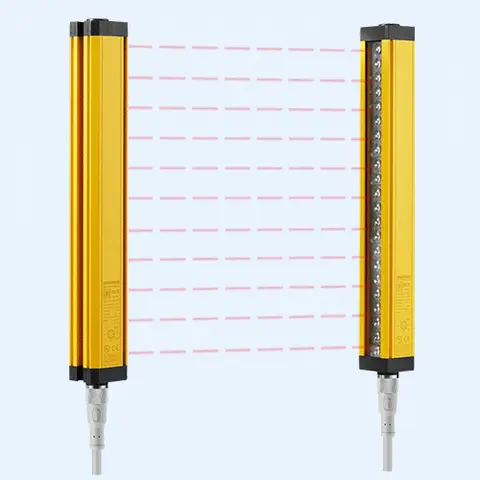
DCE Automation Safety Light Curtain
Compact through-beam safety light curtain in a 30 x 30 mm housing: 10/20/30/40 mm beam pitch, up to 72 beams, 0.3-3 m or 0.3-6 m sensing distance, NPN/PNP output. Catalogue-stated Type 4 design basis; confirm exact safety-document scope.
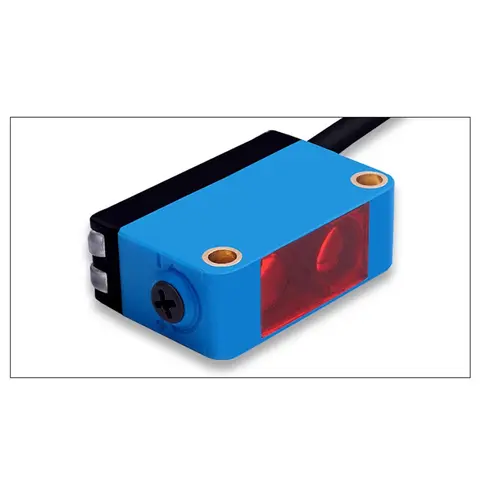
BGS-CX441 / BGS-CX442 Background Suppression Photoelectric Sensor
Wire-adjustable BGS sensor with 2 mm or 15 mm spot, 10-300 mm range, published black/white differential distance.
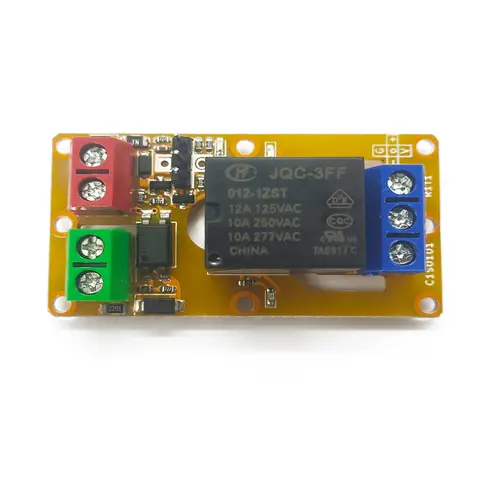
A1J0101 Economical Input Amplifier Module
Optocoupler-isolated input amplifier that turns a low-voltage signal into a 250V AC / 10A relay output.
Related Products in Measuring Light Curtains
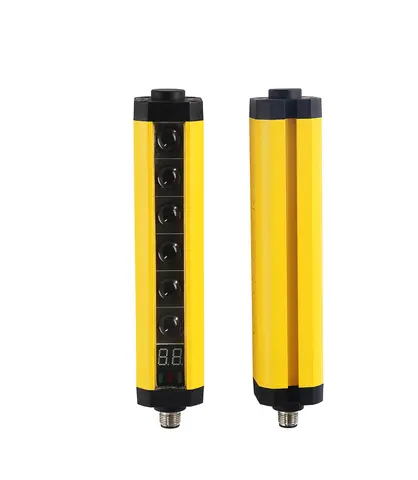
DQL Measuring Light Curtain (Analog/RS485)
Measuring light curtain with dual analog (voltage / 4-20mA current) and RS-485/RS-232 Modbus RTU serial output, 1.25-80mm beam spacing.
DQM Measuring Light Curtain (Switching Output)
Object detection and counting light curtain: NPN or PNP switching output, 0.5 ms response time, no RS485 or RS232 interface.