
RS Series M12/M18/M30 Capacitive Proximity Sensor (ABS Plastic Housing)
M12/M18/M30 threaded capacitive proximity sensors in ABS housing, detecting metallic and non-metallic targets alike.
 🔍 Click to enlarge · 1/17
Technical Specifications
| Sensing Method | Capacitive |
|---|---|
| Thread Size | M12 / M18 / M30 |
| Housing | ABS plastic |
| Output Type | NPN / PNP, NO / NC |
| Mounting Type | Flush; T suffix = non-flush |
| Sensing Range Codes | M12: 02/03/04/06; M18: 05/08/15; M30: 10/20/15/30 |
| Wiring | 3-wire (DC) |
| Material | ABS plastic housing |
Overview
The RS series is a capacitive-type proximity sensor: it detects the change in capacitance caused by a target entering its sensing field, which allows it — unlike inductive proximity sensors — to sense non-metallic materials (liquids, granules, powders, plastics, wood, glass) as well as metals. Each sensor threads into an M12, M18 or M30 mounting hole and is housed in ABS plastic rather than metal.
The series is offered in NPN or PNP output, each with NO (normally-open) or NC (normally-closed) switching, and in flush-mount or non-flush-mount (T-suffix) body styles, all wired as 3-wire DC. It suits machine builders and process-equipment integrators who need a threaded, panel-mountable sensor to detect material level, presence, or position of non-metallic or metallic targets — e.g. level sensing in plastic tanks/hoppers, detecting objects through a non-metallic wall, or general presence detection where inductive sensing cannot see the target.
Features & Benefits
Detects non-metallic and metallic targets alike
Because sensing relies on a capacitance change rather than eddy currents, the RS series can detect liquids, powders, granules, plastics, wood and glass, in addition to metal, extending its use beyond what an inductive proximity sensor can sense.
Three thread sizes — M12, M18, M30 — for different mounting and range needs
A common product family covers small panel-mount installations (M12) up to larger housings with correspondingly greater sensing range (M30), letting an integrator standardize on one series across different equipment sizes.
NPN and PNP output, each with NO and NC logic
Every thread size is available in NPN or PNP switching, and in normally-open or normally-closed configuration, so the sensor can be matched to the sinking or sourcing input type of the customer's PLC/controller and to the required fail-safe logic without needing a different sensor family.
Flush and non-flush mounting options within the same series
Standard part numbers are flush-mount (embeddable, side shielding tolerant); T-suffix part numbers are non-flush mount, allowing selection based on how the sensor will be installed relative to surrounding material.
3-wire DC wiring
All variants use a 3-wire DC connection, a standard wiring scheme compatible with common industrial DC control circuits.
ABS plastic housing
The housing is molded ABS plastic rather than metal, an alternative construction to the metal-housing capacitive series in this product line for applications where a non-metallic housing is preferred.
Multiple sensing-range codes per thread size
Each thread size offers several range-code variants (M12: 02/03/04/06; M18: 05/08/15; M30: 10/20/15/30, per the part-number series), giving a choice of nominal sensing distance within the same mounting size before the exact mm figures are confirmed with the factory.
Applications
Models & Ordering Information
M12 Series
M18 Series
M30 Series
How to Select
- By thread size (M12/M18/M30): choose based on the equipment's mounting hole diameter and required sensing range — larger threads generally offer larger range codes (e.g. M30 offers 10/20/15/30 codes, M12 offers 02/03/04/06 codes).
- By sensing range code: the two digits in the part number are a range code (e.g. RS1202 = M12/code 02, RS3030 = M30/code 30); the exact mm sensing distance for each code is pending confirmation from the factory, so request the code-to-distance table when selecting.
- By output type (N/P): N = NPN, P = PNP in the part number; choose according to the sinking (NPN) or sourcing (PNP) input type of the site PLC/controller.
- By switching logic (1/2): 1 = normally-open (NO), 2 = normally-closed (NC) in the part number; choose according to whether the control logic requires the contact to close or open on target detection.
- By mounting type (flush/non-flush): part numbers without a T suffix are flush-mount; part numbers ending in T are non-flush mount — choose based on whether metal/material shielding surrounds the sensor and the required installation depth.
- Part-number key: RS + thread size (12/18/30) + range code + N/P (NPN/PNP) + 1/2 (NO/NC) + [T for non-flush]. Example: RS1805N1 = M18 thread, range code 05, NPN output, normally-open, flush mount.
📘 Need the full method? How to Choose a Proximity Sensor · NPN vs PNP Sensor Outputs Explained
When NOT to specify the RS — and what to use instead
Dusty, humid, or condensing locations, or spots prone to material buildup on the sensing face
Why not: Capacitive sensing - the principle this series relies on to detect non-metallic dielectric targets - is inherently sensitive to humidity, dust, and buildup near the sensing face, which can cause false triggering.
Use instead: A tubular M12/M18/M30 inductive proximity sensor (e.g. the M8/M12/M18/M30 DC 2-wire series) for metal-only targets in contamination-prone locations.
Needing the exact millimeter sensing distance for a given range code before finalizing a design
Why not: The exact mm sensing-distance value for each range code (e.g. M12 02/03/04/06, M18 05/08/15, M30 10/20/15/30) is explicitly listed as pending confirmation from the factory.
Use instead: Request the current code-to-distance table from the factory before finalizing the sensing gap in the mechanical design.
Machine guarding or personnel-safety interlocking
Why not: This is a standard presence/level-detection sensor with no safety rating or safety category listed in its specifications.
Use instead: a dedicated safety interlock switch (e.g. the DX-series safety door switch) or a safety light curtain
Specifications we do not publish yet
We only publish a figure once we are confident it is true. The items below are still being validated through further testing and real-world customer feedback, so for now we would rather leave them open than guess. If one of them matters to your design, ask us for the latest validated status.
- Exact millimeter sensing distance for each range code (M12: 02/03/04/06; M18: 05/08/15; M30: 10/20/15/30)
- Operating/supply voltage range
- Ingress protection (IP) rating
- Operating temperature range
- Response/switching frequency
- Short-circuit and overload protection
- Cable length
- Certification status (CE/UL/RoHS, etc.)
Frequently Asked Questions
What is the difference between a capacitive proximity sensor and an inductive proximity sensor?
What thread sizes are available in the RS series?
What output types does the RS series offer?
What is the difference between flush and non-flush mount versions?
What is the wiring configuration of the RS series?
What is the housing material of the RS series?
Can the RS series detect liquid inside a plastic container?
How do I read an RS series part number, e.g. RS1805N1?
What is the exact sensing distance in mm for each range code?
What supply voltage does the RS series require?
Can you provide certification documents for the RS series?
Related Categories and Example Products
Explore other functions that may be needed in a machine or line. The products below are category examples, not pre-validated electrical or safety combinations. Confirm each interface and application separately: Photoelectric Sensors · Relay & Timer Modules · Laser Switch Sensors
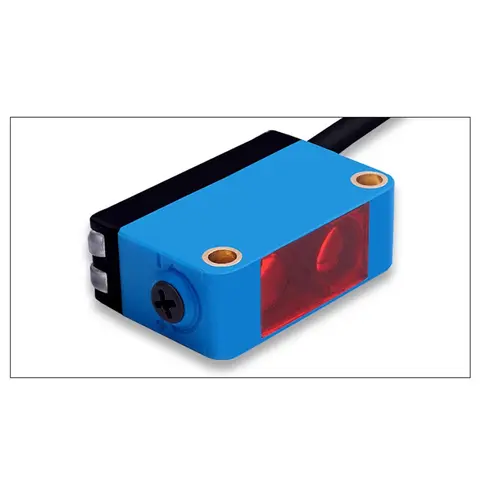
BGS-CX441 / BGS-CX442 Background Suppression Photoelectric Sensor
Wire-adjustable BGS sensor with 2 mm or 15 mm spot, 10-300 mm range, published black/white differential distance.
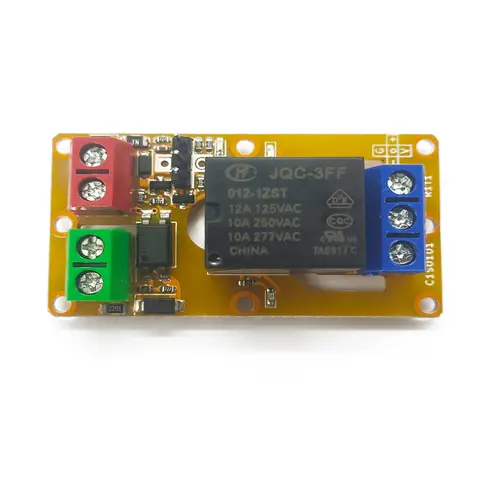
A1J0101 Economical Input Amplifier Module
Optocoupler-isolated input amplifier that turns a low-voltage signal into a 250V AC / 10A relay output.
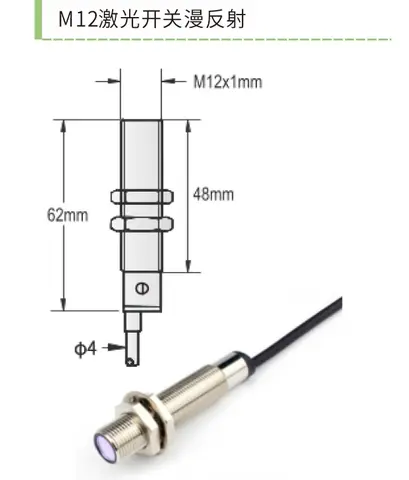
DDSK Laser Diffuse Reflective Sensor M12 / DK Laser Diffuse Reflective Sensor M18
M12/M18 threaded laser diffuse reflective sensor with a visible 650nm red laser for fast alignment.
Related Products in Proximity Sensors
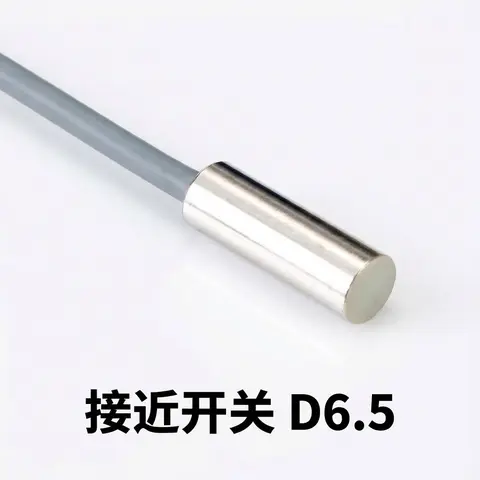
D6.5 Series Inductive Proximity Sensors (Ultra-Short 18mm / Y-Type / 35mm / 45mm)
6.5mm-diameter inductive proximity sensors for tight-clearance mounting where M8 sensors won't fit.
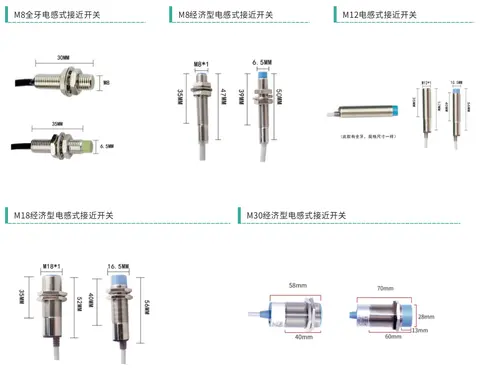
Economy Inductive Proximity Sensors M8/M12/M18/M30 (JNX/JNS Series)
Economy 3-wire DC inductive proximity sensors M8/M12/M18/M30 - flush/non-flush, NPN/PNP, NO/NC, IP67.
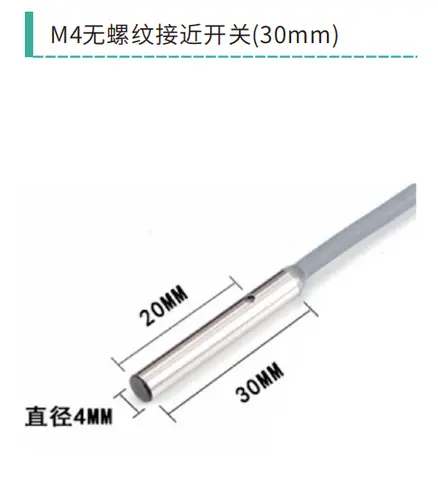
Economy M4/M5/M6 Inductive Proximity Switches (Export-Grade)
Compact export-grade M4/M5/M6 inductive proximity switches in NPN/PNP, NO/NC for tight-space detection.
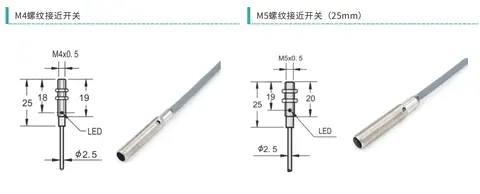
High-Quality Threaded M4/M5/M6 Inductive Proximity Sensors
Threaded M4/M5/M6 inductive proximity sensors with selectable NPN/PNP output and NO/NC logic for tight spaces.