
M8/M12/M18/M30 DC 2-Wire Inductive Proximity Sensors
M8/M12/M18/M30 threaded-barrel 2-wire DC inductive sensors, 10-30VDC, IP67, sensing distance 1-25mm.
 🔍 Click to enlarge · 1/7
Technical Specifications
| Sensing Method | Inductive |
|---|---|
| Body Size | M8 / M12 / M18 / M30 |
| Wiring | 2-wire DC |
| Output Type | NO (D1) / NC (D2) |
| Mounting | Flush (P) / Non-flush (T) |
| Operating Voltage | 10-30VDC |
| Sensing Distance | M8: 1mm/2mm (flush), 2mm/4mm (non-flush); M12: 2mm/3mm/4mm (flush), 4mm/6mm/8mm (non-flush); M18: 5mm/8mm (flush), 8mm/12mm/16mm (non-flush); M30: 10mm/16mm (flush), 15mm/25mm (non-flush) |
| Protection Rating | IP67 |
| Operating Temperature | -25°C to +70°C |
| Surge Protection | 1kV/1ms/1kΩ |
| Short-Circuit Protection | Yes, with 120mA overload protection point |
| LED Indicator | Yes |
| Standard Cable Length | 2m (longer lengths available on request) |
| Body Length | M8: 45mm; M12: 45mm; M18: 55mm; M30: 55mm |
| Switching Frequency (example) | M8 1mm flush: 2kHz; M8 4mm non-flush: 800Hz |
Overview
This is a series of cylindrical, threaded-barrel inductive proximity sensors in four standard body sizes (M8, M12, M18, M30), wired as 2-wire DC devices that operate in series with the load. Each size is offered in a flush-mount (shielded, embeddable) version and a non-flush-mount (unshielded) version, each available with normally-open (NO/D1) or normally-closed (NC/D2) output.
They are intended for machine builders, panel integrators, and OEMs who need a compact, standardized metal-detection sensor for machine automation, packaging lines, and material-handling equipment, and who want a simple 2-wire connection that reduces cabling versus 3-wire PNP/NPN sensors. Sensing distance across the series ranges from 1mm (M8, flush mount) to 25mm (M30, non-flush mount), and all variants operate on 10-30VDC with an IP67 protection rating.
Features & Benefits
Four Body Sizes in One Family (M8/M12/M18/M30)
Lets integrators standardize sourcing and spare-parts stock across a machine that needs different sensing ranges in different locations, using one consistent naming and wiring logic.
Sensing Distance Graded from 1mm to 25mm
Covers close-range precision detection (M8, 1-4mm) up to longer-range detection for larger targets or looser mounting tolerance (M30, up to 25mm), without changing sensor family or wiring scheme.
Flush and Non-Flush Mount Options on Every Size
Flush (shielded) versions can be embedded flush in metal housings without false triggering from surrounding metal; non-flush versions deliver longer sensing distance when a metal-free clearance zone around the sensor face is available.
2-Wire DC Connection, 10-30VDC
Wires in series with the load (brown/BN to +, blue/BU through the load to +), simplifying cabling compared with 3-wire sensors and letting it work directly with many DC control circuits in this voltage range.
Selectable NO (D1) or NC (D2) Output
Matches either "detect presence = signal on" or "detect presence = signal off" logic without extra interface relays, simplifying PLC/control-circuit design.
IP67 Protection Rating
Withstands washdown, dust, and splash exposure typical of production-floor and conveyor environments without additional enclosure.
Built-In Surge and Short-Circuit Protection
1kV/1ms/1kΩ surge protection plus short-circuit protection and a 120mA overload trip point reduce the risk of sensor damage from wiring transients or accidental output shorts during installation and maintenance.
-25°C to +70°C Operating Range with LED Status Indication
Suits both standard indoor machine environments and cooler/warmer plant conditions, while the LED gives a visual on/off status check during commissioning and troubleshooting without a meter.
Applications
Models & Ordering Information
M8 Series
M12 Series
M18 Series
M30 Series
How to Select
- Selection is driven by four variables encoded directly in the model number: body size, sensing distance, output logic (D1/D2), and mount type (P/T).
- Choose body size (M8/M12/M18/M30) based on available installation space and required sensing distance range — larger barrel sizes support longer sensing distances (M8: 45mm long, M12: 45mm long, M18: 55mm long, M30: 55mm long).
- Choose flush mount (P) if the sensor face needs to be mounted flush with surrounding metal without false triggering, accepting a shorter sensing distance for the same barrel size.
- Choose non-flush mount (T) if a longer sensing distance is needed for the same barrel size and a metal-free clearance zone around the sensing face is available.
- Pick the sensing distance (Sn) from the graded values available per size/mount combination: M8: 1mm (flush)/2mm (flush)/2mm (non-flush)/4mm (non-flush); M12: 2mm/3mm/4mm (flush)/4mm/6mm/8mm (non-flush); M18: 5mm/8mm (flush)/8mm/12mm/16mm (non-flush); M30: 10mm/16mm (flush)/15mm/25mm (non-flush).
- Choose D1 (normally open) if the control logic should read "signal on when target detected"; choose D2 (normally closed) if it should read "signal off when target detected".
- Confirm the target control circuit matches the 2-wire DC, 10-30VDC wiring topology before specifying — all variants in this family are 2-wire DC.
- For high line speed, favor the shortest sensing distance in each size, which generally gives the highest switching frequency (e.g. M8 1mm flush = 2kHz vs M8 4mm non-flush = 800Hz).
- Model naming logic: Size + detection-range code + D1(NO)/D2(NC) + P(flush)/T(non-flush) — e.g. M1204D1T = M12 barrel, 4mm sensing distance, NO output, non-flush mount.
📘 Need the full method? How to Choose a Proximity Sensor · NPN vs PNP Sensor Outputs Explained
When NOT to specify the M8/M12/M18/M30 — and what to use instead
Detecting plastic, wood, liquid, or other non-metallic targets
Why not: This series is inductive (Sensing Method: Inductive), so it only responds to metal targets, not to plastic, liquid, wood, or other non-metallic materials.
Use instead: A capacitive proximity sensor, such as the RS series (M12/M18/M30) or the Q20 square capacitive switch, which are built to detect non-metallic dielectric targets.
Wiring directly into a high-impedance PLC input with no allowance for OFF-state leakage or a minimum holding current
Why not: As a 2-wire DC device, this sensor is wired in series with the load, so it inherently passes a small residual current in the OFF state and needs a minimum load current to keep its own control circuit powered - and the exact residual-current and minimum-load-current figures are not listed in the current spec table for this series.
Use instead: A 3-wire DC sensor from this site (e.g. the Q25/Q30/Q40 or Q17/Q18C square inductive series), where the output switches independently of the load current path.
Embedding a non-flush (T) model flush with surrounding metal to save space
Why not: Non-flush (T) mount versions in this family need a metal-free clearance zone around the sensing face to reach their rated sensing distance, per the flush/non-flush guidance for this series.
Use instead: The flush (P) mount version of the same body size, which is shielded for embedding level with surrounding metal (at a shorter rated sensing distance).
Sensing aluminum, brass, copper, or other non-ferrous targets at the full rated sensing distance
Why not: The published sensing-distance figures (e.g. M8 1-4mm, M30 10-25mm) are not qualified with a non-ferrous correction factor in the current spec table, so actual distance to non-ferrous metal is not confirmed.
Use instead: Confirm the non-ferrous correction factor with the factory before specifying for aluminum/brass/copper targets, or size the mounting position with extra margin.
Machine guarding or personnel-safety interlocking
Why not: This is a standard non-contact metal-detection sensor with no safety rating or safety category listed in its specifications.
Use instead: a dedicated safety interlock switch (e.g. the DX-series safety door switch) or a safety light curtain
Specifications we do not publish yet
We only publish a figure once we are confident it is true. The items below are still being validated through further testing and real-world customer feedback, so for now we would rather leave them open than guess. If one of them matters to your design, ask us for the latest validated status.
- Non-ferrous correction factor for aluminum/brass/copper targets
- MTBF (mean time between failures)
- Housing material
- Minimum load current / OFF-state residual (leakage) current for the 2-wire circuit
- Full cable/connector pinout beyond the BN/BU 2-wire color code (e.g. connector variants)
- Certification status (CE/UL/RoHS, etc.)
Frequently Asked Questions
What is the operating voltage range for this proximity sensor series?
How is a 2-wire DC inductive proximity sensor wired?
What is the difference between flush (P) and non-flush (T) mount versions?
What sensing distances are available in this series?
What is the protection rating (IP rating) of these sensors?
What is the operating temperature range?
Does this sensor have built-in short-circuit or surge protection?
What is the standard cable length?
Can I choose between normally-open and normally-closed output?
What is the difference in switching frequency between sizes?
Can you provide certification documents for this sensor?
Related Categories and Example Products
Explore other functions that may be needed in a machine or line. The products below are category examples, not pre-validated electrical or safety combinations. Confirm each interface and application separately: Photoelectric Sensors · Relay & Timer Modules · Laser Switch Sensors
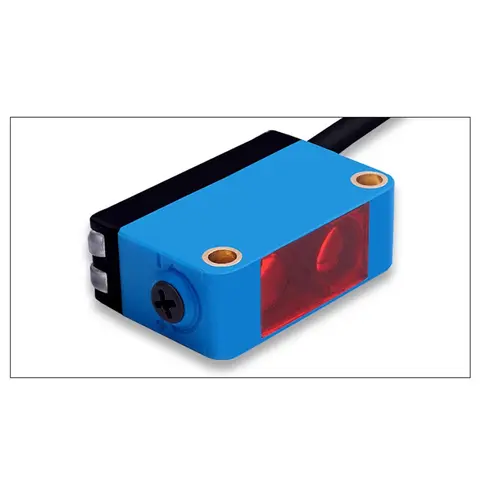
BGS-CX441 / BGS-CX442 Background Suppression Photoelectric Sensor
Wire-adjustable BGS sensor with 2 mm or 15 mm spot, 10-300 mm range, published black/white differential distance.
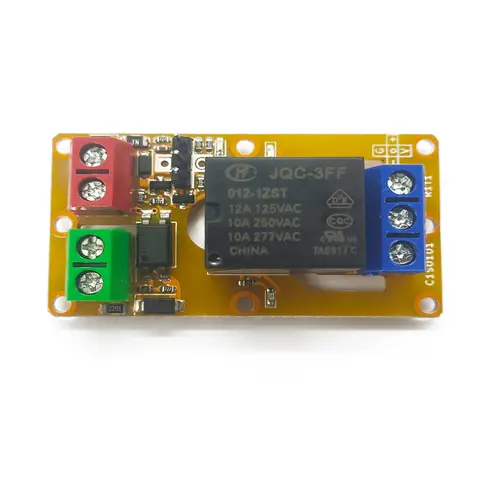
A1J0101 Economical Input Amplifier Module
Optocoupler-isolated input amplifier that turns a low-voltage signal into a 250V AC / 10A relay output.
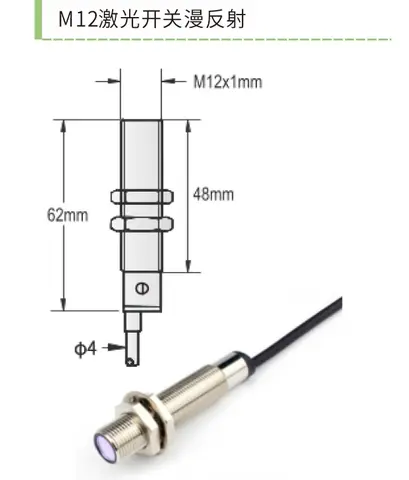
DDSK Laser Diffuse Reflective Sensor M12 / DK Laser Diffuse Reflective Sensor M18
M12/M18 threaded laser diffuse reflective sensor with a visible 650nm red laser for fast alignment.
Related Products in Proximity Sensors
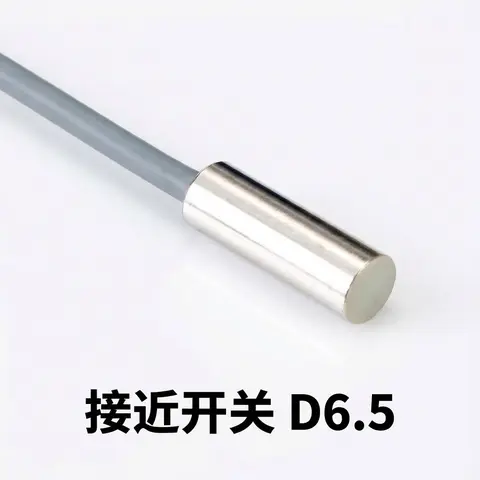
D6.5 Series Inductive Proximity Sensors (Ultra-Short 18mm / Y-Type / 35mm / 45mm)
6.5mm-diameter inductive proximity sensors for tight-clearance mounting where M8 sensors won't fit.
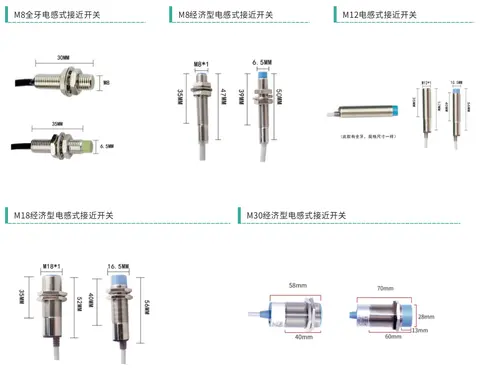
Economy Inductive Proximity Sensors M8/M12/M18/M30 (JNX/JNS Series)
Economy 3-wire DC inductive proximity sensors M8/M12/M18/M30 - flush/non-flush, NPN/PNP, NO/NC, IP67.
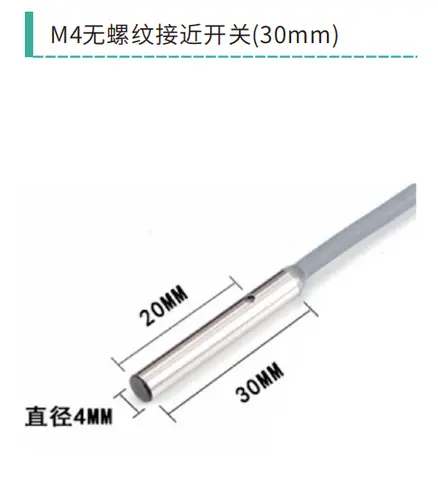
Economy M4/M5/M6 Inductive Proximity Switches (Export-Grade)
Compact export-grade M4/M5/M6 inductive proximity switches in NPN/PNP, NO/NC for tight-space detection.
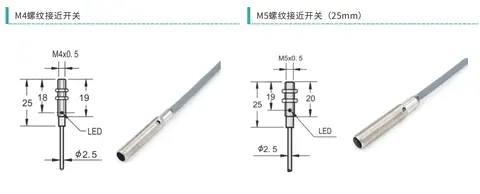
High-Quality Threaded M4/M5/M6 Inductive Proximity Sensors
Threaded M4/M5/M6 inductive proximity sensors with selectable NPN/PNP output and NO/NC logic for tight spaces.