
M3/M4/M5 Short-Body Separate-Amplifier Inductive Proximity Switches (15mm)
Ultra-short 15mm-body M3/M4/M5 unthreaded inductive proximity switches for space-constrained metal-target sensing.
 🔍 Click to enlarge · 1/11
Technical Specifications
| Sensing Method | Inductive (M3 / M4 / M5) |
|---|---|
| Body Type / Length | M3: D3, 15mm, unthreaded; M4: D4, 15mm, unthreaded; M5: short separate-amplifier type |
| Output Type | NPN / PNP, NO / NC (all diameters) |
| Sensing Distance | M3: 0.6 / 0.8 / 1.0 mm; M4 & M5: 0.8 / 1.0 / 1.2 / 1.5 mm |
| Wiring | 3-wire (DC) |
Overview
This is a family of small-diameter (D3/D4/M5), threadless, 15mm short-body inductive proximity switches for detecting metal targets at close range. Because they have no mounting thread, they are fitted (not screwed) into a housing or bracket, which suits designers who need the smallest possible footprint inside a machine, jig, or tooling assembly.
They are intended for OEM machine builders, panel and tooling integrators, and automation engineers who are retrofitting or designing compact mechanisms - cylinders, small fixtures, gauging jigs, packaging heads - where a standard M8/M12 threaded proximity switch will not physically fit. M3 offers 0.6/0.8/1.0mm sensing distance, while M4 and M5 offer 0.8/1.0/1.2/1.5mm, each available in NPN/PNP output with NO/NC selection on a 3-wire DC connection.
Features & Benefits
Ultra-Short 15mm Body
At just 15mm long, this body is markedly shorter than the same brand's standard M3/M4 unthreaded proximity switches (25mm) and threaded M5 switches (25mm). That extra clearance frees up axial space in compact assemblies where a standard-length sensor simply won't fit.
Three Diameters: D3, D4, M5
Available in three diameters - D3, D4, and M5 - to match different bore and bracket sizes without redesigning the mounting point.
NPN/PNP Output, NO/NC Selectable
Every diameter and sensing distance is offered in both NPN and PNP transistor output, each with normally-open (NO) or normally-closed (NC) logic, giving direct compatibility with common PLC input cards, whether sourcing or sinking.
Multiple Sensing Distances per Diameter
M3 offers 0.6mm, 0.8mm, or 1.0mm sensing distance; M4 and M5 offer 0.8mm, 1.0mm, 1.2mm, or 1.5mm. This lets engineers fine-tune trigger distance to the target size and installation gap tolerance of their application.
3-Wire DC Connection
All variants use a 3-wire DC connection scheme, consistent with standard PNP/NPN 3-wire proximity switch wiring practice.
Systematic Model Coding
Model numbers directly encode output type, NO/NC logic, and sensing distance - for example, M30615N1 denotes M3 diameter, 0.6mm sensing distance, NPN output, normally-open, 15mm body. This makes part selection and reordering straightforward.
Applications
Models & Ordering Information
M3 Unthreaded Short-Body (D3 x 15mm)
M4 Unthreaded Short-Body (D4 x 15mm)
M5 Short Separate-Amplifier Type
How to Select
- M3 (D3 x 15mm) offers 0.6mm, 0.8mm, or 1.0mm sensing distance - choose a shorter distance for smaller targets or tighter installation gaps.
- M4 (D4 x 15mm) and M5 (short separate-amplifier type) offer 0.8mm, 1.0mm, 1.2mm, or 1.5mm sensing distance.
- NPN output (model code contains "N", e.g. M30615N1) suits PLC sinking inputs; PNP output (model code contains "P") suits PLC sourcing inputs - confirm your PLC input card type before ordering.
- Normally-open (NO) logic uses suffix "1" (e.g. N1, P1): output is off with no target and turns on when the target approaches.
- Normally-closed (NC) logic uses suffix "2" (e.g. N2, P2): output is on with no target and turns off when the target approaches. Choose based on your downstream PLC logic to avoid interlock errors.
- D3 (M3 series) suits the smallest mounting bore and smallest targets; D4 (M4 series) is a mid-size diameter balancing strength and mounting space; M5 has a larger diameter for better mechanical strength while keeping the 15mm short body.
- All models in this series share the same 15mm short body length, distinct from the same brand's standard-length unthreaded M3/M4 (25mm) and threaded M5 (25mm) - if installation space allows, standard-length models offer a longer mechanical support surface.
📘 Need the full method? How to Choose a Proximity Sensor · NPN vs PNP Sensor Outputs Explained
When NOT to specify the M3/M4/M5 — and what to use instead
Sizing a power supply or confirming voltage compatibility before ordering
Why not: This 15mm short-body series does not publish an operating voltage rating in its specs; the product's own FAQ states to contact the factory for the confirmed voltage range.
Use instead: Confirm the operating voltage with the factory first, or specify the standard-length M3/M4 non-threaded (25mm) inductive proximity switch series, which publishes a 10-30VDC rating.
Outdoor, washdown, or dusty environments requiring a stated IP rating
Why not: No IP ingress-protection rating or operating-temperature range is published for this 15mm short-body series.
Use instead: The M3/M4 non-threaded standard-length (25mm) series, which is rated IP67 and -25°C to +70°C, if the longer body fits the installation.
Detecting non-metallic targets
Why not: This is an inductive family, so it senses metal only.
Use instead: A capacitive proximity sensor, such as the M8 capacitive proximity switch, the smallest-diameter capacitive family currently offered.
Ordering the M5 "short separate-amplifier" variant by model number alone
Why not: Per the product's own FAQ, the M5 short-body model codes overlap with the threaded M5 25mm series in the source catalog, and the two are distinguished only by physical body form.
Use instead: Confirm the exact model number and body form with the sales team before ordering, as stated in the FAQ.
High-speed counting where response time or switching frequency is a selection criterion
Why not: Response time and switching frequency are not published for this series.
Use instead: Confirm timing specs with the factory, or use the M3/M4 non-threaded (25mm) series, which is rated 0.1-0.3ms response and 1-2KHz switching frequency.
Safety-related guarding or interlocks
Why not: No safety rating is claimed for this product.
Use instead: A dedicated safety switch or safety light curtain (DX series).
Specifications we do not publish yet
We only publish a figure once we are confident it is true. The items below are still being validated through further testing and real-world customer feedback, so for now we would rather leave them open than guess. If one of them matters to your design, ask us for the latest validated status.
- Operating voltage range - not published; the FAQ instructs contacting the factory
- IP ingress-protection rating
- Operating temperature range
- Response time and switching frequency
- Housing material
- Cable length and wire color/pinout assignment
- MTBF and certification marks (CE, UL, etc.)
- Exact distinguishing model code for the M5 short separate-amplifier type versus the threaded M5 25mm series
Frequently Asked Questions
What does "15mm short body" mean for M3/M4/M5 proximity switches?
Are these proximity switches threaded?
What sensing distances are available?
What output types are offered?
How many wires does this sensor use?
How do I read the model number, e.g. M30615N1?
Is the M5 "short separate type" the same product as the threaded M5 25mm version?
What operating voltage do these sensors require?
Related Categories and Example Products
Explore other functions that may be needed in a machine or line. The products below are category examples, not pre-validated electrical or safety combinations. Confirm each interface and application separately: Photoelectric Sensors · Relay & Timer Modules · Laser Switch Sensors
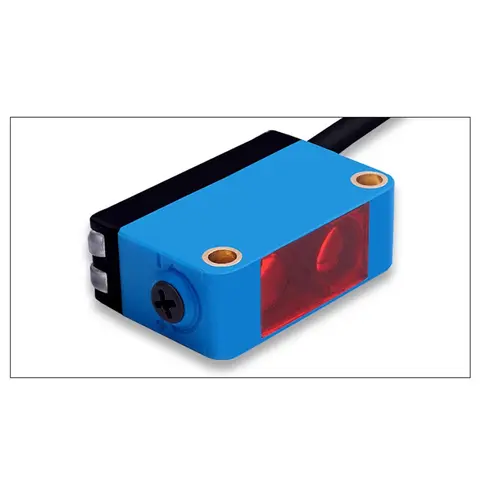
BGS-CX441 / BGS-CX442 Background Suppression Photoelectric Sensor
Wire-adjustable BGS sensor with 2 mm or 15 mm spot, 10-300 mm range, published black/white differential distance.
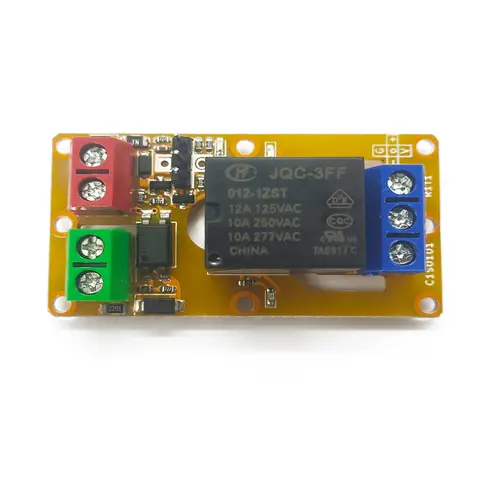
A1J0101 Economical Input Amplifier Module
Optocoupler-isolated input amplifier that turns a low-voltage signal into a 250V AC / 10A relay output.
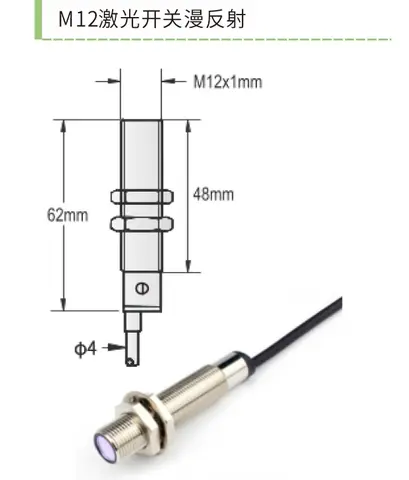
DDSK Laser Diffuse Reflective Sensor M12 / DK Laser Diffuse Reflective Sensor M18
M12/M18 threaded laser diffuse reflective sensor with a visible 650nm red laser for fast alignment.
Related Products in Proximity Sensors
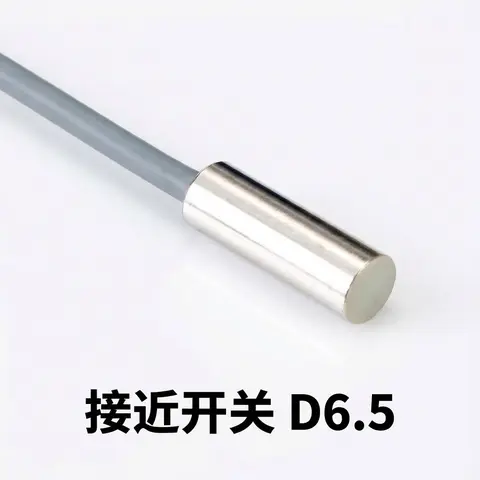
D6.5 Series Inductive Proximity Sensors (Ultra-Short 18mm / Y-Type / 35mm / 45mm)
6.5mm-diameter inductive proximity sensors for tight-clearance mounting where M8 sensors won't fit.
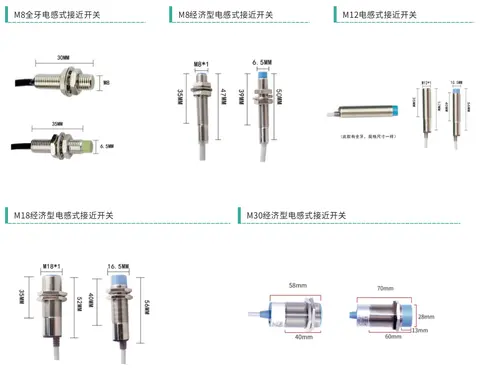
Economy Inductive Proximity Sensors M8/M12/M18/M30 (JNX/JNS Series)
Economy 3-wire DC inductive proximity sensors M8/M12/M18/M30 - flush/non-flush, NPN/PNP, NO/NC, IP67.
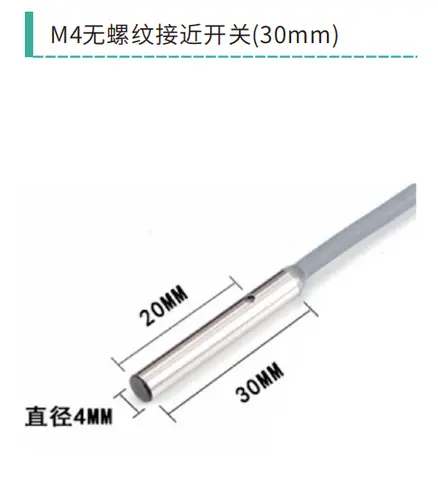
Economy M4/M5/M6 Inductive Proximity Switches (Export-Grade)
Compact export-grade M4/M5/M6 inductive proximity switches in NPN/PNP, NO/NC for tight-space detection.
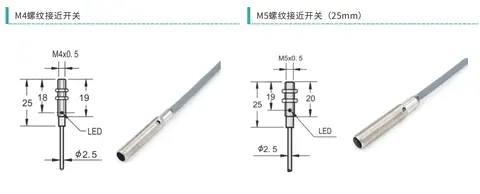
High-Quality Threaded M4/M5/M6 Inductive Proximity Sensors
Threaded M4/M5/M6 inductive proximity sensors with selectable NPN/PNP output and NO/NC logic for tight spaces.