
M18/M30 Capacitive Proximity Sensors with M12 Connector (Plug-in Type)
Nickel-plated M18/M30 capacitive proximity sensors with a detachable M12, 4-pin connector for field-replaceable cables.
 🔍 Click to enlarge · 1/6
Technical Specifications
| Sensing principle | Capacitive |
|---|---|
| Thread size | M18 / M30 |
| Connector type | M12 plug-in aviation connector, 4-pin |
| Output type | NPN / PNP, NO / NC |
| Mounting style | Flush; "T" suffix = non-flush |
| Adjustable sensing distance, M18 flush R1805 | 2-5mm |
| Adjustable sensing distance, M18 flush R1808 | 2-8mm |
| Adjustable sensing distance, M18 non-flush R1808T | 2-8mm |
| Adjustable sensing distance, M18 non-flush R1815T | 2-15mm |
| Adjustable sensing distance, M30 flush R3010 | 2-10mm |
| Adjustable sensing distance, M30 flush R3020 | 2-20mm |
| Adjustable sensing distance, M30 non-flush R3015T | 2-15mm |
| Adjustable sensing distance, M30 non-flush R3030T | 2-30mm |
| Operating voltage | 10-30VDC |
| Wiring | 3-wire DC, BN(+)/BK(signal)/BU(-) |
| Response time | 1.5ms |
| Overload current protection | 240mA |
| Protection features | Short-circuit protection, overload protection |
| Housing material | Nickel-plated metal |
| Ingress protection | IP67 |
| Operating temperature | -25°C to +70°C |
| Indicator | Built-in LED status indicator |
| Overall length, M18 | 80mm (M18*80*M12) |
| Overall length, M30 | 93mm (M30*93*M12) |
Overview
This is a plug-in (插件式) variant of the M18 and M30 capacitive proximity sensor family: the same M18/M30 threaded sensing head as the cable-type series, but terminated in a detachable M12, 4-pin aviation-style connector instead of a fixed cable. Capacitive sensing works on dielectric-constant change rather than metal-only induction, so these sensors respond to non-metallic materials (plastics, wood, liquids, powders, granules) in addition to metal.
The M12 connector interface is intended for machine builders and system integrators who need field-replaceable cables or sensors -- for example after cable damage in a moving assembly, or for standardized wiring harnesses across a machine -- avoiding the need to re-terminate wiring at the sensor end. Each size (M18/M30) is offered in flush and non-flush ("T" suffix) mounting, NPN/PNP output, and NO/NC logic, across 16 models.
Features & Benefits
Detachable M12, 4-pin connector for fast cable/sensor replacement
The sensor terminates in an M12 plug rather than a fixed cable, so a damaged cable or a failed sensor can be swapped in the field without cutting and re-terminating wires.
Detects non-metallic and liquid targets via capacitive sensing
As with the rest of the capacitive family, the sensor responds to any material with a dielectric constant different from air, covering liquids, powders, plastics, and wood in addition to metal.
Factory-defined, field-adjustable sensing distance on every model
Each model has a stated adjustable range: M18 flush 2-5mm (R1805) / 2-8mm (R1808); M18 non-flush 2-8mm (R1808T) / 2-15mm (R1815T); M30 flush 2-10mm (R3010) / 2-20mm (R3020); M30 non-flush 2-15mm (R3015T) / 2-30mm (R3030T).
Flush and non-flush mounting for different installation constraints
Flush models install level with surrounding metal without derating; non-flush ("T" suffix) models offer a longer adjustable range but require clearance around the sensing face.
NPN/PNP and NO/NC combinations on standard DC wiring
Every model is available as NPN or PNP, normally-open or normally-closed, matching common PLC input card requirements, with BN/BK/BU 3-wire DC connections.
Nickel-plated metal housing rated IP67
The housing material is nickel-plated, with a sealed construction rated IP67 for water and dust ingress protection.
Fast 1.5ms response with LED status indication
Both M18 and M30 sizes share a 1.5ms response time and a built-in LED indicator for at-a-glance status checking during installation and maintenance.
Built-in short-circuit and overload protection
The sensor electronics include short-circuit protection and a stated overload current protection point of 240mA.
Wide operating temperature range for factory floor conditions
Rated for -25°C to +70°C, per the manufacturer's selection table.
Applications
Models & Ordering Information
M18 Flush, R1805 (2-5mm adjustable)
M18 Flush, R1808 (2-8mm adjustable)
M18 Non-flush, R1808T (2-8mm adjustable)
M18 Non-flush, R1815T (2-15mm adjustable)
M30 Flush, R3010 (2-10mm adjustable)
M30 Flush, R3020 (2-20mm adjustable)
M30 Non-flush, R3015T (2-15mm adjustable)
M30 Non-flush, R3030T (2-30mm adjustable)
How to Select
- Step 1 -- Choose thread size by installation dimension: M18 thread uses the R18xx series (80mm overall length); M30 thread uses the R30xx series (93mm overall length).
- Step 2 -- Choose mounting style: flush (no "T" suffix) mounts level with surrounding metal with a shorter adjustable sensing range; non-flush ("T" suffix) needs clearance around the sensing face but offers a longer adjustable sensing range.
- Step 3 -- Choose the sensing distance tier: M18 flush R1805 (2-5mm) or R1808 (2-8mm); M18 non-flush R1808T (2-8mm) or R1815T (2-15mm); M30 flush R3010 (2-10mm) or R3020 (2-20mm); M30 non-flush R3015T (2-15mm) or R3030T (2-30mm).
- Step 4 -- Choose output type: N = NPN, P = PNP, to match your PLC input card's sinking or sourcing requirement; 1 = NO (normally open), 2 = NC (normally closed), based on desired fail-safe behavior.
- Step 5 -- Confirm connector and power: M12 plug, 4-pin, 10-30VDC operating voltage, 3-wire BN(+)/BK(signal)/BU(-) connections.
📘 Need the full method? How to Choose a Proximity Sensor · NPN vs PNP Sensor Outputs Explained
When NOT to specify the M18/M30 — and what to use instead
Permanent, vibration-heavy installations where a mating connector joint is a risk
Why not: This is the plug-in M12, 4-pin connector variant rather than a fixed cable; connector mating-cycle life and vibration resistance of the connector joint are not stated in the datasheet.
Use instead: The fixed-cable M12/M18/M30 metal-housing capacitive proximity sensor series for permanently wired installations.
Detecting metal only, where sensitivity to nearby dust, humidity, or condensation is undesirable
Why not: Capacitive sensing responds to any dielectric-different material near the sensing face, and no humidity/dust immunity spec is published for this series.
Use instead: The M18/M30 inductive proximity sensor series, which responds only to metal.
Applications needing a fixed, non-adjustable trip point for repeatable gauging
Why not: Every model has a factory-defined adjustable sensing range (from 2-5mm up to 2-30mm depending on model), and the exact as-shipped default point is not stated.
Use instead: Confirm the factory default sensing-distance setting with the factory before relying on it as a fixed gauge point.
Safety-related guarding or interlocks
Why not: No safety rating is claimed for this product.
Use instead: A dedicated safety switch or safety light curtain (DX series).
AC-powered circuits, or installations needing M8-thread mounting
Why not: Operating voltage is specified as 10-30VDC only with no AC option, and this series covers M18/M30 thread sizes only.
Use instead: The M12/M18/M30 2-wire AC inductive proximity sensor series for AC circuits with metal targets, or the M8/M12 capacitive proximity switch with connector series for M8-thread mounting.
Specifications we do not publish yet
We only publish a figure once we are confident it is true. The items below are still being validated through further testing and real-world customer feedback, so for now we would rather leave them open than guess. If one of them matters to your design, ask us for the latest validated status.
- Non-conductive dielectric constant threshold for reliable detection
- Humidity/condensation immunity or sensing-distance drift
- Connector mating-cycle life / vibration resistance of the M12 plug joint
- Function of the 4th pin on the M12, 4-pin connector - wiring description covers only BN/BK/BU
- IP rating of the mated connector itself, versus the IP67 housing rating
- MTBF / certification marks (CE, UL, etc.)
Frequently Asked Questions
What is the difference between this M12-connector series and the cable-type capacitive proximity sensor series?
What is the adjustable sensing distance for each model?
Can this sensor detect non-metallic materials?
What is the difference between flush and non-flush ("T" suffix) mounting?
What connector does this series use?
How do I choose between NPN and PNP output?
What is the housing material and ingress protection rating?
What is the response time and overload protection?
What is the overall sensor length?
Are certification documents available for this sensor?
Related Categories and Example Products
Explore other functions that may be needed in a machine or line. The products below are category examples, not pre-validated electrical or safety combinations. Confirm each interface and application separately: Photoelectric Sensors · Relay & Timer Modules · Laser Switch Sensors
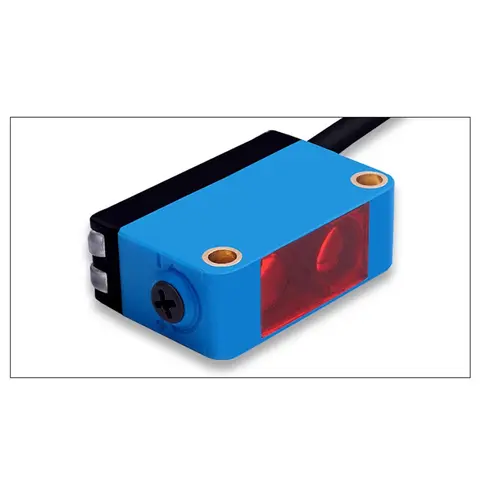
BGS-CX441 / BGS-CX442 Background Suppression Photoelectric Sensor
Wire-adjustable BGS sensor with 2 mm or 15 mm spot, 10-300 mm range, published black/white differential distance.
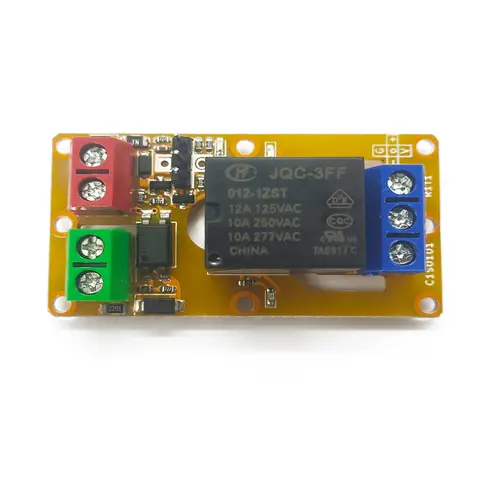
A1J0101 Economical Input Amplifier Module
Optocoupler-isolated input amplifier that turns a low-voltage signal into a 250V AC / 10A relay output.
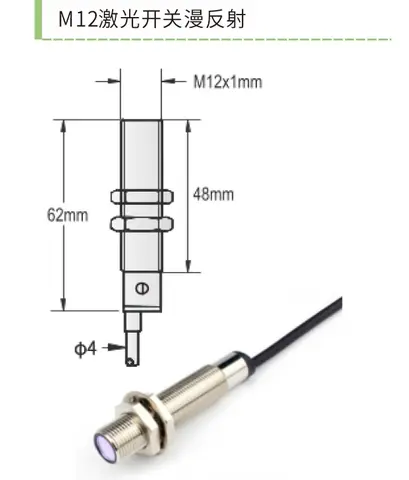
DDSK Laser Diffuse Reflective Sensor M12 / DK Laser Diffuse Reflective Sensor M18
M12/M18 threaded laser diffuse reflective sensor with a visible 650nm red laser for fast alignment.
Related Products in Proximity Sensors
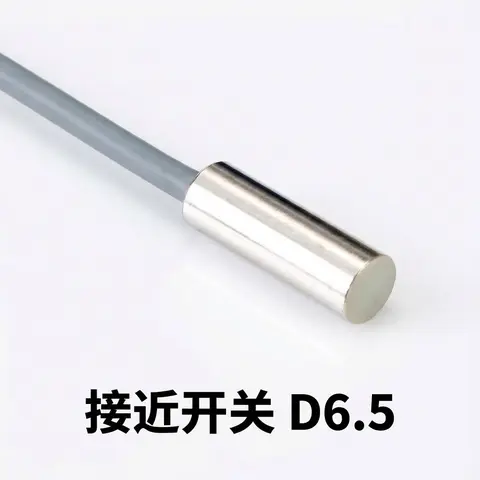
D6.5 Series Inductive Proximity Sensors (Ultra-Short 18mm / Y-Type / 35mm / 45mm)
6.5mm-diameter inductive proximity sensors for tight-clearance mounting where M8 sensors won't fit.
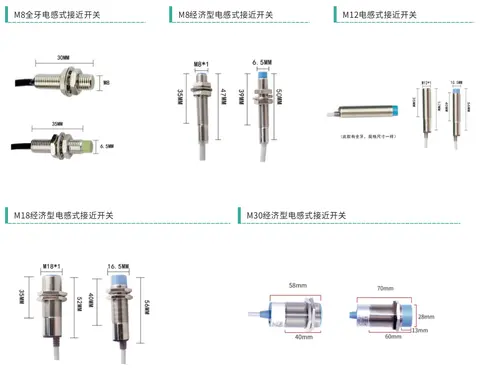
Economy Inductive Proximity Sensors M8/M12/M18/M30 (JNX/JNS Series)
Economy 3-wire DC inductive proximity sensors M8/M12/M18/M30 - flush/non-flush, NPN/PNP, NO/NC, IP67.
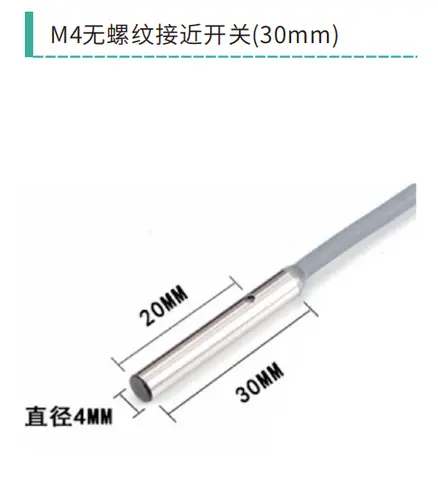
Economy M4/M5/M6 Inductive Proximity Switches (Export-Grade)
Compact export-grade M4/M5/M6 inductive proximity switches in NPN/PNP, NO/NC for tight-space detection.
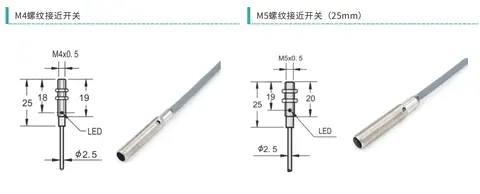
High-Quality Threaded M4/M5/M6 Inductive Proximity Sensors
Threaded M4/M5/M6 inductive proximity sensors with selectable NPN/PNP output and NO/NC logic for tight spaces.