
M12/M18/M30 2-Wire AC Inductive Proximity Sensors
Two-wire M12/M18/M30 inductive sensors that wire directly into a 20-250V AC circuit, no DC supply needed.
 🔍 Click to enlarge · 1/7
Technical Specifications
| Sensing method | Inductive |
|---|---|
| Thread sizes | M12, M18, M30 |
| Wiring | 2-wire (AC) |
| Output type | Normally open (A1) / Normally closed (A2) |
| Mounting style | Flush (P) / Non-flush (T) |
| Working voltage | 20-250V AC |
| Sensing distance - M12 | 2mm, 4mm (flush P) / 4mm, 8mm (non-flush T) |
| Sensing distance - M18 | 5mm, 8mm (flush P) / 8mm, 16mm (non-flush T) |
| Sensing distance - M30 | 10mm, 16mm (flush P) / 8mm, 16mm (non-flush T) |
| Max load current | 400mA |
| No-load leakage current | <1.8mA |
| Inrush current | 5A for 20ms |
| Overload current protection point | 120mA |
| Protection rating | IP67 |
| Operating temperature | -25°C to +70°C |
| Response time | 10ms |
| Switching hysteresis | <15%(Sr) |
| Repeat accuracy | <5%(Sr) |
| Temperature drift | <10%(Sr) |
| Voltage drop | <8VAC at 400mA |
| Switching frequency | <25Hz |
| LED indicator | Yes |
| Cable length | 2m standard (extendable on request) |
Overview
This is a family of inductive proximity sensors in M12, M18 and M30 threaded metal housings, wired with only two leads (brown BN and blue BU) that are inserted in series with an AC load — the sensor itself does not need a separate power terminal. Each size is available in flush (P, embeddable in metal) and non-flush (T, needs metal-free clearance around the head) mounting styles, and in normally-open (A1) or normally-closed (A2) output logic.
It suits OEM machine builders, panel retrofitters, and maintenance engineers working on equipment where the control circuit is AC-powered (e.g., older relay/contactor panels, AC solenoid/lamp circuits) and a DC 2-wire or 3-wire sensor would require an extra power-conversion or interface step. Working voltage spans 20-250V AC, with sensing distances from 2mm up to 16mm across the three thread sizes.
Features & Benefits
Direct AC line connection, no DC power supply needed
Wires directly in series with a 20-250V AC load using only 2 leads (BN/BU), eliminating the need for a separate DC power supply, transformer, or interface relay in AC-controlled panels.
Wide sensing-distance lineup across three thread sizes
Sensing distances span 2mm (M12 flush) up to 16mm (M18/M30 non-flush), giving 24 model variants across NO/NC outputs to match different target sizes and mounting clearances.
Both flush and non-flush mounting options
Flush (P) versions can be embedded flush with surrounding metal, while non-flush (T) versions offer longer sensing distance where metal-free clearance is available around the sensing face.
NO/NC output selection built into the part number
A1 suffix denotes AC normally-open output, A2 denotes AC normally-closed output, letting engineers directly match existing relay logic without adding a signal-inverting relay.
IP67-rated sealed metal housing
Rated IP67, suitable for environments with dust, splashing water, or washdown exposure typical of production-line mounting locations.
Built-in overload current protection
The sensor's overload current protection point is specified at 120mA, giving the switching circuit a defined protection threshold.
Onboard LED status indication
Every model in this AC series includes an LED, giving a visual on/off status indication at the sensor without needing to trace back to the control panel.
2m standard cable, extendable on request
Ships with a 2-meter lead cable as standard, with longer lengths available for custom orders.
Applications
Models & Ordering Information
M12
M18
M30
How to Select
- Step 1 - Choose thread size by installation space: M12 (compact, tightest mounting clearance), M18 (mid-size), or M30 (largest body, longest available sensing distance).
- Step 2 - Choose sensing distance (Sn) needed for your target: M12 offers 2mm/4mm (flush) or 4mm/8mm (non-flush); M18 offers 5mm/8mm (flush) or 8mm/16mm (non-flush); M30 offers 10mm/16mm (flush) or 8mm/16mm (non-flush).
- Step 3 - Choose mounting style: Flush (P suffix) if the sensor will be embedded level with surrounding metal (e.g., in a metal bracket or machine frame); Non-flush (T suffix) if the sensing face needs to protrude with clearance for maximum range.
- Step 4 - Choose output logic (NO/NC): A1 suffix = AC normally-open (contact closes on target detection); A2 suffix = AC normally-closed (contact opens on target detection). Match this to your existing control-circuit logic (e.g., fail-safe stop circuits typically prefer normally-closed).
- Step 5 - Confirm AC electrical compatibility: Working voltage range is 20-250V AC, max load current 400mA, with a no-load/leakage current under 1.8mA - check that your load (relay coil, PLC AC input, lamp, etc.) draws enough current to keep the sensor's internal circuit powered and does not exceed 400mA.
- Reference part number example: M1808A1T = M18 body, 8mm sensing distance, A1 (AC normally-open), T (non-flush).
📘 Need the full method? How to Choose a Proximity Sensor · NPN vs PNP Sensor Outputs Explained
When NOT to specify the M12/M18/M30 — and what to use instead
Detecting non-metallic targets such as plastic, wood, liquid, or glass
Why not: This is an inductive sensing family - it only responds to metal targets, per the sensing-method spec; it has no dielectric-based detection capability for non-metallic materials.
Use instead: A capacitive proximity sensor, such as the M12/M18/M30 metal-housing capacitive proximity sensor series, which responds to non-metallic and liquid targets.
Wiring the sensor into a DC-powered PLC input or control circuit
Why not: This is a 2-wire AC-only device rated 20-250V AC on its brown/blue leads; it has no DC operating-voltage rating and is not designed to be driven by a DC supply.
Use instead: A 3-wire DC inductive proximity sensor, such as the M18/M30 inductive proximity sensor series, for DC-powered control circuits.
Driving a very low-current relay coil, PLC input, or other high-impedance AC load
Why not: As a 2-wire AC sensor, the load current itself keeps the sensor's internal circuit powered; the datasheet gives a no-load leakage current below 1.8mA but does not publish the minimum load current the sensor needs to operate reliably, so an undersized high-impedance load risks nuisance-triggering or the sensor failing to switch off cleanly.
Use instead: Confirm the minimum required load current with the factory, or use a DC 3-wire sensor with its own dedicated power feed instead of load-powered operation.
High-speed applications needing switching frequencies above the rated 25Hz, such as fast part counting
Why not: Switching frequency for this AC series is specified at <25Hz and response time at 10ms, both slower than the DC 3-wire inductive families in this catalog.
Use instead: A DC 3-wire inductive proximity sensor, such as the M18/M30 inductive proximity sensor series, which is rated from 0.2ms to 2ms response depending on model.
Safety-related guarding or personnel-protection interlocks
Why not: No safety rating or safety-standard compliance is claimed anywhere in this product's specifications.
Use instead: A dedicated safety interlock switch or safety light curtain (DX series), not a standard proximity sensor.
Specifications we do not publish yet
We only publish a figure once we are confident it is true. The items below are still being validated through further testing and real-world customer feedback, so for now we would rather leave them open than guess. If one of them matters to your design, ask us for the latest validated status.
- Non-ferrous metal (aluminum/brass/stainless) sensing-distance correction factor
- Minimum load current required to keep the sensor's internal circuit reliably powered
- Housing material composition (e.g., brass, stainless steel)
- MTBF / rated mechanical and electrical life
- Cable conductor gauge and jacket material for the standard 2m cable
- Certification marks (CE, UL, etc.)
- Tolerance band on the rated 2-16mm sensing distances (e.g., ±10%)
Frequently Asked Questions
Does this sensor need a separate DC power supply?
What is the difference between the A1 and A2 suffix in the part number?
What is the difference between the P and T suffix?
What sensing distances are available in this AC series?
What is the working voltage and maximum load current?
What is the protection rating and operating temperature range?
Does the sensor have short-circuit or overload protection?
Is there a visual status indicator on the sensor?
What cable length is standard, and can it be customized?
What wire colors are used, and what do they connect to?
Related Categories and Example Products
Explore other functions that may be needed in a machine or line. The products below are category examples, not pre-validated electrical or safety combinations. Confirm each interface and application separately: Photoelectric Sensors · Relay & Timer Modules · Laser Switch Sensors
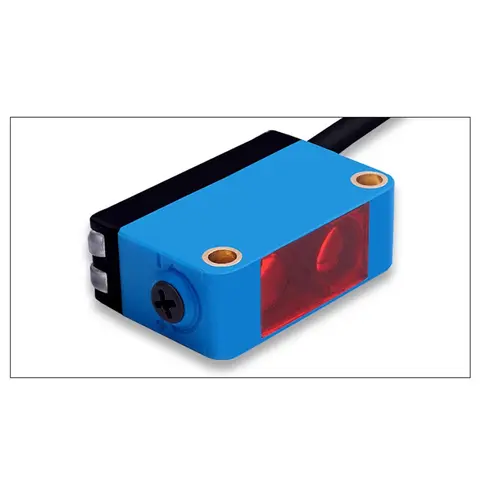
BGS-CX441 / BGS-CX442 Background Suppression Photoelectric Sensor
Wire-adjustable BGS sensor with 2 mm or 15 mm spot, 10-300 mm range, published black/white differential distance.
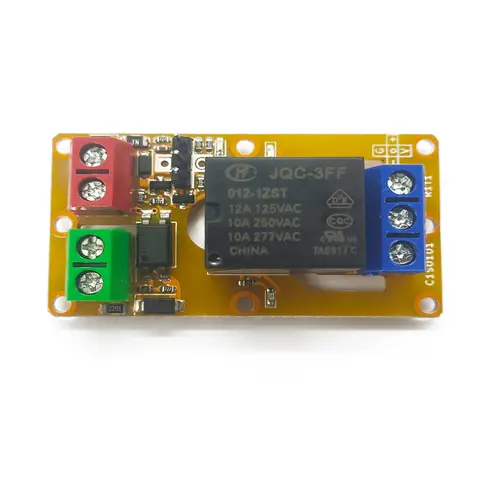
A1J0101 Economical Input Amplifier Module
Optocoupler-isolated input amplifier that turns a low-voltage signal into a 250V AC / 10A relay output.
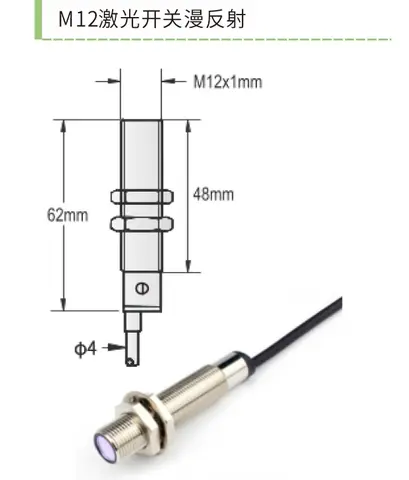
DDSK Laser Diffuse Reflective Sensor M12 / DK Laser Diffuse Reflective Sensor M18
M12/M18 threaded laser diffuse reflective sensor with a visible 650nm red laser for fast alignment.
Related Products in Proximity Sensors
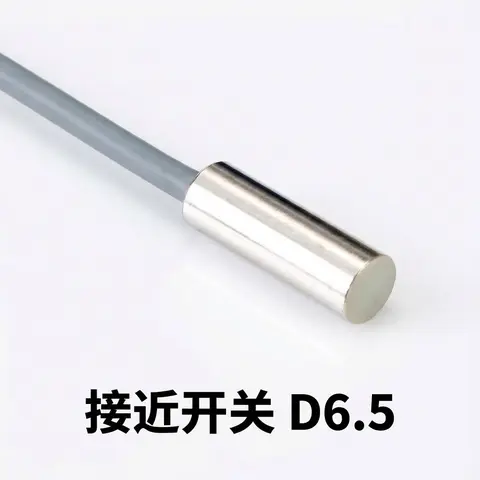
D6.5 Series Inductive Proximity Sensors (Ultra-Short 18mm / Y-Type / 35mm / 45mm)
6.5mm-diameter inductive proximity sensors for tight-clearance mounting where M8 sensors won't fit.
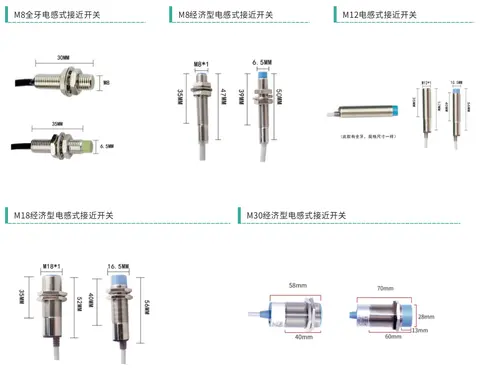
Economy Inductive Proximity Sensors M8/M12/M18/M30 (JNX/JNS Series)
Economy 3-wire DC inductive proximity sensors M8/M12/M18/M30 - flush/non-flush, NPN/PNP, NO/NC, IP67.
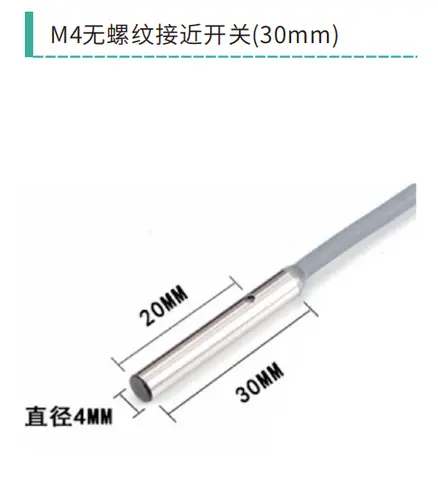
Economy M4/M5/M6 Inductive Proximity Switches (Export-Grade)
Compact export-grade M4/M5/M6 inductive proximity switches in NPN/PNP, NO/NC for tight-space detection.
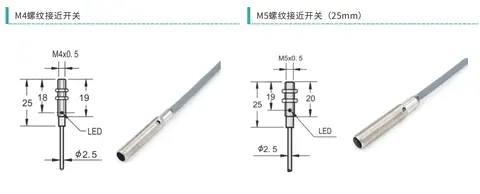
High-Quality Threaded M4/M5/M6 Inductive Proximity Sensors
Threaded M4/M5/M6 inductive proximity sensors with selectable NPN/PNP output and NO/NC logic for tight spaces.