
JM8 Series Quick-Disconnect (Connector-Type) Inductive Proximity Sensors
M8 inductive proximity sensor with M8/M12 quick-disconnect connector for tool-free sensor replacement.
 🔍 Click to enlarge · 1/8
Technical Specifications
| Detection Method | Inductive |
|---|---|
| Probe Thread | M8 |
| Connector Type | 3-wire quick-disconnect connector, M8 or M12 |
| Body Length Options | 32 / 45 / 53 / 60 / 70 mm |
| Sensing Distance | 1 / 2 / 3 / 4 / 6 mm (by model code JM801-JM806) |
| Output Type | NPN / PNP |
| Switching Function | NO (normally open) / NC (normally closed) |
| Mounting Type | Flush (standard); non-flush with T suffix |
| Wiring | 3-wire DC |
| Operating Voltage | 10-30VDC |
| Max Load Current | 150mA |
| No-Load Current | <10mA |
| Short-Circuit Protection | Yes |
| Overload Trip Point | 180mA |
| Response Time | 0.1ms to 1ms (varies by model) |
| Switching Frequency | 400Hz to 2KHz (varies by model) |
| Protection Rating | IP67 |
| Operating Temperature | -25°C to +70°C |
| Housing Material | Stainless steel / nickel-plated brass |
| Indicator | Built-in LED, lights when target is detected |
Overview
The JM8 series is an M8-thread three-wire DC inductive proximity sensor built with a threaded quick-disconnect connector at the tail (3-pin M8 or 4-pin M12) instead of a fixed cable, so a faulty or damaged sensor can be swapped in seconds without cutting, stripping, or re-terminating wires.
It is available in NPN or PNP output, normally-open (NO) or normally-closed (NC) switching, flush or non-flush mounting, and five body lengths (32/45/53/60/70mm), with sensing distances confirmed at 1mm, 2mm, 3mm, 4mm, and 6mm across model codes JM801 through JM806, targeting machine builders, panel integrators, and maintenance teams who need to standardize sensor cabling or minimize downtime during sensor replacement.
Features & Benefits
Tool-Free Sensor Replacement via Quick-Disconnect Connector
Swap a failed or damaged sensor by unscrewing the connector coupling nut and plugging in a new unit. No cutting, stripping, or re-terminating wires is required.
Two Connector Options to Match Cabinet Wiring Standards
M8-M8 variants use a 3-pin M8 connector, while M8-M12 variants use a 4-pin M12 connector, letting integrators standardize on one connector family across a panel.
Selectable Sensing Distance per Model Code
Model codes JM801/802/803/804/806 correspond to confirmed sensing distances of 1mm, 2mm, 3mm, 4mm, and 6mm respectively, with the larger distances achieved by non-flush variants. The right detection range can be picked directly from the part number.
NPN/PNP and NO/NC Combinations for Direct PLC Compatibility
Every sensing distance and body length is offered in NPN or PNP output, with normally-open or normally-closed switching, so the sensor can be matched to the customer's existing PLC input card without adding an interposing relay.
Fast Switching Response for High-Speed Counting/Positioning
Response time is confirmed at 0.1ms to 1ms depending on model, with switching frequency from 400Hz to 2KHz, suitable for counting or position-detection tasks that require quick, repeatable triggering.
IP67-Rated, Wide-Temperature Stainless/Nickel-Plated Housing
The sensor housing is rated IP67 and specified for continuous operation from -25°C to +70°C, with a stainless steel/nickel-plated brass shell suitable for washdown or dusty factory-floor environments.
Built-In Short-Circuit and Overload Protection
The output stage includes short-circuit protection and an overload trip point of 180mA, reducing the risk of sensor damage from wiring mistakes or downstream faults during installation and commissioning.
LED Status Indicator for On-Site Troubleshooting
Every JM8 model includes a built-in LED that lights when the target is detected, allowing technicians to verify switching state without a multimeter.
Applications
Models & Ordering Information
Flush (Standard) Models — 1/2/3/4/6mm Sensing Distance
Non-Flush (T-Suffix) Models — Extended Sensing Distance
How to Select
- Select by sensing distance: 1mm needs JM801 (flush only), 2mm needs JM802 (flush or non-flush depending on length), 3mm needs JM803 (flush, 60mm/70mm bodies only), 4mm needs JM804 (non-flush only), and 6mm needs JM806 (non-flush only, 60mm/70mm bodies only).
- Select output type by PLC/controller input: NPN (sinking) models contain 'N' in the part number, e.g. JM801N132; PNP (sourcing) models contain 'P', e.g. JM801P132.
- Select switching function: normally open (NO) is indicated by a second digit '1' (e.g. JM801N132); normally closed (NC) is indicated by a second digit '2' (e.g. JM801N232).
- Select mounting by installation clearance: flush models (no 'T' suffix) need no metal-free zone around the sensing face; non-flush models ('T' suffix, e.g. JM802N1T45) need a metal-free area but achieve a longer sensing distance for the same barrel size.
- Select connector type by cabinet wiring standard: M8-M8 variants (32/45/60mm bodies) use a 3-pin M8 connector; M8-M12 variants (53/70mm bodies) use a 4-pin M12 connector.
- Select body length (32/45/53/60/70mm) based on available mounting depth and existing bracket hole spacing, and confirm the target load (relay coil or PLC input impedance) falls within the 10-30VDC, 150mA max load current rating before final selection.
📘 Need the full method? How to Choose a Proximity Sensor · NPN vs PNP Sensor Outputs Explained
When NOT to specify the JM8 — and what to use instead
Detecting plastic, wood, liquid, or other non-metallic parts
Why not: This is an inductive sensor built to detect metal targets; no non-metallic detection rating is listed.
Use instead: A capacitive proximity sensor series, which can detect non-metallic and liquid targets.
Need a 1mm sensing distance with non-flush mounting
Why not: Per the selection guide, JM801 (1mm) is available in flush mounting only; no non-flush 1mm variant is offered.
Use instead: JM802 (2mm), which is available in both flush and non-flush mounting depending on body length.
Need a 3mm sensing distance on the 32mm or 45mm body
Why not: Per the selection guide, JM803 (3mm) is only available on the 60mm/70mm body lengths, not on the shorter 32mm/45mm bodies.
Use instead: JM802 (2mm) or JM804 (4mm) on the shorter body, or step up to a 60mm/70mm body length if the 3mm distance is required.
Need a 6mm sensing distance on a body shorter than 60mm
Why not: Per the selection guide, JM806 (6mm) is available only in non-flush mounting and only on 60mm/70mm bodies.
Use instead: JM804 (4mm, available in more body lengths) or a 60mm/70mm body if the 6mm distance is required.
Driving a load current above the sensor's rated output directly
Why not: Maximum load current is rated at 150mA with a 180mA overload protection trip point.
Use instead: An interposing relay between the sensor output and higher-current loads such as contactor coils.
Machine-guard interlocking or any personnel-safety function
Why not: No functional-safety or safety-rated certification is listed for this series.
Use instead: A dedicated safety-rated interlock switch or safety light curtain for guarding duty.
Specifications we do not publish yet
We only publish a figure once we are confident it is true. The items below are still being validated through further testing and real-world customer feedback, so for now we would rather leave them open than guess. If one of them matters to your design, ask us for the latest validated status.
- Exact body-length vs sensing-distance vs flush/non-flush availability matrix beyond the selection-guide summary
- Correction factor for non-ferrous (aluminum/brass/copper) targets versus the rated steel sensing distance
- MTBF / expected service life
- Connector pin-out assignment and matching cordset part number
- Weld-field (weld-immune) suitability
- Certification documents (stated as available on request, not published)
Frequently Asked Questions
What connectors does the JM8 series use?
What sensing distances are available in the JM8 series?
Is the JM8 series NPN or PNP?
What does the 'T' suffix mean in a JM8 part number, e.g. JM802N1T45?
What is the operating voltage and maximum load current?
What is the IP rating and operating temperature range?
Does the JM8 series have a status indicator?
Why choose a connector-type sensor (JM8) over a cable-type sensor?
What is the switching frequency and response time?
What housing material is used?
Related Categories and Example Products
Explore other functions that may be needed in a machine or line. The products below are category examples, not pre-validated electrical or safety combinations. Confirm each interface and application separately: Photoelectric Sensors · Relay & Timer Modules · Laser Switch Sensors
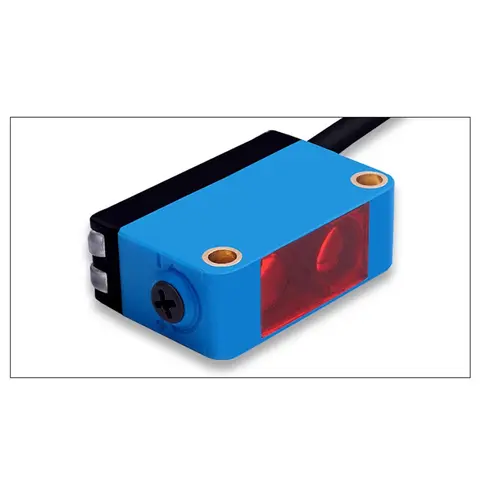
BGS-CX441 / BGS-CX442 Background Suppression Photoelectric Sensor
Wire-adjustable BGS sensor with 2 mm or 15 mm spot, 10-300 mm range, published black/white differential distance.
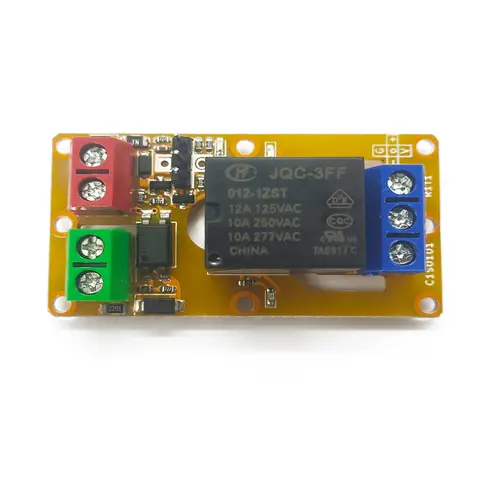
A1J0101 Economical Input Amplifier Module
Optocoupler-isolated input amplifier that turns a low-voltage signal into a 250V AC / 10A relay output.
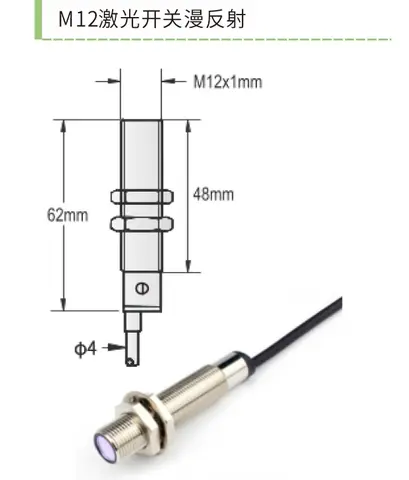
DDSK Laser Diffuse Reflective Sensor M12 / DK Laser Diffuse Reflective Sensor M18
M12/M18 threaded laser diffuse reflective sensor with a visible 650nm red laser for fast alignment.
Related Products in Proximity Sensors
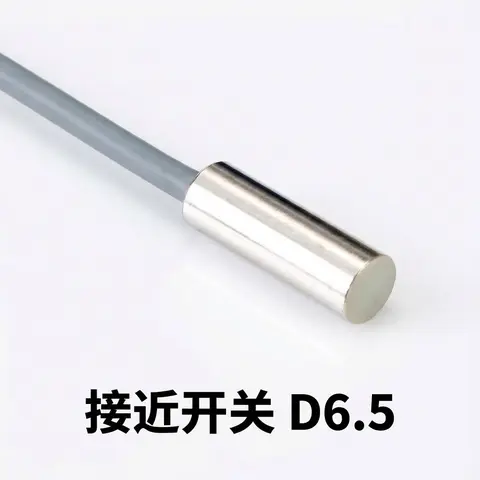
D6.5 Series Inductive Proximity Sensors (Ultra-Short 18mm / Y-Type / 35mm / 45mm)
6.5mm-diameter inductive proximity sensors for tight-clearance mounting where M8 sensors won't fit.
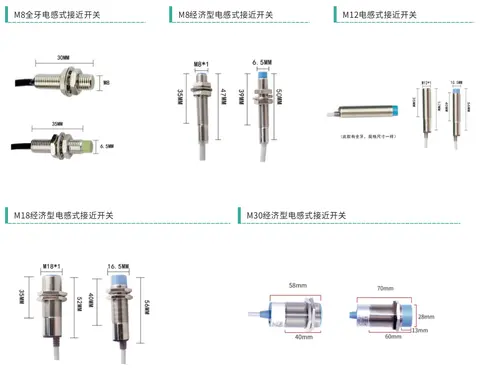
Economy Inductive Proximity Sensors M8/M12/M18/M30 (JNX/JNS Series)
Economy 3-wire DC inductive proximity sensors M8/M12/M18/M30 - flush/non-flush, NPN/PNP, NO/NC, IP67.
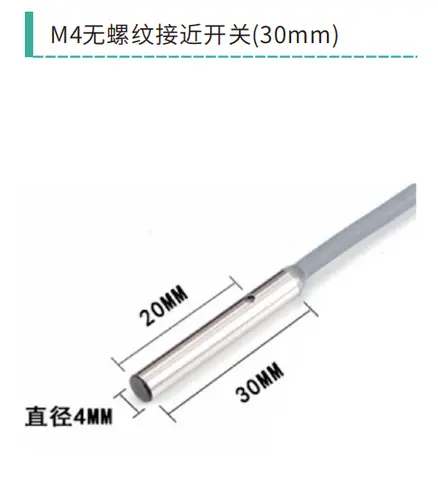
Economy M4/M5/M6 Inductive Proximity Switches (Export-Grade)
Compact export-grade M4/M5/M6 inductive proximity switches in NPN/PNP, NO/NC for tight-space detection.
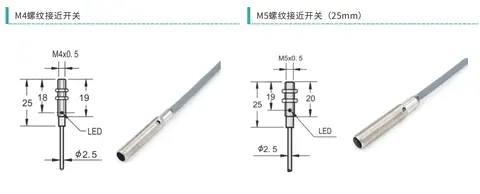
High-Quality Threaded M4/M5/M6 Inductive Proximity Sensors
Threaded M4/M5/M6 inductive proximity sensors with selectable NPN/PNP output and NO/NC logic for tight spaces.