
JM12 Series M12 Inductive Proximity Sensor with M12 Aviation (Quick-Disconnect) Connector
M12x1 inductive proximity sensor with an M12 aviation connector for tool-free field replacement.
 🔍 Click to enlarge · 1/6
Technical Specifications
| Sensing method | Inductive |
|---|---|
| Probe thread | M12 |
| Connector type | 3-wire aviation (quick-disconnect) connector, mates to M12 |
| Body length | 40 / 50 / 68 mm |
| Output type | NPN / PNP, normally open (NO) / normally closed (NC) |
| Mounting type | Flush; T suffix = non-flush |
| Sensing distance | Indicated by part number grade (02/04/06/08/10) |
| Supply voltage | 10-30VDC |
| Max load current | 150mA |
| No-load current | <10mA |
| Voltage drop | <1.5V |
| Short-circuit protection | Yes |
| Overload protection trip point | 180mA |
| Response time | 0.1ms to 1ms, depending on length/sensing-distance combination |
| Switching frequency | 400Hz to 2KHz, depending on length/sensing-distance combination |
| Protection rating | IP67 |
| Operating temperature | -25°C to +70°C |
| Housing material | Stainless steel / nickel-plated brass |
| Indicator | Built-in LED |
| Wiring | 3-wire DC |
Overview
The JM12 is a DC 3-wire inductive proximity sensor with an M12x1 threaded barrel and an M12 4-pin aviation (quick-disconnect) connector at the sensor end, mating to a separate M12 cordset instead of a fixed output cable. It is available in three body lengths (40mm, 50mm, 68mm) and five sensing-distance grades (2/4/6/8/10mm), in NPN or PNP output, normally-open (NO) or normally-closed (NC), flush or non-flush mounting.
It suits machine builders and panel integrators who standardize on M12 connectorized sensors for faster commissioning, and end users who need to replace a failed sensor in the field by unscrewing the connector and screwing in a new unit, without opening a junction box or re-crimping terminals.
Features & Benefits
Plug-and-play field replacement via M12 connector
Swap a failed or damaged sensor by unscrewing the M12 connector and screwing in a new unit, no wire stripping or terminal re-crimping required.
Five sensing-distance grades in one series
2/4/6/8/10mm sensing-distance grades let the buyer match detection distance to the target gap without switching to a different body diameter.
Flush and non-flush mounting options
Flush units can be mounted with the sensing face level with a metal surface for tight installations. Non-flush (T-suffix) units offer greater sensing distance where surrounding metal clearance is available.
NPN or PNP, NO or NC — four output combinations per size
Matches either sinking (NPN) or sourcing (PNP) PLC input cards, and either normally-open or normally-closed logic, without a separate wiring adapter.
10-30VDC wide supply range with built-in protection
Tolerates typical industrial DC bus voltage variation and protects the sensor output against wiring faults; overload protection trips at 180mA.
Fast response down to 0.1ms
The shortest-length/shortest-distance configurations respond in as little as 0.1ms, suitable for higher-speed part counting or position sensing.
IP67-rated stainless steel / nickel-plated brass housing
Withstands washdown, splash, dust, and coolant exposure common on production floors.
-25°C to +70°C operating range
Covers most indoor industrial environments, including unheated workshops and locations near heat-generating machinery.
Applications
Models & Ordering Information
Flush mount, base codes (sensing distance 02/04/06/08/10mm)
Non-flush mount, T-suffix (sensing distance 04/06/08/10mm)
How to Select
- Naming logic: JM12 + sensing-distance code (02/04/06/08/10, mm) + N (NPN) or P (PNP) + 1 (NO) or 2 (NC) + optional T (non-flush) + length suffix (40/50/68, mm). Example: JM1204N1T68 = JM12 series, 4mm sensing distance, NPN, normally-open, non-flush, 68mm body.
- Body length (40 / 50 / 68mm): longer bodies (68mm) support more sensing-distance grades across flush and non-flush than the shorter 40mm and 50mm bodies. Choose the length that fits the mounting envelope and required sensing distance together — see the selection table images for the exact combinations available for each length.
- Sensing distance (2 / 4 / 6 / 8 / 10mm): match to the actual gap between the sensor face and the metal target at installation, with margin. Non-flush (T) variants generally reach the longer distances (8mm, 10mm) that flush variants on the same body do not offer.
- Mounting type — flush vs non-flush (T-suffix): flush units can be installed level with a surrounding metal surface (space-saving) but at correspondingly shorter rated sensing distances; non-flush units need metal-free clearance around the sensing face but achieve longer sensing distances.
- Output type — NPN vs PNP: choose NPN for sinking-input PLC/controller cards, PNP for sourcing-input cards. Confirm which your control system requires before ordering.
- Switching logic — NO vs NC: NO (code 1) closes the output when a target is detected; NC (code 2) opens the output when a target is detected. Combined NPN NO+NC and PNP NO+NC dual-output variants are also shown in the wiring diagram for applications needing both NO and NC signals.
- Supply/output electrical fit: all JM12 variants run on 10-30VDC, max load current 150mA, with built-in short-circuit protection (overload trip at 180mA) — confirm this matches your control cabinet's DC supply and input card ratings.
📘 Need the full method? How to Choose a Proximity Sensor · NPN vs PNP Sensor Outputs Explained
When NOT to specify the JM12 — and what to use instead
Detecting plastic, wood, liquid, or other non-metallic parts
Why not: This is an inductive sensor built to detect metal targets; no non-metallic detection rating is listed.
Use instead: A capacitive proximity sensor series, which can detect non-metallic and liquid targets.
Application needs more than 10mm sensing distance
Why not: The largest sensing-distance grade in this series is 10mm, available only in non-flush mounting on the 68mm body.
Use instead: The JM-series M18/M30 connector sensors, rated up to 40mm sensing distance, or an economy M30 series.
Need the largest sensing-distance grades (8mm/10mm) on the shortest 40mm body
Why not: Per the factory selection table, not every length/sensing-distance combination is available on every base code, and the largest non-flush distances are associated with the longer body lengths.
Use instead: The 68mm body length when both non-flush mounting and the largest sensing distances are needed together -- confirm the exact SKU with the factory.
Ordering a specific length + distance + mount combination without checking availability first
Why not: The factory catalog states that not every length/sensing-distance combination is available on every base code, and the exact SKU matrix is only shown in selection-table images, not fully itemized in text.
Use instead: Request the current selection-table or price list from the factory before finalizing a part number.
Driving a load current above the sensor's rated output directly
Why not: Maximum load current is rated at 150mA with a 180mA overload protection trip point.
Use instead: An interposing relay between the sensor output and higher-current loads such as contactor coils.
Machine-guard interlocking or any personnel-safety function
Why not: No functional-safety or safety-rated certification is listed for this series.
Use instead: A dedicated safety-rated interlock switch or safety light curtain for guarding duty.
Specifications we do not publish yet
We only publish a figure once we are confident it is true. The items below are still being validated through further testing and real-world customer feedback, so for now we would rather leave them open than guess. If one of them matters to your design, ask us for the latest validated status.
- Exact SKU availability matrix -- which body length / sensing distance / flush combinations actually exist
- Correction factor for non-ferrous (aluminum/brass/copper) targets versus the rated steel sensing distance
- MTBF / expected service life
- Connector pin-out assignment and matching cordset part number
- Weld-field (weld-immune) suitability
- Certification documents (stated as available on request, not published)
Frequently Asked Questions
What does "flush" and "non-flush" mean for the JM12 series, and which should I choose?
What is the difference between the NO and NC output on this sensor?
Is this an NPN or PNP sensor?
What connector does the JM12 use, and do I need to buy a separate cable?
What supply voltage and load current does the JM12 support?
What is the sensing distance range across the JM12 series?
What is the protection rating and operating temperature of the JM12?
How fast does the JM12 respond to a detected target?
Does the sensor have a status LED?
What material is the JM12 housing made of?
What certifications does the JM12 series carry?
Related Categories and Example Products
Explore other functions that may be needed in a machine or line. The products below are category examples, not pre-validated electrical or safety combinations. Confirm each interface and application separately: Photoelectric Sensors · Relay & Timer Modules · Laser Switch Sensors
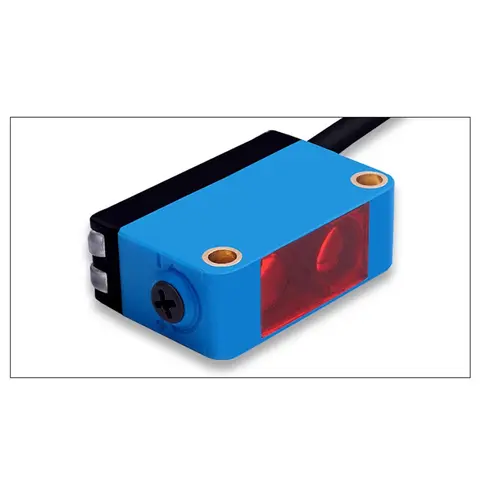
BGS-CX441 / BGS-CX442 Background Suppression Photoelectric Sensor
Wire-adjustable BGS sensor with 2 mm or 15 mm spot, 10-300 mm range, published black/white differential distance.
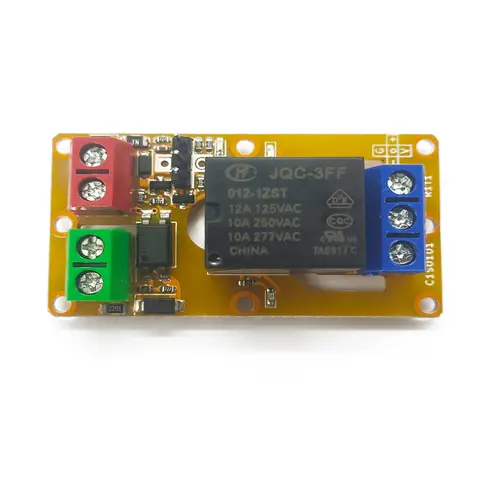
A1J0101 Economical Input Amplifier Module
Optocoupler-isolated input amplifier that turns a low-voltage signal into a 250V AC / 10A relay output.
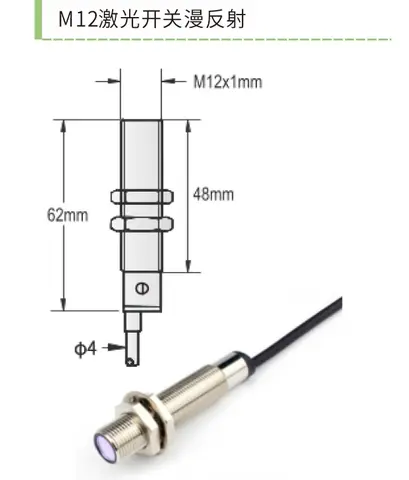
DDSK Laser Diffuse Reflective Sensor M12 / DK Laser Diffuse Reflective Sensor M18
M12/M18 threaded laser diffuse reflective sensor with a visible 650nm red laser for fast alignment.
Related Products in Proximity Sensors
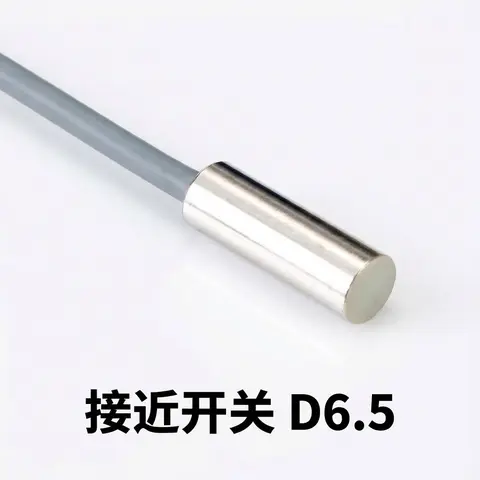
D6.5 Series Inductive Proximity Sensors (Ultra-Short 18mm / Y-Type / 35mm / 45mm)
6.5mm-diameter inductive proximity sensors for tight-clearance mounting where M8 sensors won't fit.
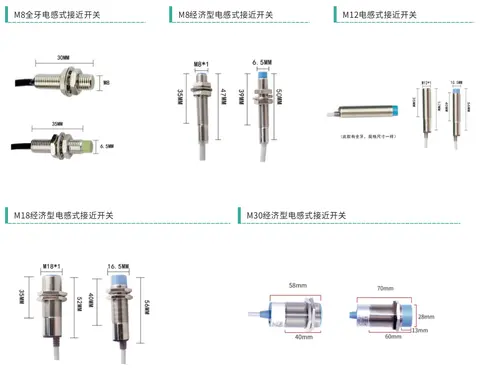
Economy Inductive Proximity Sensors M8/M12/M18/M30 (JNX/JNS Series)
Economy 3-wire DC inductive proximity sensors M8/M12/M18/M30 - flush/non-flush, NPN/PNP, NO/NC, IP67.
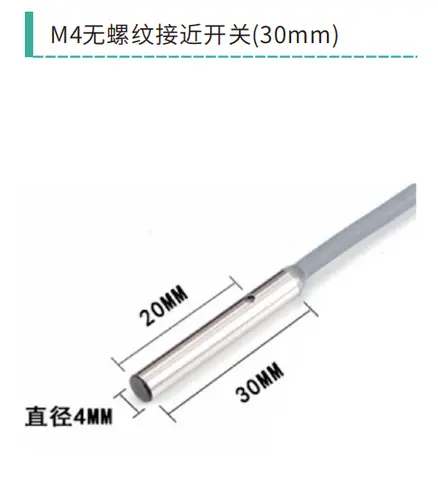
Economy M4/M5/M6 Inductive Proximity Switches (Export-Grade)
Compact export-grade M4/M5/M6 inductive proximity switches in NPN/PNP, NO/NC for tight-space detection.
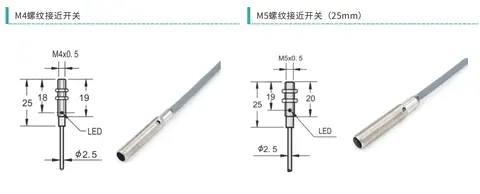
High-Quality Threaded M4/M5/M6 Inductive Proximity Sensors
Threaded M4/M5/M6 inductive proximity sensors with selectable NPN/PNP output and NO/NC logic for tight spaces.