
E3Z Compact Photoelectric Sensor
Compact 31×11×22mm DC photoelectric sensor with diffuse (30-300mm) or through-beam (5m) detection and NPN/PNP output.
 🔍 Click to enlarge · 1/11
Technical Specifications
| Output Type | D61/T61 = NPN N.O., D81/T81 = PNP N.O., D62/T62 = NPN N.C., D82/T82 = PNP N.C.; 20/30 series: N1 = NPN N.O., P1 = PNP N.O., N2 = NPN N.C., P2 = PNP N.C. |
|---|---|
| Sensing Mode / Distance | Diffuse-reflective D series 30-100mm (adjustable), 20 series 30-200mm (adjustable), 30 series 30-300mm (adjustable); Through-beam T series 5m |
| Supply Voltage | 10-30VDC |
| Protection Rating | IP65 |
| Housing Dimensions | 31×11×22mm |
| Material | PBT plastic |
Overview
E3Z is a compact-housing photoelectric sensor family built for OEM machine builders and panel integrators who need to fit object or presence detection into tight mounting spaces. Its diffuse-reflective versions sense objects directly without a reflector, while its through-beam version pairs an emitter and receiver across a gap for longer-range, surface-independent detection.
The full output matrix (NPN or PNP, N.O. or N.C.) lets one series interface with either sinking or sourcing PLC input cards, while three adjustable diffuse-reflective ranges (30-100mm, 30-200mm, 30-300mm) and a 5 m through-beam option cover both near and long-distance detection needs within a 31 × 11 × 22 mm, IP65-rated, 10-30VDC housing.
Features & Benefits
Compact Housing for Tight Spaces
The 31 × 11 × 22 mm PBT housing fits into mounting spaces too small for larger sensor bodies. This makes it suitable for OEM machine sub-assemblies and panel-mounted detection points.
Full NPN/PNP × N.O./N.C. Output Matrix
D61/T61 and D81/T81 give NPN or PNP normally-open outputs, while D62/T62 and D82/T82 give NPN or PNP normally-closed outputs (the 20/30 series uses N1/P1/N2/P2 the same way). One series covers both sinking (NPN) and sourcing (PNP) PLC input types.
Three Adjustable Diffuse-Reflective Ranges
Diffuse-reflective versions are offered in 30-100mm, 30-200mm, and 30-300mm adjustable ranges. Matching the range to the actual working distance helps reduce background interference.
5 m Through-Beam Detection
The through-beam version uses a separate emitter and receiver to detect across a 5 m gap. Because detection depends on beam interruption rather than reflection, it is not affected by the target's color or surface finish.
IP65-Rated Housing
The IP65 rating protects against dust ingress and water splashes, suiting general industrial environments with dust or occasional splashing.
Wide 10-30VDC Supply Range
A 10-30VDC input range covers common industrial DC supply voltages, simplifying power design across control cabinets.
Applications
Models & Ordering Information
Diffuse-Reflective, 30-100mm (adjustable)
Diffuse-Reflective, 30-200mm (adjustable)
Diffuse-Reflective, 30-300mm (adjustable)
Through-Beam, 5m
How to Select
- Choose diffuse-reflective (D / 20 / 30 series) if you need to detect the object directly without mounting a separate reflector.
- Choose through-beam (T series) if you need longer range, or the target's surface is reflective or its color varies and you need stable detection.
- For diffuse-reflective, match the sensing distance to your actual working distance: 30-100mm (D series), 30-200mm (20 series), or 30-300mm (30 series) — all adjustable, and generally the smallest range that covers your distance reduces background interference.
- For through-beam, the sensing distance is fixed at 5m (T series).
- If your PLC input card is NPN (sinking), choose an N-prefix or D61/D62/T61/T62 model; if it is PNP (sourcing), choose a P-prefix or D81/D82/T81/T82 model.
- Choose 61/N1/P1 (N.O.) if you need the output to turn on when the target is detected, or 62/N2/P2 (N.C.) if you need the output to turn off when the target is detected — confirm actual Light-ON/Dark-ON behavior against your wiring.
- Supply voltage (10-30VDC), housing size (31×11×22mm), material (PBT), and protection rating (IP65) are the same across the whole series, so no further differentiation is needed on these points.
📘 Need the full method? NPN vs PNP Sensor Outputs Explained
When NOT to specify the E3Z — and what to use instead
Detecting dark-colored, matte-black, or steeply angled targets with a diffuse-reflective D/20/30 model
Why not: The 30-100mm/30-200mm/30-300mm diffuse-reflective ranges depend on light reflected back from the target itself, so a low-reflectivity or angled surface will trigger well short of the rated adjustable range.
Use instead: the E3Z series' own through-beam (T) version, which detects by beam interruption rather than reflected light, or a through-beam pair for longer, color-independent range
Spans longer than the fixed 5 m through-beam range, e.g. wide gates or long conveyor aisles
Why not: The E3Z through-beam (T) version has a single fixed sensing distance of 5 m; no longer-range variant is offered in this series.
Use instead: a through-beam pair rated for a longer range (up to 15 m)
Personnel guarding or a safety interlock on a hazardous machine opening
Why not: The E3Z series is a general-purpose presence/object sensor; nothing in its specification qualifies it as a safety component.
Use instead: a safety-rated light curtain or safety interlock
Only one mounting point is available on the machine, with no place to install a facing emitter/receiver pair
Why not: The through-beam (T) version needs two aligned mounting points across the gap; only the diffuse-reflective (D/20/30) versions work from a single side.
Use instead: the diffuse-reflective D/20/30 versions of the same series
The target must be discriminated by color, pattern, or a complex surface feature rather than simple presence
Why not: Both the diffuse and through-beam E3Z versions only report reflected light or beam interruption, with no feature-recognition capability.
Use instead: a vision-based one-touch-teach sensor for feature discrimination
Specifications we do not publish yet
We only publish a figure once we are confident it is true. The items below are still being validated through further testing and real-world customer feedback, so for now we would rather leave them open than guess. If one of them matters to your design, ask us for the latest validated status.
- Minimum detectable object size for both diffuse-reflective and through-beam versions
- Light source type/wavelength (e.g. infrared LED and nm value)
- Response time (operate/reset)
- Hysteresis (differential travel)
- Operating and storage temperature range
- MTBF or expected service life
- Cable/connector type (pigtail length, connector style)
- Applicable certification standards beyond 'available on request'
Frequently Asked Questions
What is the difference between the diffuse-reflective and through-beam versions of the E3Z series?
How do I know if I need NPN or PNP output?
What do the N.O. and N.C. designations mean?
What is the housing size and material of the E3Z series?
What is the supply voltage and protection rating?
What is the maximum sensing distance of the through-beam version?
What are the three adjustable sensing ranges of the diffuse-reflective version?
Is the sensing distance fixed or adjustable?
Can the E3Z series provide certification documents such as CE?
Related Categories and Example Products
Explore other functions that may be needed in a machine or line. The products below are category examples, not pre-validated electrical or safety combinations. Confirm each interface and application separately: Proximity Sensors · Laser Switch Sensors · Relay & Timer Modules
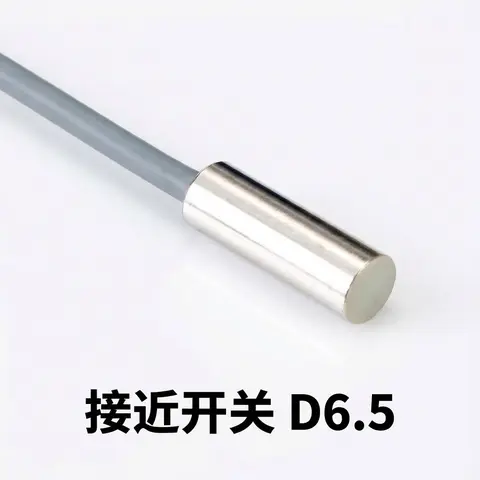
D6.5 Series Inductive Proximity Sensors (Ultra-Short 18mm / Y-Type / 35mm / 45mm)
6.5mm-diameter inductive proximity sensors for tight-clearance mounting where M8 sensors won't fit.
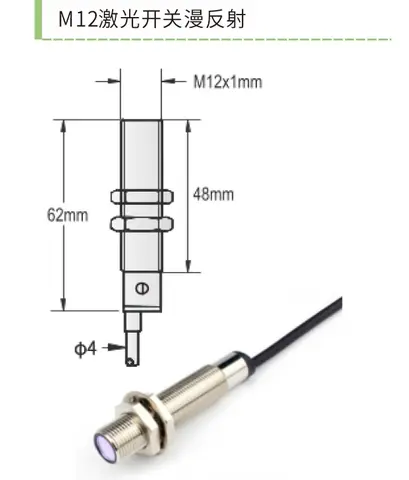
DDSK Laser Diffuse Reflective Sensor M12 / DK Laser Diffuse Reflective Sensor M18
M12/M18 threaded laser diffuse reflective sensor with a visible 650nm red laser for fast alignment.
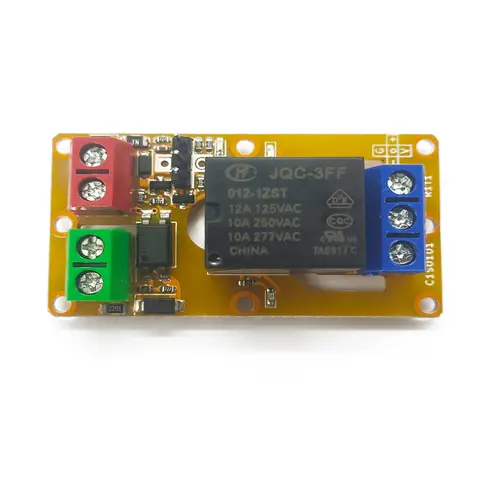
A1J0101 Economical Input Amplifier Module
Optocoupler-isolated input amplifier that turns a low-voltage signal into a 250V AC / 10A relay output.
Related Products in Photoelectric Sensors
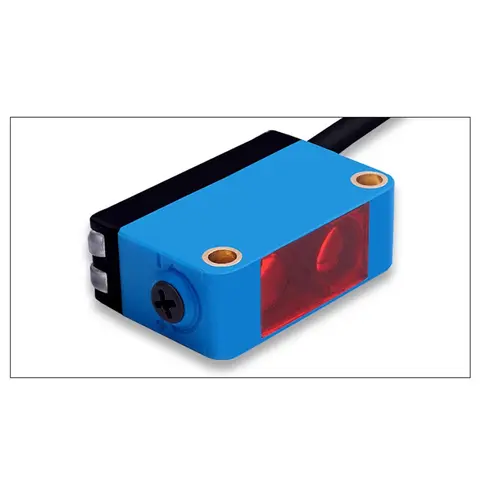
BGS-CX441 / BGS-CX442 Background Suppression Photoelectric Sensor
Wire-adjustable BGS sensor with 2 mm or 15 mm spot, 10-300 mm range, published black/white differential distance.
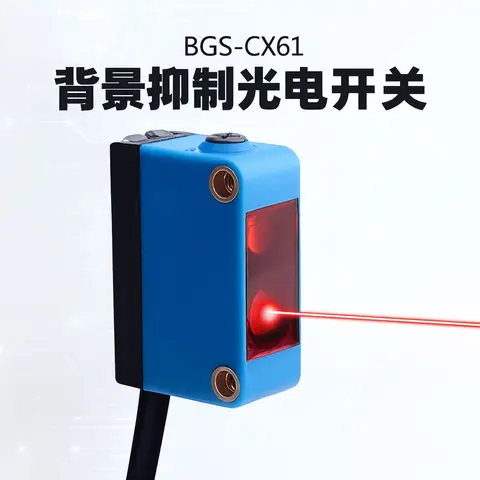
BGS-CX61 Focused-Beam Background Suppression Photoelectric Sensor
2 mm focused-spot BGS sensor that switches strictly by distance, ignoring shiny or close backgrounds.
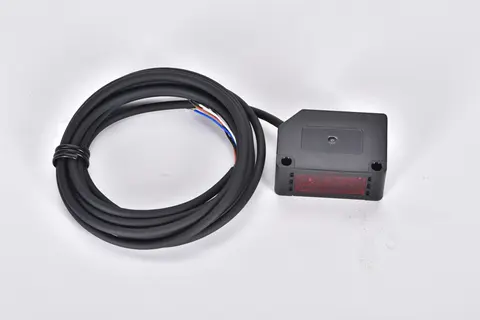
BX Series Long-range Background Suppression (BGS) Photoelectric Sensor
Background suppression photoelectric sensor detecting up to 4 m from one side, no reflector needed.
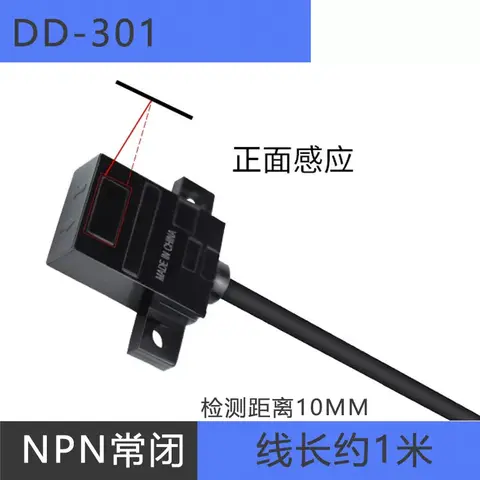
DD-301/401/302/402 Series Reflective Photoelectric Sensor (Wire-lead Type)
Wire-lead NPN reflective sensor, 5mm range, horizontal/vertical mount, Light-ON/Dark-ON logic options.