
DS Right-Angle (90°) Laser Through-Beam Switch M4 / M6
90° right-angle M4/M6 laser through-beam switch with a 1.5-2mm spot and 20m detection range for tight spaces.
 🔍 Click to enlarge · 1/13
Technical Specifications
| Type | Laser through-beam photoelectric switch (90° right-angle) |
|---|---|
| Light source | 650nm red laser |
| Detection method | Through-beam (emitter + receiver pair) |
| Detection range | M4: 20m; M6: 20m (against 100x100mm white paper target) |
| Laser spot size | M4: approx. 1.5mm (standard); M6: approx. 2mm (standard); custom 0.5mm/1.0mm small spot available |
| Output type | NPN / PNP, NO (suffix 1) / NC (suffix 2) |
| Working voltage | 10-30VDC |
| Thread size | M4x0.5mm / M6x0.75mm |
| Structure | 90° right-angle (bent) body |
| Protection rating | IP65 |
| Housing material | Stainless steel |
| Response time | 5ms |
| Switching frequency | 100Hz (max) |
| Leakage current | <0.01mA |
| Voltage drop | <1.5V |
| Switching hysteresis | <15% (Sr) |
| Repeatability | <5% (Sr) |
| Max load current | 150mA |
| Overload protection point | 180mA |
| Overall length | M4: 18.0mm; M6: 20.0mm |
| Threaded section length | M4: 11.0mm; M6: 14.0mm |
| Cable | φ3.0mm OD, 1.5m PVC, 3x0.15mm² conductors |
Overview
The DS right-angle M4/M6 laser through-beam switch is a through-beam (opposed) photoelectric sensor built into an M4x0.5mm or M6x0.75mm threaded, 90 degree bent stainless steel housing. The emitter and receiver are used as a matched pair, facing each other across the detection gap; when an object interrupts the 650nm laser beam, the receiver switches its output.
It is built for machine builders and integrators who need to detect small, thin, or precisely positioned parts in equipment where space around the mounting point is limited and a straight-body sensor cannot be aimed correctly. Both the M4 and M6 versions reach a 20m detection range against the standard white-paper test target, with a 1.5-2mm laser spot, 5ms response time and IP65 protection.
Features & Benefits
Small 1.5-2mm laser spot for fine-feature detection
The M4 model has a standard ~1.5mm spot (customizable to 0.5mm/1mm), and the M6 model has a standard ~2mm spot (customizable to 0.5mm/1.0mm), letting it resolve narrow gaps and small parts that a larger-beam diffuse sensor would miss.
20m through-beam range in a compact threaded body
Both the M4 and M6 versions reach a 20m emitter-to-receiver range against the standard white-paper test target, well beyond what a diffuse-reflective sensor of the same size can achieve.
90° right-angle body for space-constrained mounting
The bent housing lets the cable exit sideways instead of straight back, so the sensor can be installed where a straight in-line body would collide with adjacent structure.
Selectable NPN/PNP output and NO/NC logic
Each thread size is offered in four wiring/logic combinations (NPN-NO, PNP-NO, NPN-NC, PNP-NC), so it can be matched directly to the PLC or controller input type without an external relay.
Stainless steel threaded housing, IP65 rated
The M4x0.5mm and M6x0.75mm bodies are stainless steel with IP65 ingress protection, suitable for factory-floor environments with dust and occasional splashes.
5ms response time, 100Hz switching frequency
Fast enough to catch small or fast-moving parts on a conveyor or indexing station without missing detections.
Precision electrical specs for reliable long-term operation
Less than 0.01mA leakage current, less than 1.5V voltage drop, less than 15% switching hysteresis, less than 5% repeatability, plus built-in short-circuit protection and a 180mA overload protection point.
Applications
Models & Ordering Information
M4x0.5mm right-angle through-beam (20m range)
M6x0.75mm right-angle through-beam (20m range)
How to Select
- Choose M4x0.5mm (18.0mm overall length, 11.0mm threaded section) for smaller mounting hole positions.
- Choose M6x0.75mm (20.0mm overall length, 14.0mm threaded section) for a coarser thread and a more secure mount where a slightly larger mounting hole is available.
- Both M4 and M6 have a 20m detection range against the standard 100x100mm white paper test target; darker, less reflective, or transparent objects will reduce the usable distance, so consult the supplier for guidance on those cases.
- For detecting finer or smaller parts, choose a smaller custom spot size (0.5mm or 1.0mm) rather than the standard 1.5mm (M4) or 2mm (M6) spot.
- For a PLC with NPN (sinking) inputs, choose N1 (normally open) or N2 (normally closed).
- For a PLC with PNP (sourcing) inputs, choose P1 (normally open) or P2 (normally closed).
- If the output should turn ON when an object is detected, choose a normally-open (NO) model (suffix 1).
- If the output should turn OFF when an object is detected (staying ON when no object is present), choose a normally-closed (NC) model (suffix 2).
- Both M4 and M6 share a 10-30VDC supply voltage, a 150mA maximum load current, and a 180mA overload protection point with built-in short-circuit protection.
- This is a through-beam type sensor: order the emitter and receiver together as a matched pair.
📘 Need the full method? NPN vs PNP Sensor Outputs Explained
When NOT to specify the DS — and what to use instead
Only one side of the target is accessible for mounting
Why not: This is a through-beam pair: the emitter and receiver are sold and used together, facing each other across the detection gap.
Use instead: a laser diffuse model (e.g., a right-angle diffuse sensor) where only one mounting point is available
A span longer than 20m, or a target darker/less reflective than the white-paper test standard
Why not: The 20m range for both the M4 and M6 versions is measured against a standard 100x100mm white paper target; the spec notes that darker, less reflective, or transparent objects reduce the usable distance.
Use instead: the M12/M18 through-beam pair rated to 50m, or confirm dark/transparent-target performance with the factory first
A straight in-line mounting position with no clearance restriction behind the panel
Why not: This model's defining feature is its 90-degree bent stainless housing, which routes the cable sideways; that added geometry isn't needed when a straight body already fits.
Use instead: a straight-body M4/M6 through-beam sensor of the same thread size
Machine guarding or personnel-safety interlocking
Why not: The rich electrical/mechanical spec sheet (response time, hysteresis, leakage current, IP65) documents performance, not a safety-function certification.
Use instead: a dedicated safety light curtain for guarding, never this positioning switch
Specifications we do not publish yet
We only publish a figure once we are confident it is true. The items below are still being validated through further testing and real-world customer feedback, so for now we would rather leave them open than guess. If one of them matters to your design, ask us for the latest validated status.
- Laser safety class (only 650nm wavelength is documented)
- MTBF
- Exact operating/storage temperature range
- Certification (CE/UL/RoHS etc.)
Frequently Asked Questions
What is the detection range of the DS M4/M6 right-angle laser through-beam switch?
Do I need to order the emitter and receiver separately?
What is the laser spot size, and can it be made smaller?
What output types are available - NPN or PNP, NO or NC?
What is the difference between the M4 and M6 versions?
Does the detection distance change with the color or material of the object being detected?
What is the response time and switching frequency?
What ingress protection rating and housing material does this sensor have?
What is the cable specification?
Can you provide certification documents for this sensor?
Related Categories and Example Products
Explore other functions that may be needed in a machine or line. The products below are category examples, not pre-validated electrical or safety combinations. Confirm each interface and application separately: Photoelectric Sensors · Fiber Optic Sensors · Slot Sensors
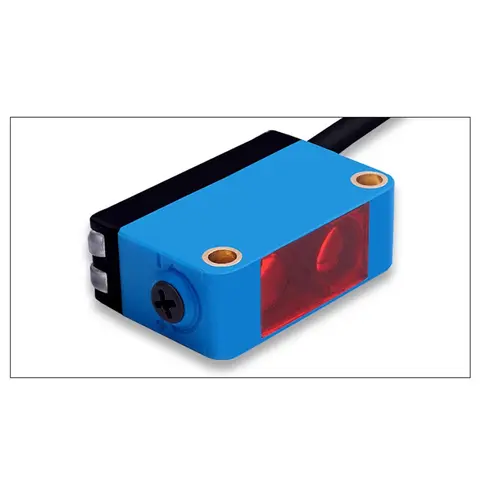
BGS-CX441 / BGS-CX442 Background Suppression Photoelectric Sensor
Wire-adjustable BGS sensor with 2 mm or 15 mm spot, 10-300 mm range, published black/white differential distance.
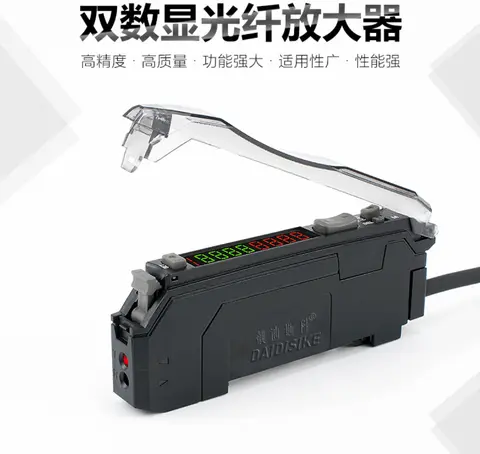
Fiber Amplifier (Digital Fiber Optic Sensor Amplifier)
Digital fiber optic amplifiers with NPN/PNP output, from potentiometer economy models to 25µs dual-display smart units.
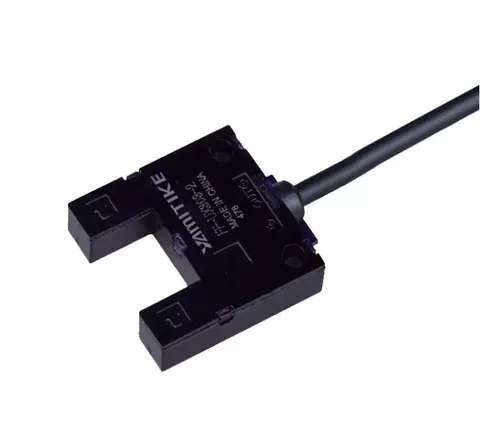
DD-303N / DD-403N Wide-slot Photoelectric Sensor
13 mm through-beam slot sensor giving real tolerance for thick or fluttering parts, still detecting down to 2.2×0.5 mm.
Related Products in Laser Switch Sensors
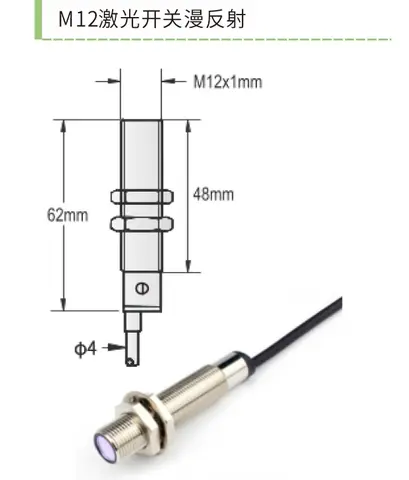
DDSK Laser Diffuse Reflective Sensor M12 / DK Laser Diffuse Reflective Sensor M18
M12/M18 threaded laser diffuse reflective sensor with a visible 650nm red laser for fast alignment.
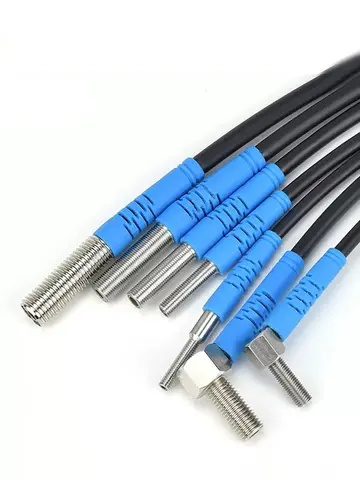
DDSK Ultra-Miniature Laser Diffuse Reflective Sensor (M3/M4/M5/M6/M8)
Ultra-miniature M3-M8 threaded laser diffuse sensor, 650nm laser, no reflector, 10-30VDC, IP65.
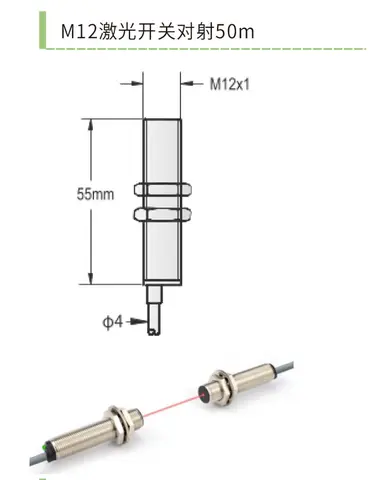
DS Laser Through-Beam Sensor M12/M18 (50m)
M12/M18 laser through-beam sensor pair, 50m range, NPN/PNP output, NO or NO+NC, IP65 rated.
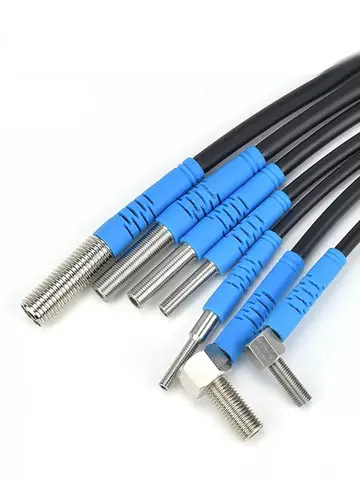
DS Miniature Laser Through-Beam Sensor (M3/M4/M5/M6/M8)
Ultra-small M3-M8 laser through-beam sensor pair detects tiny parts up to 20-30m, NPN/PNP, NO/NC output.