
DK-SCZ-II Hot & Cold Metal Detector (Laser Distance Type)
Active laser sensor detects hot and cold metal at 1 mm accuracy, in a water/air-cooled IP65 housing for the melt shop.
Technical Specifications
| Model | DK-SCZ-II |
|---|---|
| Category | Hot metal detection / laser distance special application |
| Output Type | Programmable switching output (setpoint and hysteresis, 0.5 A load) + 4-20 mA analog output (load impedance <=500 Ohm) + RS232 serial data interface (RS422 on request, 9600 baud, ASCII) |
| Measuring Range | 0.1-3 m, 5 m, 10 m, 20 m (selectable) |
| Accuracy | 1 mm |
| Resolution | 0.1 mm |
| Repeatability | 0.5 mm |
| Measuring Rate | 10 Hz |
| Power Supply | 10-30 V DC |
| Protection Rating | IP65 |
| Water-cooling Port | 0.3 MPa |
| Air-purge Port | 0.3 MPa compressed air |
| Switching Output Load Capacity | 0.5 A |
| Analog Output Load Impedance | <=500 Ohm |
| Serial Interface | RS232, 9600 baud, ASCII format (RS422 available on request) |
| Signal Cable Length | Up to 200 m, shielded cable |
| Housing Material | Aluminum |
Overview
The DK-SCZ-II is a laser distance-measurement instrument, not a simple presence switch. It uses a modulated semiconductor laser and photoelectric receiver to determine the position or level of a target - molten metal, hot billet, or cold stock - from 0.1 m up to 20 m depending on the selected range.
It is built for metallurgical and casting environments where ambient heat, steam, and dust would degrade a standard sensor: the housing accepts water-cooling and compressed-air purge connections and is rated IP65. It is intended for process/automation engineers at steel mills, foundries, and aluminum smelters who need continuous position or level feedback, not just an on/off signal, to control furnace pouring, casting-line pacing, or tank/vessel level.
Features & Benefits
Active Laser Detection Works on Both Hot and Cold Metal
Unlike passive infrared hot metal detectors that rely on the target's own thermal radiation and lose signal once the workpiece cools, the DK-SCZ-II emits its own modulated red laser beam and reads the reflected signal, so the same unit covers a line from cold billet through molten metal.
1 mm Accuracy Continuous Measurement, Not Just an On/Off Switch
Delivers true distance/level data at 10 Hz with 1 mm accuracy, 0.1 mm resolution and 0.5 mm repeatability, so one unit can drive both discrete position control and continuous 4-20 mA level monitoring, replacing a separate detector-plus-level-meter setup.
Programmable Setpoint and Hysteresis on the Switching Output
Users configure the trigger position and a hysteresis band to filter out chatter from surface ripple or product vibration, with a 0.5 A load capacity to drive interposing relays or indicator lamps directly.
Three Output Interfaces on One Unit
Discrete switching, a scalable 4-20 mA analog output (load impedance <=500 Ohm), and an RS232 serial data interface (9600 baud, ASCII; RS422 on request) cover interlock signals for PLCs, analog inputs for DCS systems, and data logging for SCADA/upper computers.
Built-in Water-cooling and Air-purge Ports, IP65 Aluminum Housing
The housing has dedicated water-cooling connections (0.3 MPa) for high-ambient-temperature installations and a compressed-air purge port (0.3 MPa) to keep steam, smoke, and dust from attenuating the laser beam, so it can be mounted directly at casting and melting stations without a third-party cooling jacket.
Strong Beam Penetration and Interference Immunity
The modulated-laser / amplified-photoelectric-receiver architecture is designed for continuous-casting and melt-shop conditions where ambient steam, moisture, and airborne dust are constant.
Four Selectable Measuring Ranges from 0.1 m to 20 m
A single product family covers close-range on-line position detection through large-vessel level measurement, so plant engineers can standardize on one sensor architecture across multiple applications.
Fiber-optic Coupled Emitter/Receiver Design
Emitter and receiver sections each comprise circuit, optical fiber, and lens components, with shielded signal cable runs up to 200 m, so the control cabinet can be sited well away from furnace heat.
Applications
Models & Ordering Information
DK-SCZ-II Series
How to Select
- By measuring range: the product offers 0.1-3 m / 5 m / 10 m / 20 m ranges. Close-range position detection (such as workpiece arrival or slab tracking) typically uses the 0.1-3 m or 5 m range; large-vessel or furnace level measurement selects the 10 m or 20 m range according to vessel depth.
- By output type: standard configuration includes a programmable switching output (0.5 A load, with settable setpoint and hysteresis), a programmable 4-20 mA analog output (load impedance <=500 Ohm), and an RS232 data interface (9600 baud, ASCII format). RS422 is available on request.
- By power supply: standard 10-30 V DC supply range is compatible with common 24 V industrial power supplies, requiring no additional selection.
- By installation environment: in high-ambient-temperature locations, connect the water-cooling port (0.3 MPa); in environments with steam or dust, connect the air-purge port (0.3 MPa compressed air) to protect the optics.
- By signal cable run: the signal cable between the sensor and the control room should be within 200 m, using shielded cable; longer runs require evaluation of a separate signal relay solution.
When NOT to specify the DK-SCZ-II — and what to use instead
The target is a non-metal material or a surface too poorly reflective for the sensor's laser
Why not: The DK-SCZ-II is documented and marketed specifically for hot/cold metal targets (molten metal, hot billet, cold stock) in metallurgical settings using a modulated laser reflected off the target surface, not as a general-purpose material sensor.
Use instead: A general-purpose laser or ultrasonic distance sensor rated for the specific target material's reflectivity.
The application needs precise dimensional or thickness gauging at sub-millimeter/micron accuracy rather than position or level
Why not: Rated accuracy is 1 mm with 0.1 mm resolution -- coarser than this manufacturer's own JNS-Q contact displacement grating sensor, which is rated 0.2-5 µm resolution.
Use instead: The JNS-Q contact displacement grating sensor for micron-level dimensional gauging where the target can be physically contacted, or a dedicated precision laser displacement sensor.
The mounting location has no provision for water-cooling plumbing or a compressed-air supply, in a very high-heat installation
Why not: The housing's cooling architecture is built around dedicated water-cooling and compressed-air purge ports (each rated 0.3 MPa); the sellingPoints text ties these ports to mounting 'directly at casting and melting stations without a third-party cooling jacket,' implying they matter for close-in installation at that heat class.
Use instead: Confirm with DAIDISIKE whether ambient-only (uncooled) operation is viable for the specific stand-off distance and ambient temperature, or provision the water/air utilities the ports are designed for.
The signal cable run from the sensor head to the control room will exceed 200 m
Why not: Signal cable length is documented as up to 200 m using shielded cable, with longer runs requiring a separate evaluation per the selectionGuide.
Use instead: A signal relay/repeater solution, or relocate the control cabinet within the 200 m limit.
Specifications we do not publish yet
We only publish a figure once we are confident it is true. The items below are still being validated through further testing and real-world customer feedback, so for now we would rather leave them open than guess. If one of them matters to your design, ask us for the latest validated status.
- Operating temperature range of the sensor itself is not documented
- Overall unit dimensions are not documented
- Certification documents beyond "available on request" are not specified
- The detailed ordering-suffix system for measuring-range and output combinations is still being finalized — ask us to configure the right variant for your line
- Laser wavelength and laser safety class of the sensor's own emitter are not documented -- source only states a "modulated semiconductor laser"
- Response time of the switching output beyond the 10 Hz measuring rate is not separately documented
Frequently Asked Questions
Can the DK-SCZ-II detect cold (room-temperature) metal, or only hot metal?
What is the measuring accuracy and how fast does it update?
What measuring ranges are available?
What outputs does the sensor provide?
Does the sensor need cooling, and how is it cooled?
What is the enclosure protection rating and housing material?
How far can the signal cable run between the sensor and the control room?
What is the power supply requirement?
Is this sensor suitable for use in humid, dusty, or steam-filled environments?
What certifications does the DK-SCZ-II carry?
Related Categories and Example Products
Explore other functions that may be needed in a machine or line. The products below are category examples, not pre-validated electrical or safety combinations. Confirm each interface and application separately: Laser Distance Sensors · Photoelectric Sensors
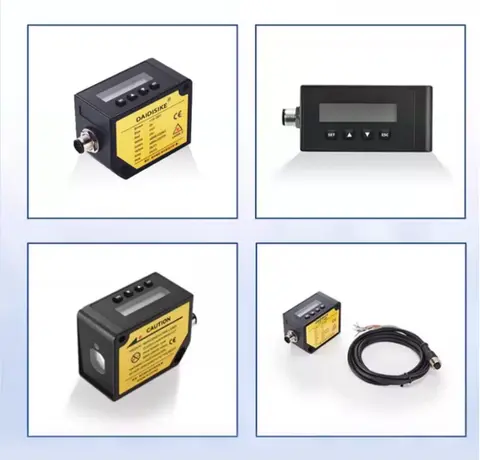
DDA-Y & DDB-Y Industrial Laser Distance Sensor (Phase-Shift)
Phase-shift laser distance sensors: 0.2-100 m range, millimeter accuracy, RS485 Modbus RTU, switching or analog output.
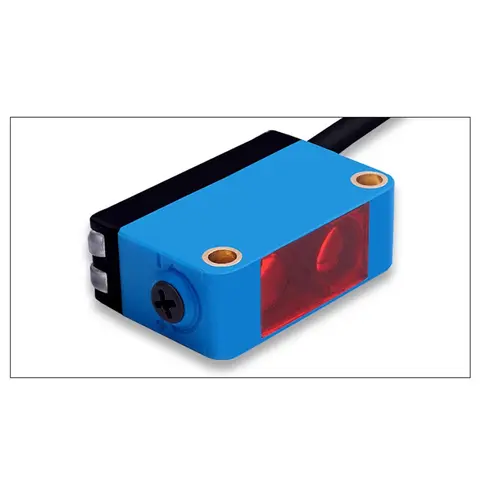
BGS-CX441 / BGS-CX442 Background Suppression Photoelectric Sensor
Wire-adjustable BGS sensor with 2 mm or 15 mm spot, 10-300 mm range, published black/white differential distance.